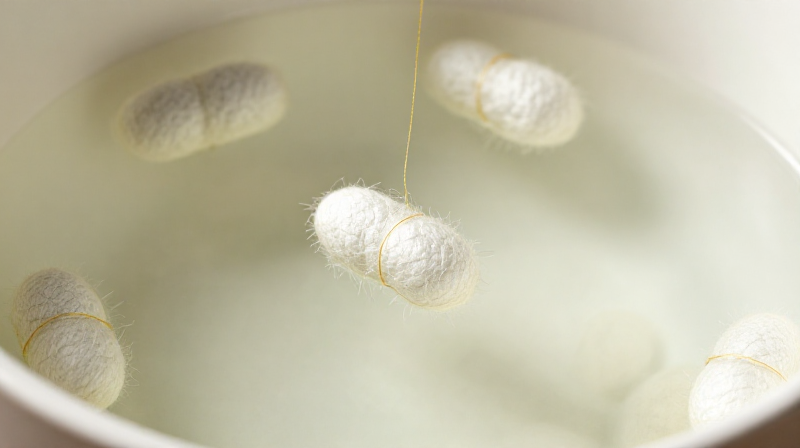


Reeling Silk from Cocoons — Unwinding the Continuous Filament
Silk is the only natural fiber that comes as a continuous filament rather than short staple lengths. A single silkworm cocoon (Bombyx mori) contains between 300 and 900 meters of unbroken thread, finer than a human hair. The discovery that these cocoons could be softened in hot water and their filament unwound onto a reel is attributed to Chinese tradition around 3000 BCE, though archaeological evidence of silk production dates to at least 3630 BCE (Henan province).
The process is deceptively simple: submerge dried cocoons in hot water to dissolve the sericin gum that binds the filament into a compact shell, find the loose end, and wind the thread onto a reel. In practice, a single filament is too fine to work with — reelers combine 3 to 8 filaments from separate cocoons simultaneously, twisting them lightly so the residual sericin bonds them into a single usable thread called 'raw silk.' This combining step is what makes reeled silk strong enough for weaving.
Silk reeling remained a closely guarded Chinese monopoly for over two thousand years. The technology eventually spread westward along the Silk Road — first to Korea and Japan, then to India, Persia, and finally Europe. Today the fundamental process is unchanged: hot water, careful hands, and a turning reel.
Istruzioni
Obtain dried silkworm cocoons
Obtain dried silkworm cocoons
Source dried Bombyx mori cocoons from a sericulture supplier. The cocoons should be intact, oval-shaped, and white or pale yellow. Each cocoon is roughly 3–4 cm long and feels papery when dry. The silkworm pupa inside has been killed by heat during the drying process — this prevents the moth from emerging and breaking the continuous filament. Plan approximately 100 cocoons for a meaningful practice session.
Materiali per questo passaggio:
 Bozzoli secchi di bombice del gelso100 pezzi
Sort cocoons by quality
Sort cocoons by quality
Inspect each cocoon and remove any that are stained, misshapen, or have holes (where a moth emerged). Stained cocoons produce discolored thread. Holed cocoons have broken filaments and will yield only short waste fiber (called 'schappe'), not continuous reelable silk. Sort the good cocoons into a clean bowl.
Heat water to 60–70°C
Heat water to 60–70°C
Fill a wide, shallow pot with clean water and heat it to 60–70°C. This temperature is critical: too cool and the sericin gum will not dissolve, too hot and the silk protein (fibroin) denatures and becomes brittle. Do not let the water boil. Use a thermometer to monitor — hold the temperature steady throughout the reeling session.
Materiali per questo passaggio:
 Acqua5 litri
Strumenti necessari:
 Pentola grande
 Fonte di calore
Submerge cocoons in the hot water
Submerge cocoons in the hot water
Gently place 10–15 cocoons into the hot water. Do not overcrowd — each cocoon needs space to soften evenly. Push them under the surface with a wooden stick. The cocoons will initially float; after 2–3 minutes they absorb water and sink. The water will turn slightly cloudy as sericin dissolves.
Strumenti necessari:
 Bastoncino di legno per mescolare
Soak cocoons for 5–10 minutes
Soak cocoons for 5–10 minutes
Let the cocoons soak until the outer layers feel soft and slightly slippery. Test by gently pressing a cocoon between your fingers — the outer fibers should slide freely over the inner layers. If the cocoon still feels stiff and papery, continue soaking. Oversoaking (beyond 15 minutes) tangles the filament layers and makes finding the end more difficult.
Find the filament end with a brush or stick
Find the filament end with a brush or stick
Roll a softened cocoon gently against the surface of the water with a small whisk broom, twig bundle, or rough stick. The loose outer fibers will catch on the bristles and pull away as a fuzzy tangle — this is waste silk (kibiso). Continue brushing until a single clean filament separates from the cocoon surface. This is the reelable end of the continuous thread.
Pull the filament gently to test continuity
Pull the filament gently to test continuity
Pinch the single filament between your fingers and draw it slowly upward out of the water. It should pull smoothly without breaking — a continuous, almost invisible thread. If it snaps, the cocoon is under-soaked or damaged. Set broken cocoons aside for waste silk. A good filament pulls 30 cm or more without resistance.
Combine filaments from multiple cocoons
Combine filaments from multiple cocoons
Find the filament ends from 4–6 cocoons and group them together. A single cocoon filament is only 10–15 micrometers thick — far too fine to handle or weave. Combining multiple filaments produces raw silk thread of usable thickness. The residual sericin on the wet filaments acts as a natural adhesive, bonding the parallel strands together as they dry.
Thread the combined filament through a guide
Thread the combined filament through a guide
Pass the grouped filaments through a small ceramic or wooden eyelet mounted above the pot. This guide serves two purposes: it strips excess water and it forces the filaments into close contact so the sericin bonds them. Historically, reelers used a porcelain ring or a forked twig. Any smooth, non-absorbent guide works.
Strumenti necessari:
 Guidafilo dell'aspo da seta
Attach the thread to the reeling frame
Attach the thread to the reeling frame
Tie or loop the combined thread onto a simple reeling frame — a wooden cross or H-shaped frame that turns on an axle. The reel should be positioned at least 50 cm above and to the side of the pot so the thread has distance to partially dry. Wrap the thread around the frame once to anchor it.
Strumenti necessari:
 Aspo da seta
Turn the reel slowly and steadily
Turn the reel slowly and steadily
Begin turning the reel at a slow, steady pace — approximately one revolution per second. The thread should draw smoothly from the cocoons through the guide and onto the reel. Maintain consistent speed; jerky motion snaps filaments. The cocoons will bob and rotate in the water as they unwind, gradually shrinking as layers peel away.
Monitor for broken filaments
Monitor for broken filaments
Watch the thread between the pot and the guide. When a single cocoon's filament breaks or runs out, the combined thread becomes visibly thinner. Stop reeling, find a new filament end from a fresh soaked cocoon, twist it into the running thread, and resume. Experienced reelers splice without stopping. Each cocoon yields 300–900 meters of filament before exhausting.
Replace exhausted cocoons with fresh ones
Replace exhausted cocoons with fresh ones
As cocoons are fully unwound, their pupal casing (a thin papery shell containing the dead chrysalis) drops to the bottom of the pot. Remove spent casings and add new soaked cocoons to maintain 4–6 active filaments at all times. Keep a batch of cocoons soaking alongside the reeling pot so replacements are always ready.
Maintain water temperature throughout
Maintain water temperature throughout
The water temperature must stay between 60–70°C for the entire reeling session. If it drops below 55°C, the sericin resolidifies and the filaments stick to the cocoon. If it exceeds 80°C, the fibroin weakens. Add small amounts of hot water as needed and monitor with a thermometer. A low, steady heat source works best.
Wind thread in a figure-eight pattern
Wind thread in a figure-eight pattern
As the reel turns, shift the thread guide slightly left and right to distribute the silk across the reel in a figure-eight or cross-winding pattern. This prevents layers from sticking together as the sericin dries. A flat, single-layer winding will bond into a solid sheet that cannot be unwound. Cross-winding keeps individual passes separate.
Reel until all cocoons are unwound
Reel until all cocoons are unwound
Continue reeling, replacing cocoons and maintaining temperature, until all 100 cocoons are exhausted. This produces approximately 800–1200 meters of raw silk thread (depending on cocoon quality and how many filaments were combined). The process takes 2–4 hours of steady, patient work.
Remove the silk skein from the reel
Remove the silk skein from the reel
Tie the skein in 3–4 places with loose figure-eight ties to prevent tangling, then slide it off the reel. The raw silk at this stage is stiff and slightly sticky from residual sericin — this is normal. It has a natural pale cream or golden color and a subtle sheen even before degumming.
Dry the raw silk skein
Dry the raw silk skein
Hang the skein in a well-ventilated area away from direct sunlight to dry completely. Drying takes 24–48 hours depending on humidity. Do not use heat to accelerate drying — this yellows the silk. The dried raw silk (called 'grège') can be stored indefinitely. It will be degummed (sericin fully removed) before dyeing and weaving, which transforms it from stiff and matte to the luminous, soft fiber known as finished silk.
Strumenti necessari:
 Essiccatoio
Strumenti richiesti
6- Segnaposto
- Segnaposto
- Segnaposto
- Segnaposto
- Segnaposto
- Segnaposto
Materiali dei progetti collegati
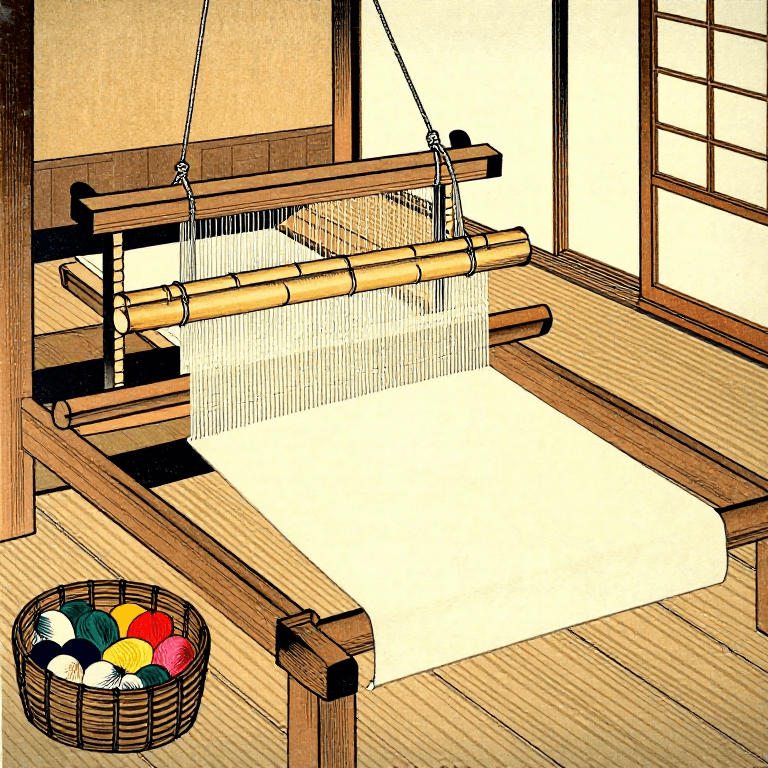
Questo progetto realizza


Blueprint correlati
Questi blueprint condividono conoscenze — tecniche, materiali o principi
CC0 Pubblico dominio
Questo progetto è rilasciato sotto CC0. Sei libero di copiare, modificare, distribuire e utilizzare quest'opera per qualsiasi scopo, senza chiedere permesso.
Supporta il Maker acquistando prodotti tramite il suo progetto dove guadagna una Commissione Maker stabilita dai venditori, oppure crea una nuova iterazione di questo progetto e includilo come collegamento nel tuo progetto per condividere i ricavi.