ARTE
BELLEZZA E BENESSERE
MESTIERE
CULTURA E STORIA
DIVERTIMENTO
AMBIENTE
CIBO E BEVANDE
INGEGNERIA INVERSA
SCIENZE
SPORT
TECNOLOGIA
INDOSSABILI
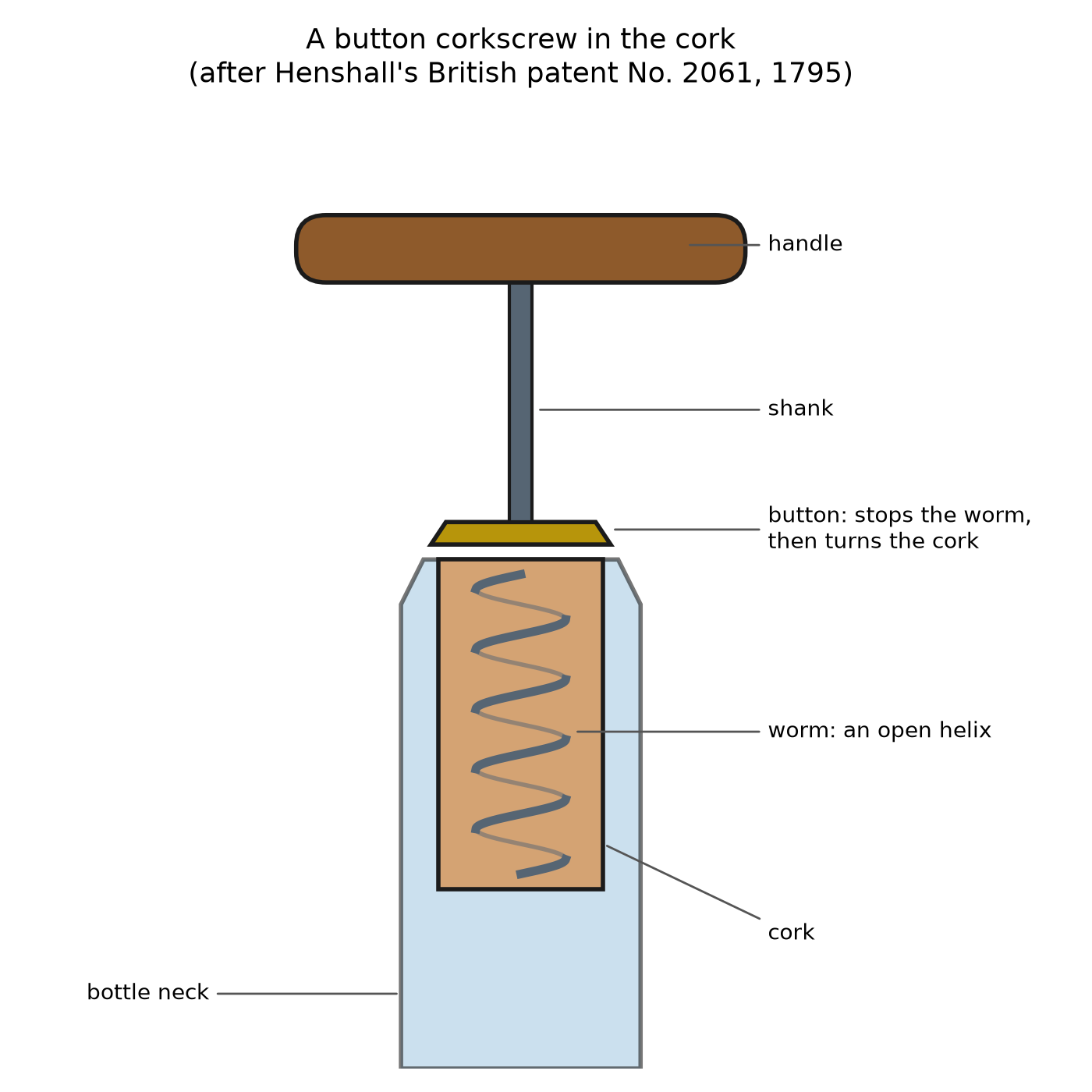
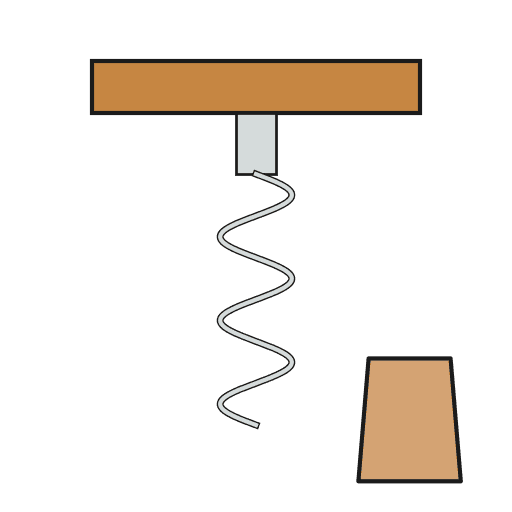
Youblob (drawn diagram, draw_corkscrew.py) · CC0

The Button Corkscrew: A Helix That Grips and a Disc That Stops It
A cork is squeezed into a bottle neck so hard that pulling it out by a simple worm takes a strong arm — and a worm driven too far pierces the cork and pushes crumbs into the wine. Samuel Henshall, an English clergyman, took out British patent No. 2061 on 24 August 1795 for a corkscrew with a button: a concave disc fixed between the worm and the shank. The button stops the worm once it is deep enough, and turning on past that point twists the whole cork in the neck, breaking its hold on the glass before it is pulled. Matthew Boulton's works in Birmingham made it.
This rung works out the worm's turns and grip and the force a pull needs, and makes and tests a button corkscrew.
Principiante
About 2 hours
Istruzioni
1
1
Worm pitch, grip and pulling force
Worm pitch, grip and pulling force
Caricamento del notebook Jupyter…
2
2
The helix underneath it
The helix underneath it
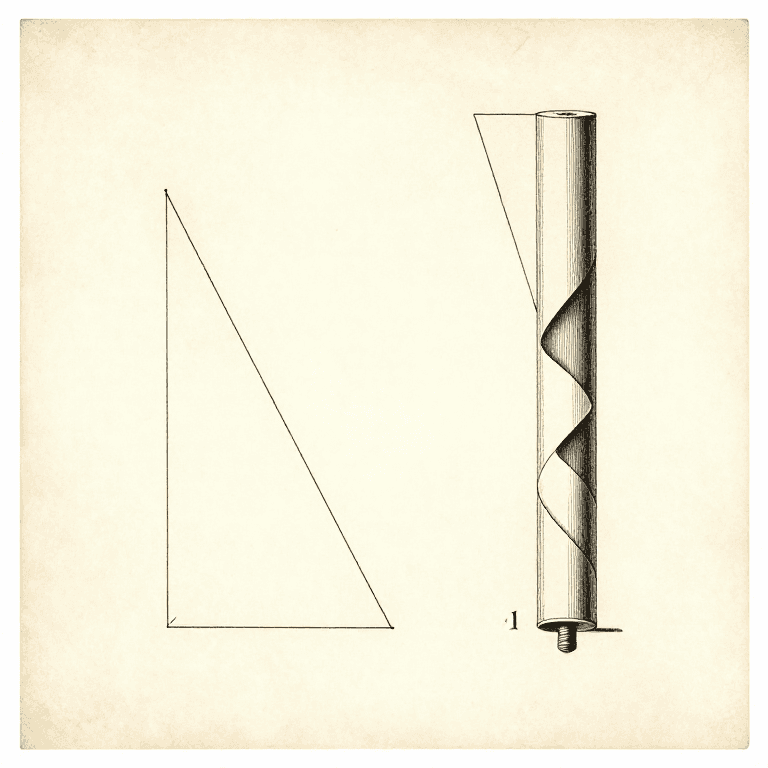
A corkscrew worm is a helix with nothing inside it. The embedded blueprint shows the helix as a ramp wrapped round a cylinder.
3
3
Make a worm and a button
Make a worm and a button
Wind 2 mm spring steel wire round a 6 mm rod held in a vice, five turns at an 8 mm pitch — set the pitch by winding over a spacer strip. Grind the free end to a point on the outside of the helix so it follows the helix, not the centre. Leave a straight tail as the shank.
For the button, drill a 20 mm steel washer to fit the shank and file its underside slightly concave with abrasive paper wrapped round a rod. Slide it down to where the worm starts and solder it in place. Fit a wooden handle across the top of the shank.
Materiali per questo passaggio:
 Filo di acciaio armonico1 pezzo
 Rondella piana1 pezzo
 Tasselli di legno duro1 pezzo
 Lega saldante stagno-piombo1 pezzo
Strumenti necessari:
 Morsa da banco
 Trapano a batteria
 Serie di punte da trapano
 Assortimento di carta abrasiva
 Saldatore a stagno
 Guanti da lavoro in pelle
 Occhiali di sicurezza trasparenti
4
4
Measure the pull, with and without the twist
Measure the pull, with and without the twist
Recork several empty wine bottles with new corks of the same kind, using a hand corker, and let them stand a day.
On the first, drive the worm in until the button touches, stop, and pull straight up with a spring scale hooked to the handle: read the peak force. On the next, drive it in until the button touches, then turn two more turns so the cork rotates in the neck, and pull again. Compare the peak forces. Compare also with a commercial corkscrew.
Materiali per questo passaggio:
 Tappi di sughero6 pezzi
Strumenti necessari:
 Dinamometro (bilancia a molla)
 Kit di tappatura delle bottiglie di vino
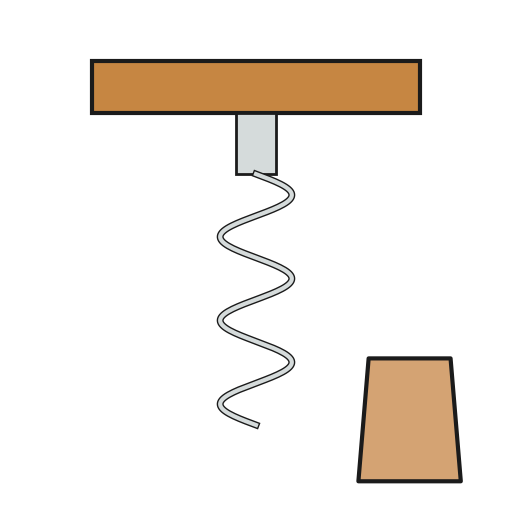 Cavatappi a spirale d’acciaio
5
5
A cork that will not come out cleanly
A cork that will not come out cleanly
Cork removal problems.
Flow
Loading...
6
6
History and honest limits
History and honest limits
**Samuel Henshall** was granted **British patent No. 2061** on 24 August 1795 — the first patent for a corkscrew. Matthew Boulton made Henshall's corkscrews at Soho, Birmingham, marked "Obstando Promoves". Later designs added threads, levers and wings to take the effort out of the pull.
**Honest limits.** The cork pressure and friction in the notebook are illustrative; measure your own pulls. The patent itself is not in the patent databases used for this programme; its details here come from museum and patent-office sources.
Materiali
5- 1 pezzoSegnaposto
- 1 pezzoSegnaposto
- 1 pezzoSegnaposto
- 1 pezzoSegnaposto
- 6 pezziSegnaposto
Strumenti richiesti
10- Segnaposto
- 1 vendor sell this, none ship to you yetSegnaposto
- Segnaposto
- Segnaposto
- 2 vendors sell this, none ship to you yetSegnaposto
- Segnaposto
- Segnaposto
- Segnaposto
- Segnaposto
- Segnaposto
Questo progetto realizza
Blueprint correlati
Questi blueprint condividono conoscenze — tecniche, materiali o principi


CC0 Pubblico dominio
Questo progetto è rilasciato sotto CC0. Sei libero di copiare, modificare, distribuire e utilizzare quest'opera per qualsiasi scopo, senza chiedere permesso.
Supporta il Maker acquistando prodotti tramite il suo progetto dove guadagna una Commissione Maker stabilita dai venditori, oppure crea una nuova iterazione di questo progetto e includilo come collegamento nel tuo progetto per condividere i ricavi.