ARTE
BELLEZZA E BENESSERE
MESTIERE
CULTURA E STORIA
DIVERTIMENTO
AMBIENTE
CIBO E BEVANDE
INGEGNERIA INVERSA
SCIENZE
SPORT
TECNOLOGIA
INDOSSABILI
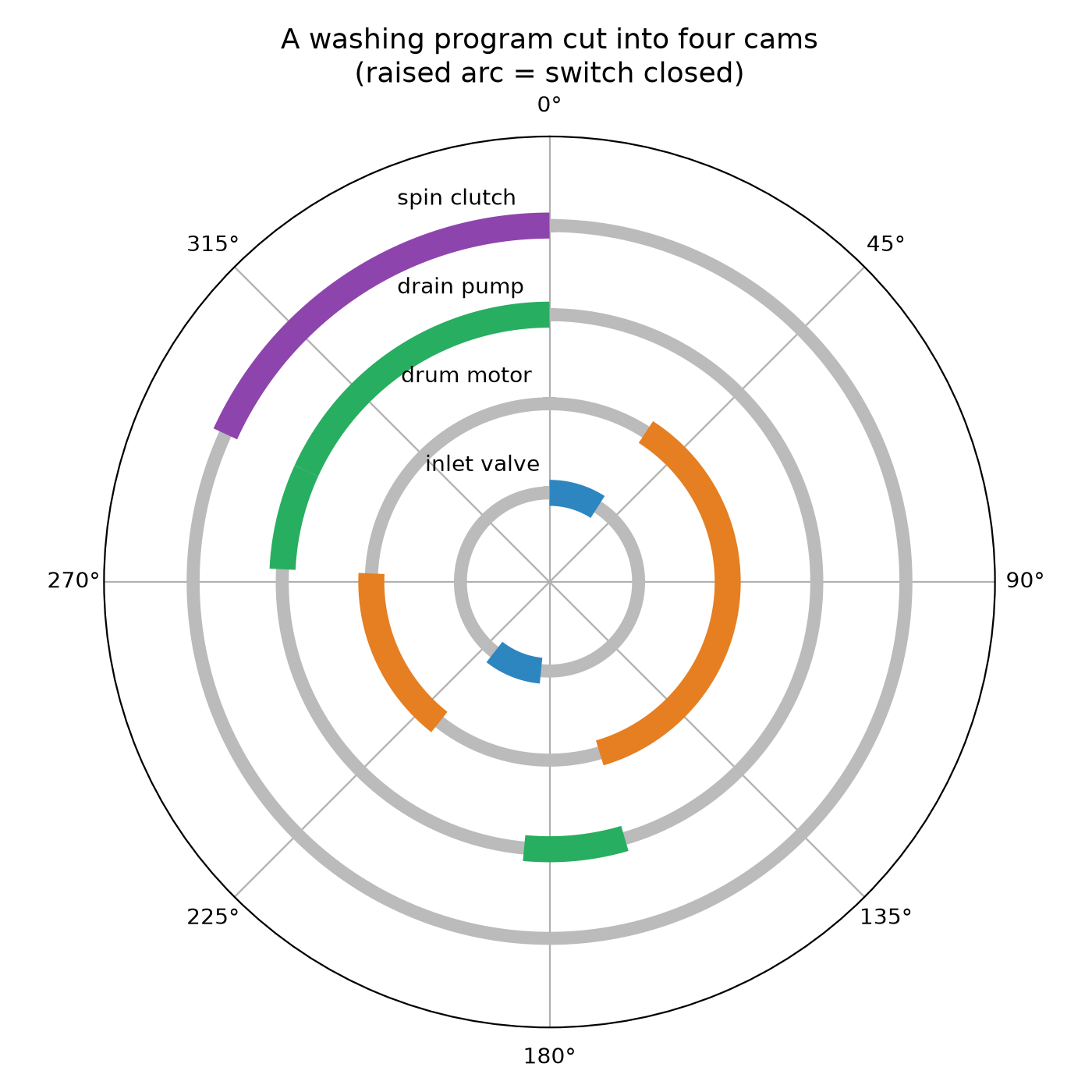
Youblob (generated from this blueprint's notebook) · CC0


The Cam Timer: A Program Cut Into Discs
Before microcontrollers, a washing machine, a dishwasher, a traffic light or an industrial process followed its sequence by turning a shaft of cam discs past a row of switches. A slow synchronous motor turns the stack once per program; each disc switches one function on while its raised arc passes; the dial on the front is simply the end of the shaft, and turning it by hand skips the program forward.
Everything about the program lives in the geometry: time is angle, and each function is an arc.
This rung turns a washing program into cam arcs, draws the cams, and builds a four-cam timer from printed discs and microswitches that switches four lamps in sequence.
Principiante
About 4 hours
Istruzioni
1
1
From program to cam arcs
From program to cam arcs
Caricamento del notebook Jupyter…
2
2
One turn of the cam shaft
One turn of the cam shaft
Spazio di lavoro Blockly
Loading Blockly workspace...
3
3
How a cam moves its follower
How a cam moves its follower
Each disc of a cam timer is a plate cam lifting a switch lever. The embedded blueprint shows how the cam's profile sets the follower's motion.
4
4
Build a four-cam timer
Build a four-cam timer
From the notebook's arcs, draw four discs 50 mm across with raised arcs 3 mm high where each function is on. Print them in PETG with a flat on their bore and stack them on an 8 mm steel shaft, with the zero marks lined up.
Turn the shaft with a slow geared DC motor — for a quick demonstration, one turn every minute or two instead of a real program's hour. Mount four lever microswitches on a plywood rail so each lever rides on one disc, and wire each through an LED and resistor from the supply.
Run it: the LEDs play the program in order. Turn the shaft by hand to jump to any step, as the dial of a washing machine does. Change one disc and the program changes.
Materiali per questo passaggio:
 Barra di acciaio grezza1 pezzo
 Motoriduttore in corrente continua1 pezzo
 Microinterruttore (azionato a leva)4 pezzi
 LED da 5 mm4 pezzi
 Resistenza da 330 ohm4 pezzi
 Pannello di compensato1 pezzo
 Cavetti ponticello1 pezzo
Strumenti necessari:
 Stampante 3D a filamento (FDM)
 Filamento PETG
 Alimentatore in corrente continua
 Trapano a batteria
 Saldatore a stagno
 Calibro digitale da 6 pollici
5
5
A cam timer stuck on one step
A cam timer stuck on one step
Program timer faults.
Flow
Loading...
6
6
Context and honest limits
Context and honest limits
Motor-driven cam timers ran washing machines, dishwashers, traffic signals and process plants for most of the twentieth century, until microcontrollers replaced them from the 1980s onward — keeping the same sequences.
**Honest limits.** A pure cam timer knows only time: a real washing machine timer also waits for the tub to fill or drain before it moves on, using the level switch to stop the timer motor. The printed demonstration runs fast; a real timer makes one turn per program.
Materiali
7- 1 pezzoSegnaposto
- Segnaposto
- Segnaposto
- Segnaposto
- 4 pezziSegnaposto
- 1 pezzoSegnaposto
- Segnaposto
Strumenti richiesti
6- Segnaposto
- Segnaposto
- Segnaposto
- 1 vendor sell this, none ship to you yetSegnaposto
- 2 vendors sell this, none ship to you yetSegnaposto
- Segnaposto
Questo progetto realizza
Blueprint correlati
Questi blueprint condividono conoscenze — tecniche, materiali o principi


CC0 Pubblico dominio
Questo progetto è rilasciato sotto CC0. Sei libero di copiare, modificare, distribuire e utilizzare quest'opera per qualsiasi scopo, senza chiedere permesso.
Supporta il Maker acquistando prodotti tramite il suo progetto dove guadagna una Commissione Maker stabilita dai venditori, oppure crea una nuova iterazione di questo progetto e includilo come collegamento nel tuo progetto per condividere i ricavi.