ARTE
BELLEZZA E BENESSERE
MESTIERE
CULTURA E STORIA
DIVERTIMENTO
AMBIENTE
CIBO E BEVANDE
INGEGNERIA INVERSA
SCIENZE
SPORT
TECNOLOGIA
INDOSSABILI

The MacPherson Strut: The Damper Is the Upper Link
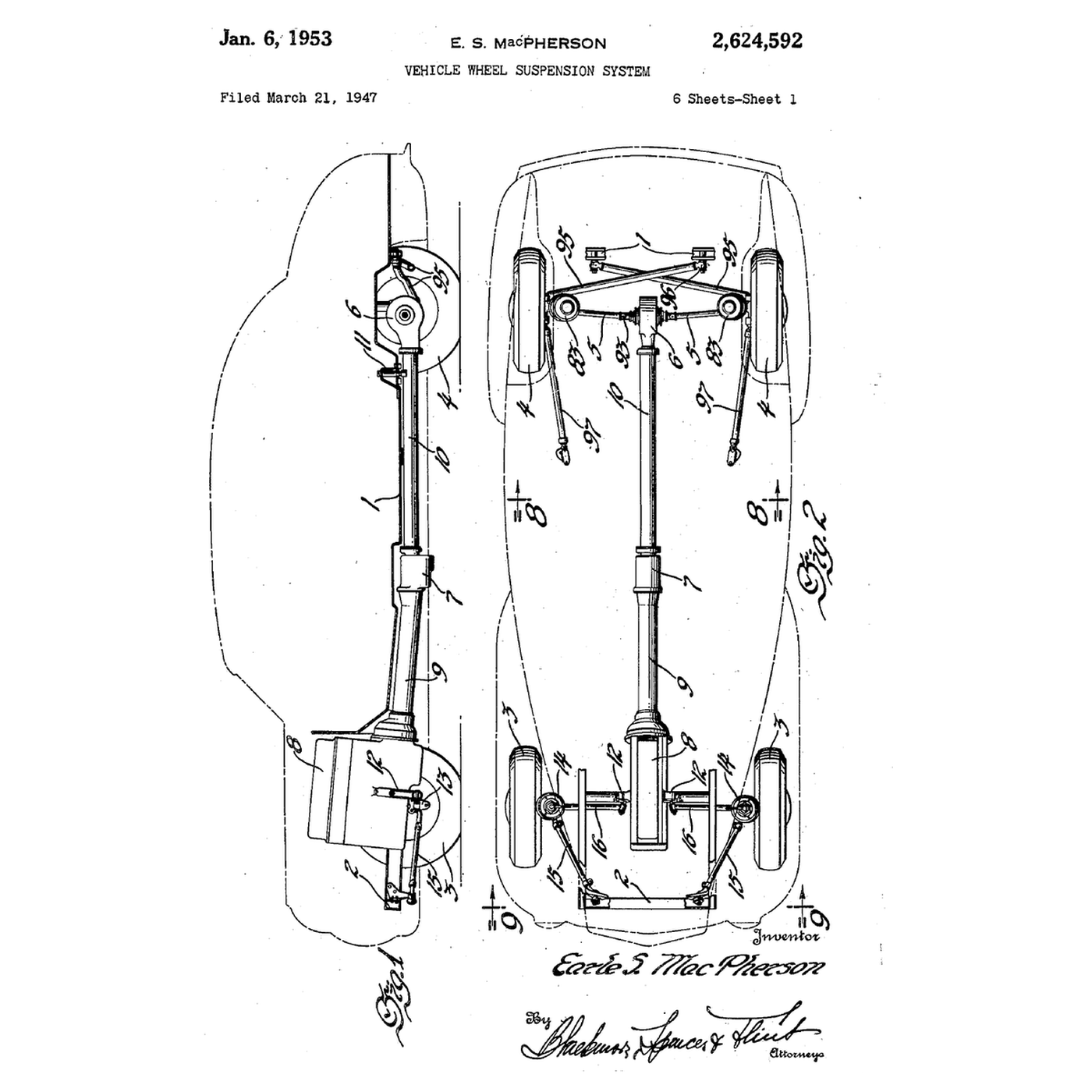
Independent front suspension usually needs two wishbones per wheel, a spring and a damper. Earle S. MacPherson, an engineer at General Motors and then Ford, combined the damper, the spring and the upper link into one telescopic strut running from the hub up to the body, with a single lower link at the bottom. His patent was filed in 1947 and granted in 1953.
It is cheap, light and compact, and it leaves room across the car for the engine — which is why most small front-wheel-drive cars use it.
This rung computes how the wheel's camber changes as the suspension moves, and builds a cardboard front-view model to measure it with a protractor.
Intermedio
About 3 hours
Istruzioni
1
1
Read MacPherson's patent
Read MacPherson's patent
US 2,624,592, 'Vehicle Wheel Suspension System', Earle S. MacPherson of Detroit, filed 21 March 1947 (Serial 736,262), granted 6 January 1953. The wheel's stub axle is connected *"to the body by a vertical telescopic strut"* and *"by a pair of horizontal swinging links"*; one link is *"formed as a turnbuckle"* for adjustment, and rubber bushes give *"a certain degree of universal joint action"*. The figures include a section of the strut's shock-absorber valving.
2
2
Camber change over the travel
Camber change over the travel
Caricamento del notebook Jupyter…
3
3
Build a front-view model
Build a front-view model
On a sheet of plywood, mark the car's centre line and 'ground'. Use the notebook's dimensions at half scale. Pin a strip of balsa as the lower link at its inner pivot. Make the strut from two cardboard tubes, one sliding in the other, pinned at the top mount and at the link's outer end. Glue a cardboard 'wheel' rigidly to the lower tube.
Move the link end up and down in 20 mm steps and measure the wheel's lean with the protractor. Compare with the notebook. Then move the inner pivot up by 20 mm and repeat: the camber curve changes — this is how suspension designers tune it.
Materiali per questo passaggio:
 Pannello di compensato1 foglio
 Tavoletta di balsa1 foglio
 Tubo di cartone2 pezzi
 Viti da metallo4 pezzi
Strumenti necessari:
 Goniometro
 Righello
 Trapano a batteria
 Serie di punte da trapano
4
4
History and context
History and context
**US 2,624,592, 'Vehicle Wheel Suspension System', Earle S. MacPherson; filed 21 March 1947, granted 6 January 1953.** The design first went into production on Ford of Britain cars in the early 1950s and became the most common front suspension on small cars.
**Honest limits.** The camber change and roll behaviour are harder to tune than with two wishbones; the strut's sliding seal carries side loads and wears; and the tall strut sets the height of the bonnet line.
Materiali
4- 1 foglioSegnaposto
- 1 foglioSegnaposto
- 2 pezziSegnaposto
- 4 pezziSegnaposto
Strumenti richiesti
4- Segnaposto
- Segnaposto
- 1 vendor sell this, none ship to you yetSegnaposto
- Segnaposto
Blueprint correlati
Questi blueprint condividono conoscenze — tecniche, materiali o principi

The Hydraulic Shock Absorber: Liquid Forced Through a Small Passage
di Emma
Meccanica
32
0
0
0
0
0
Ackermann Steering: The Inner Wheel Turns Further
di Martin
Meccanica
28
0
0
0
0
0
The Leaf Spring: A Beam That Carries the Load and Locates the Axle
di Emma
Meccanica
28
0
0
0
0
0
Constant-Velocity Joint
di Emma
Meccanica
65
0
0
0
0
0
Universal Joint
di Martin
MESTIERE
54
0
0
0
0
0
CC0 Pubblico dominio
Questo progetto è rilasciato sotto CC0. Sei libero di copiare, modificare, distribuire e utilizzare quest'opera per qualsiasi scopo, senza chiedere permesso.
Supporta il Maker acquistando prodotti tramite il suo progetto dove guadagna una Commissione Maker stabilita dai venditori, oppure crea una nuova iterazione di questo progetto e includilo come collegamento nel tuo progetto per condividere i ricavi.