ARTE
BELLEZZA E BENESSERE
MESTIERE
CULTURA E STORIA
DIVERTIMENTO
AMBIENTE
CIBO E BEVANDE
INGEGNERIA INVERSA
SCIENZE
SPORT
TECNOLOGIA
INDOSSABILI

The Water-Tube Boiler: Put the Water in the Tubes
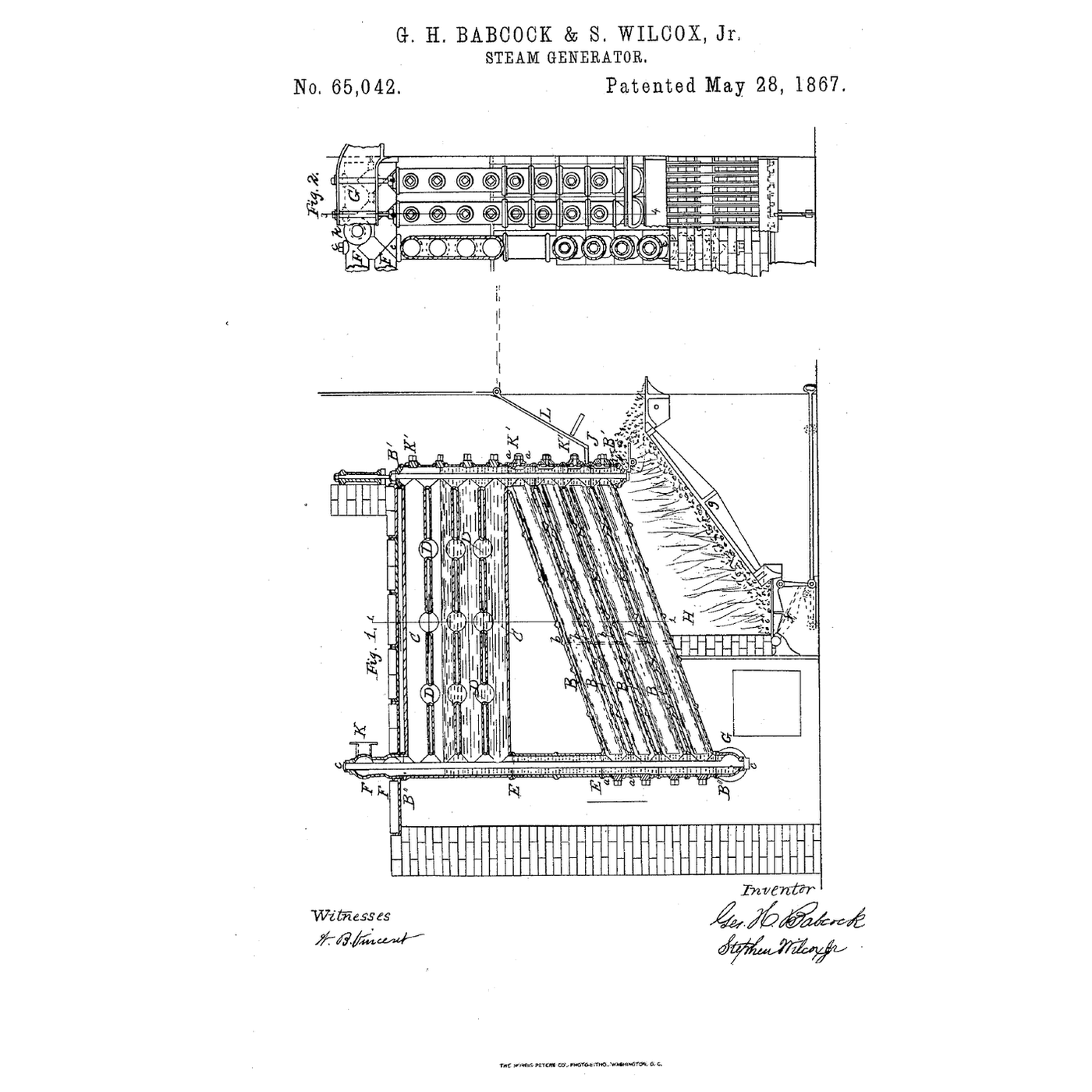
Turn the fire-tube boiler inside out: the fire and gas outside, the water inside many small inclined tubes connected to a steam drum above. George Babcock and Stephen Wilcox patented their version in 1867, naming the faults of the generators before it — sluggish circulation, and scale that could not be got out.
Two things follow from putting the water in tubes. A small tube holds high pressure with a thin wall, so pressures could climb. And a burst tube releases only a little water, not a whole shell's worth — which is why the water-tube boiler became the boiler of ships and power stations.
This rung works out both effects with real steam-table values, and builds an open, unpressurised circulation loop to watch the water drive itself round.
Intermedio
About 3 hours
Istruzioni
1
1
Read the 1867 patent
Read the 1867 patent
US 65,042, 'Steam Generator', G. H. Babcock and S. Wilcox Jr. The drawing shows sets of pipes in two directions — one set *"in a horizontal position, and the other inclined at an angle therewith"* — cast with T-heads so the sections bolt together, over a combustion chamber with an inclined grate.
The specification opens by naming the problem it solves: the *"deficient circulating capacity"* of earlier tube generators, and *"the difficulty of removing incrustations from the interior of the generating vessels, which deposits are increased by a sluggish circulation of the water"*. Circulation and scale are the two ideas of this rung.
2
2
Wall thickness and stored energy
Wall thickness and stored energy
Caricamento del notebook Jupyter…
3
3
Watch water circulate by itself
Watch water circulate by itself
Make a closed loop of clear vinyl tube about 1.5 m round, with a 30 cm length of copper tube spliced into one side and clamped. Fill it with water, leaving the top open to air through a short vertical tee — **it must stay open; never seal a heated loop.**
Tilt the loop so the copper section is the low, inclined leg, and heat it gently with the heat gun from below. Inject a drop of dye near the copper. Within a minute the dye moves: hot water, lighter, rises out of the copper leg and cold water falls down the other side to replace it. Time the dye round the loop.
Now lay the loop flat and repeat: the circulation nearly stops. That is Babcock and Wilcox's point about inclined tubes — circulation comes from height and density difference, and a sluggish loop lets steam bubbles and scale settle where they form.
Materiali per questo passaggio:
 Tubo in vinile trasparente2 metri
 Tubo di rame0.3 metro
 Assortimento di fascette per tubi1 set
 Assortimento di raccordi in PVC1 set
 Acqua1 litro
 Colorante alimentare (colorante per la visualizzazione del flusso)1 goccia
Strumenti necessari:
 Pistola termica
 Cronometro
 Tagliatubi
 Occhiali di sicurezza trasparenti
 Guanti da lavoro in pelle
4
4
How a boiler is fed against its own pressure
How a boiler is fed against its own pressure
A boiler that evaporates water must be fed more, against its own pressure. The embedded blueprint covers the injector that fed boilers of this era with no moving parts, and the feed-water temperature limit that decides whether it works.
5
5
Why water tubes fail: the usual causes
Why water tubes fail: the usual causes
A water tube fails by overheating long before it fails by pressure alone. The causes to rule out, in order.
Flow
Loading...
6
6
History and context
History and context
**US 65,042, 'Steam Generator', George H. Babcock and Stephen Wilcox Jr., of Providence, Rhode Island; patented 28 May 1867.** Babcock & Wilcox went on to build water-tube boilers for power stations and ships, and the design line runs to the high-pressure boilers that feed steam turbines today.
It inverted the fire-tube boiler of rung 1: small tubes can hold pressures a shell cannot, and the water they hold is small at any one place.
**Honest limits.** It needs clean, treated feed water — a scaled water tube overheats and fails where a big shell would only lose efficiency. It holds little water, so it responds fast but needs attentive feed control. **Boilers are pressure vessels; this rung builds only an open loop, and so should you.**
Materiali
6- 2 metriSegnaposto
- 0.3 metroSegnaposto
- Segnaposto
- Segnaposto
- 1 litroSegnaposto
- Segnaposto
Strumenti richiesti
5- 1 vendor sell this, none ship to you yetSegnaposto
- Segnaposto
- Segnaposto
- Segnaposto
- Segnaposto
Blueprint correlati
Questi blueprint condividono conoscenze — tecniche, materiali o principi
The Fire-Tube Boiler: Surface, Not Fire, Makes Steam
di Martin
Meccanica
44
0
0
0
0
0

The Economiser: The Heat Still Going Up the Chimney
di Martin
Meccanica
37
0
0
0
0
0
Safety Relief Valve
di Penny
TECNOLOGIA
42
0
0
0
0
0
The Steam Injector: Feeding a Boiler With Its Own Steam
di Martin
Meccanica
48
0
0
0
0
0
Parsons Steam Turbine
di Martin
Fisica
49
0
0
0
0
0
CC0 Pubblico dominio
Questo progetto è rilasciato sotto CC0. Sei libero di copiare, modificare, distribuire e utilizzare quest'opera per qualsiasi scopo, senza chiedere permesso.
Supporta il Maker acquistando prodotti tramite il suo progetto dove guadagna una Commissione Maker stabilita dai venditori, oppure crea una nuova iterazione di questo progetto e includilo come collegamento nel tuo progetto per condividere i ricavi.