ARTE
BELLEZZA E BENESSERE
MESTIERE
CULTURA E STORIA
DIVERTIMENTO
AMBIENTE
CIBO E BEVANDE
INGEGNERIA INVERSA
SCIENZE
SPORT
TECNOLOGIA
INDOSSABILI


Cock, Gate, Globe: Three Ways to Stop a Flow
The catalogue can already move a fluid and seal a turning shaft. It has a safety valve, a float valve and a backwater valve — three special cases. It has nothing for the ordinary job: putting a handle in a line so somebody can shut it off.
There are three ancient answers and they are still the three answers. A **cock** turns a drilled plug across the bore. A **gate** slides a wedge down through it. A **globe** lifts a disc off a seat and makes the flow turn twice to get past.
Each is good at something the others are bad at, and the differences are large — an open globe valve costs two hundred times the pressure of an open ball valve. This rung takes one of each apart, measures what they cost, and ends with the one rule that saves the most valves: never throttle with a gate.
Principiante
About 3 hours
Istruzioni
1
1
Take a valve apart and name every piece
Take a valve apart and name every piece
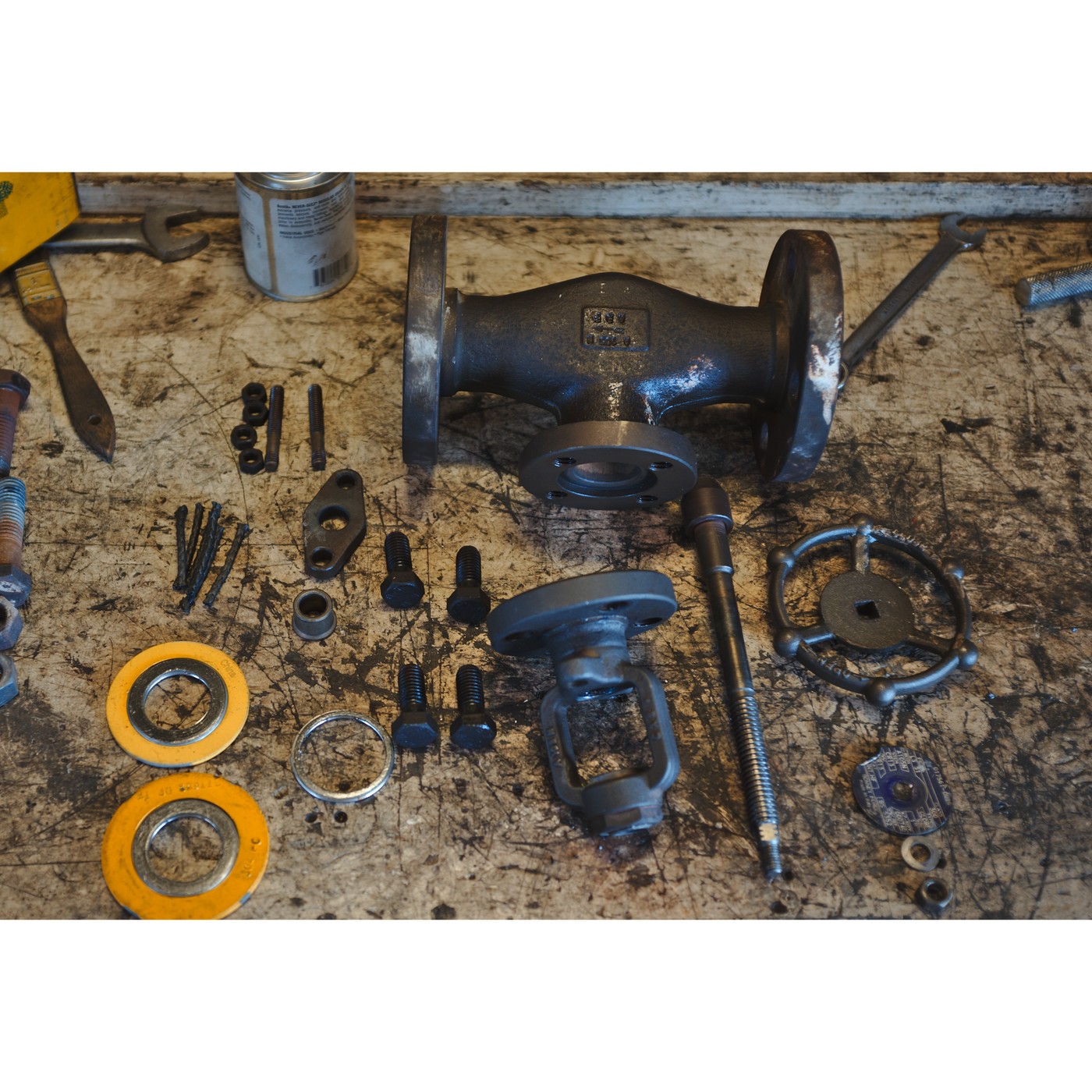
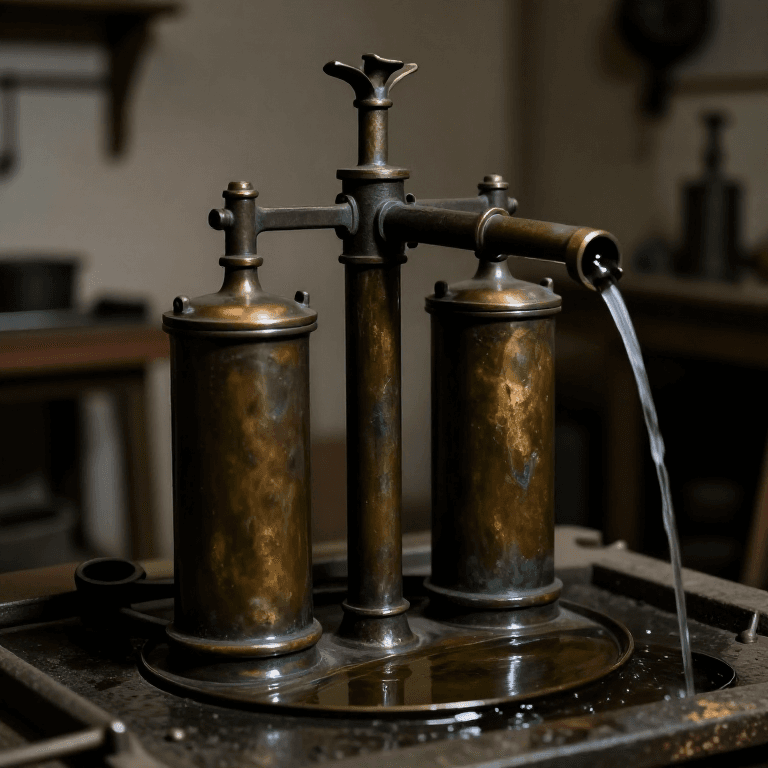
The photograph on this page is a globe valve stripped on a bench, and everything in this rung is in it. Do the same with a cheap valve of your own — a brass gate or globe valve is a few pounds second-hand and is designed to come apart.
With the valve **off any system and at zero pressure**, undo the bonnet nuts and lift the bonnet out with the stem and disc. Lay the parts out in order.
Name them:
- **Body** — the pressure shell, with the two end connections. Note the flow arrow if there is one.
- **Seat** — the machined ring the closing element lands on. This is the one surface that decides whether the valve shuts off, and it is usually the first thing to fail.
- **Disc, wedge or plug** — the closing element.
- **Stem** — the rod that moves it, threaded either inside the body or outside.
- **Packing and gland** — the rings round the stem and the nut that squeezes them. This is the catalogue's packing-gland rung, and it is where a valve leaks.
- **Bonnet and its gasket** — the removable top and its static seal.
Now look **down the bore with the valve wide open**. On a gate valve you see straight through; on a globe valve you cannot see through at all, because the flow has to go up over a bulkhead and back down. That is the whole difference, visible in one look, and step 4 prices it.
Strumenti necessari:
 Valvola a globo
 Saracinesca
 Chiave regolabile a rullino
 Serie di chiavi fisse
 Set di cacciaviti
 Morsa da banco
 Calibro digitale da 6 pollici
 Microscopio digitale
2
2
Measure what each one costs you
Measure what each one costs you
Build a simple flow bench: a bucket, a hose from a tap, the valve under test in the line, and a graduated cylinder and stopwatch at the outlet. Crude, and enough.
Run with the valve **fully open** and time how long it takes to fill a measured volume. That gives you flow rate. Repeat with each valve type in turn, and with a plain straight connector in place of any valve as the control.
The ball valve will be almost indistinguishable from the plain connector. The gate valve will be close. **The globe valve will be obviously and substantially slower** — the same tap, the same hose, a third or more of the flow gone.
If you have two pressure gauges, put one either side of the valve and read the drop directly; that is the proper measurement and it lets you compute K from step 4's formula. If you have one gauge, measure with the valve in and with it out and take the difference.
Then do it again with each valve **half open** and record the flow. Two findings usually surprise people:
- A gate valve half open passes far more than half the flow — most of the control happens in the last part of its travel, which is a bad characteristic for adjusting anything.
- A globe valve's flow tracks its handle much more evenly. That is what rung 5 calls a control characteristic, and it is why the globe body is the basis of nearly every control valve ever made.
Strumenti necessari:
Valvola a globoSaracinesca Valvola a sfera in ottone
 Tubo in silicone
 Secchio
 Cilindro graduato
 Cronometro
 Manometro
 Fascetta a vite senza fine
 Guanti in nitrile
3
3
Wreck a seat on purpose
Wreck a seat on purpose
This step produces the single commonest valve failure in the world, deliberately, in about twenty minutes, and it is worth the price of a cheap gate valve.
Set a gate valve **barely cracked open** — a turn or so off its seat — with the highest flow you can get through it, and leave it running. Listen to it: it will sing or chatter. The gate is sitting in a high-velocity jet and it is not held by anything except the stem.
After twenty minutes, shut it fully and check for leakage past the seat. Then take it apart and look at the seat ring and the wedge face under the microscope.
You are looking for **wire drawing**: fine radial scoring where the jet has cut a path across the seating face. Once that groove exists the valve will never shut tight again, and there is no repair short of re-machining the seat.
Do the same with a globe valve for comparison. Its disc is held down onto its seat by the stem and the flow pushes it *against* the seat rather than across it, so throttling does not destroy it the same way.
That is why the rule exists. A gate valve is a *shut-off* device, and using it as a tap is a slow way of destroying the one thing it was for.
Do this on cold water at domestic pressure, with the valve secured, and stand clear of the outlet.
Strumenti necessari:
SaracinescaValvola a globoTubo in siliconeSecchioMicroscopio digitaleChiave regolabile a rullinoMorsa da banco Occhiali di sicurezza trasparentiGuanti in nitrile
4
4
Resistance, equivalent length, and what each type is for
Resistance, equivalent length, and what each type is for
Caricamento del notebook Jupyter…
5
5
History and context
History and context
**Attribution, stated honestly.** No patent is claimed for this rung and none could be. The **plug cock** is Roman — bronze taps with tapered plugs and lever handles survive from Pompeii, and the design is unchanged in principle. The **gate** and the **globe** take their modern form in the nineteenth century with steam, when valves first had to hold serious pressure and be repairable.
**What steam changed.** A Roman cock leaks a little and nobody minds. A steam valve that leaks kills people and wastes fuel, so the nineteenth century contributed the parts that make a valve maintainable: a **removable bonnet**, a **renewable seat ring**, and a **packing gland** that can be re-tightened while the plant runs. Those three ideas are why a valve from 1890 can often still be repaired and a moulded plastic one from last year cannot.
**The principle to carry.** Every valve is a compromise between three things that fight: **low resistance when open**, **tight shut-off when closed**, and **good control in between**. Nothing does all three. A ball valve wins the first, a globe the second and third, a gate only the first. Choosing a valve is choosing which of the three you are willing to lose.
**Honest limits.** The K values in step 4 are handbook figures for clean water in a specific size, and they move with size, with Reynolds number and with how the valve is made — treat them as ratios, not as design data. The flow bench in step 2 measures a difference rather than an absolute. And none of this covers the cases where the valve is also a safety device, where the catalogue's safety-valve rung applies and the rules are not about convenience at all.
Strumenti richiesti
17- Segnaposto
- Segnaposto
- Segnaposto
- Segnaposto
- Segnaposto
- Segnaposto
- Segnaposto
- Segnaposto
- Segnaposto
- Segnaposto
- Segnaposto
- Segnaposto
- Segnaposto
- Segnaposto
- Segnaposto
- Segnaposto
- Segnaposto
Blueprint correlati
Questi blueprint condividono conoscenze — tecniche, materiali o principi



CC0 Pubblico dominio
Questo progetto è rilasciato sotto CC0. Sei libero di copiare, modificare, distribuire e utilizzare quest'opera per qualsiasi scopo, senza chiedere permesso.
Supporta il Maker acquistando prodotti tramite il suo progetto dove guadagna una Commissione Maker stabilita dai venditori, oppure crea una nuova iterazione di questo progetto e includilo come collegamento nel tuo progetto per condividere i ricavi.