

The Balance Spring
A pendulum keeps time because gravity gives it a restoring force that grows with displacement, and that produces a period which depends on the pendulum and not on how hard you push it.
A watch cannot use one. It gets carried, turned over and put in a pocket, and a pendulum only works hanging still and upright.
The obvious substitute — a balance wheel spun back and forth by the escapement — has a fatal property: it has no natural period at all. Nothing pulls it back to a preferred position, so it simply goes as fast or as slow as it is driven. An early balance is not a timekeeper; it is a flywheel that averages the driving force.
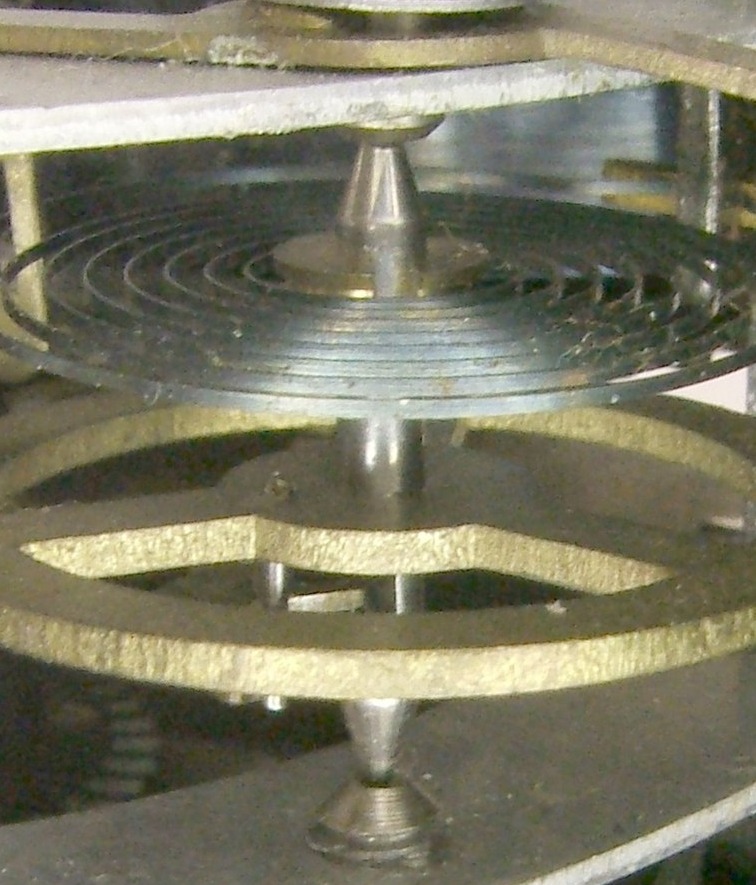
The balance spring supplies the missing half. A fine spiral spring attached to the balance produces a torque proportional to how far the wheel has turned — restoring force proportional to displacement, which is the same law a pendulum obeys under gravity.
The instant that spring is fitted, the balance acquires a period of its own, set by its inertia and the spring's stiffness, and by nothing else. Push it harder and it swings further, not faster.
A pendulum in a pocket, with the spring standing in for gravity.
手順
Prove a bare balance wheel keeps no time
Prove a bare balance wheel keeps no time
Mount a disc on a low-friction pivot with no spring, and drive it back and forth by hand or by a weighted lever at various strengths.
Try to find a rate it prefers.
Expect none: it goes at whatever rate you drive it, and when you stop it simply stops.
Write the diagnosis precisely, because it names what the spring supplies: there is no restoring force, so there is no natural frequency, so there is nothing for an escapement to count.
このステップの材料:
 エナメル被覆銅線5 m
Fit a spiral spring and find the period appear
Fit a spiral spring and find the period appear
Attach a fine spiral spring between the balance and its frame. Displace the wheel and release it.
Expect it to oscillate at a definite rate, and to return to the same rest position every time.
Now release it from a small displacement and from a large one, timing fifty oscillations each.
Expect the period to be nearly the same.
That independence is the whole point, and it is the same isochronism a pendulum has — obtained here from a spring rather than from gravity, which is why it survives being carried around.
Find what actually sets the rate
Find what actually sets the rate
Change one thing at a time. Add small weights to the rim of the balance. Then shorten the effective length of the spring by pinning it closer in.
Time the rate after each change.
Expect more rim weight to slow it and a shorter (stiffer) spring to speed it up.
Note where the weight must go to matter most: mass at the rim counts far more than mass near the centre, because it is moment of inertia, not mass, that appears in the period.
Two adjustments, two directions. Every mechanical watch is regulated by exactly these — a lever that alters the spring's working length, and screws in the rim.
Prove it does not care which way up it is
Prove it does not care which way up it is
Time your balance-and-spring oscillator lying flat, then on its side, then upside down. Then repeat with a pendulum.
Expect the balance to keep running in every position and the pendulum to fail immediately in all but one.
Then look for the residual: expect the balance's rate to change slightly between positions, because gravity still pulls on an imperfectly balanced wheel and on the spring itself.
That small remaining difference is 'positional error', and eliminating it is most of what separates a cheap movement from an expensive one — poising the wheel, and eventually the tourbillon, which simply rotates the whole assembly so the errors average out.
Watch temperature undo everything
Watch temperature undo everything
Time your oscillator cold, then warm it gently and time it again.
Expect it to run slower when warm.
Now separate the two causes: the wheel expands, so its inertia rises; and — much larger — the spring's elastic modulus falls, so it becomes weaker.
Expect the spring effect to dominate.
This is the defect that the bimetallic compensation balance exists to cancel, and later the whole reason for inventing alloys whose stiffness barely changes with temperature. A spring is a material property pretending to be a constant, and materials are not constant.
History & Context
History & Context
Huygens and Hooke both claim it, and the fight was bitter. Christiaan Huygens published a spiral balance spring in 1675 and had a watch made; Robert Hooke insisted he had demonstrated the principle years earlier and had famously deposited his claim as the anagram ceiiinosssttuv — ut tensio, sic vis, 'as the extension, so the force'. That sentence is Hooke's law, and Hooke's law is precisely why the spring works. Both names belong on it.
It is the same physics as the pendulum, wearing different clothes. Restoring force proportional to displacement gives simple harmonic motion, and a period set by inertia and stiffness alone. Gravity supplies it for a pendulum, a spring supplies it here, a coil-and-capacitor supplies it in the syntonic tuning blueprint and a quartz crystal supplies it at the end of this batch. Recognising one law behind four unrelated devices is worth more than any of them.
It created the portable, and therefore the personal, clock. Before the balance spring a watch was jewellery that lost half an hour a day. After it, a watch was an instrument. Everything downstream — pocket watches, navigation by chronometer, railway timetables, the idea that everyone in a town agrees what time it is — needed a timekeeper that could be carried.
The remaining errors defined the next two centuries of the craft. Temperature changes the spring's stiffness; gravity makes the rate depend on position; and a plain spiral does not breathe concentrically, which makes the rate depend slightly on amplitude after all. Compensation balances, Breguet's raised overcoil, and finally low-thermal-coefficient alloys such as Elinvar were each aimed at one of those. The invention was 1675; the debugging took until about 1930.
Honest limits. Its rate depends on the elastic modulus of a real material, which drifts with temperature, with age and with magnetisation. It is sensitive to position and to shock. It is a physically tiny, delicate component that must be formed and pinned with great precision. And it oscillates far faster than a seconds pendulum, so a watch counts many more beats a day and accumulates wear correspondingly faster.
接続ブループリントの材料


CC0 パブリックドメイン
このブループリントはCC0で公開されています。許可を求めずに、自由にコピー、修正、配布、あらゆる目的で使用できます。
メイカーを応援するには、ブループリント経由で製品を購入してください。メイカーには メイカーコミッション がベンダーにより設定されています。または、このブループリントの新しいイテレーションを作成し、自分のブループリントにコネクションとして含めて収益を共有できます。