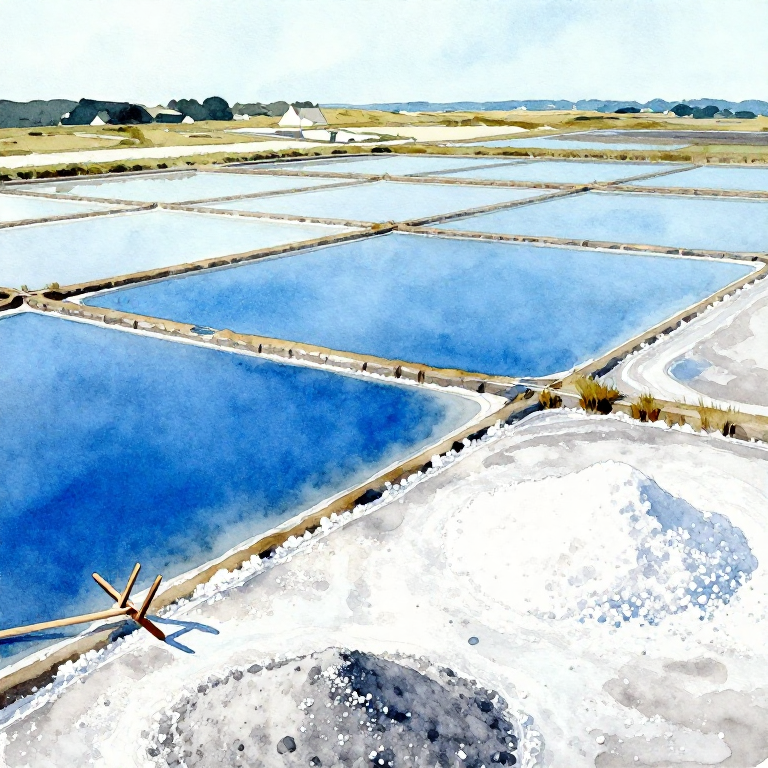


Récolte du sel de Guérande — Le savoir-faire du paludier breton
Guide complet de la récolte traditionnelle du sel dans les marais salants de Guérande, en Loire-Atlantique (Bretagne). Cette tradition ancestrale remonte à plus de 1 500 ans. Le paludier (saunier) utilise un système ingénieux de bassins successifs pour concentrer l'eau de mer par évaporation naturelle : vasière (réservoir), cobier (bassin de chauffe), fards, adernes, puis œillets (bassins de cristallisation). L'eau de mer passe de 35 g/L de salinité à environ 250 g/L avant la cristallisation.
Deux produits sont récoltés : le sel gris (gros sel raclé au fond des œillets) et la fleur de sel (fins cristaux cueillis délicatement à la surface). La fleur de sel ne représente qu'environ 5 % de la récolte totale mais se vend 10 à 20 fois plus cher que le sel gris. Un œillet produit entre 50 et 80 kg de sel gris par saison, plus 1 à 3 kg de fleur de sel. Le sel de Guérande bénéficie d'une IGP (Indication Géographique Protégée) depuis 2012. La saison de récolte s'étend de juin à septembre.
手順
Comprendre le système des marais salants
Comprendre le système des marais salants
Les marais salants de Guérande s'étendent sur environ 2 000 hectares entre Le Croisic et Guérande, en presqu'île guérandaise (Loire-Atlantique, Bretagne). Ce système exploite l'évaporation naturelle de l'eau de mer à travers une série de bassins peu profonds reliés par des canaux. L'eau de mer entre par un chenal principal (l'étier) et traverse successivement : la vasière (grand réservoir de stockage), le cobier (bassin de première chauffe), les fards et adernes (bassins intermédiaires de concentration), et enfin les œillets (petits bassins de cristallisation d'environ 70 m²). À chaque étape, l'eau perd du volume par évaporation, passant de 35 g/L à environ 250 g/L de salinité dans les œillets.
Préparation saisonnière des bassins
Préparation saisonnière des bassins
De mars à mai, avant la saison de récolte, le paludier prépare ses bassins. Après l'hiver, les œillets et les canaux contiennent des sédiments, des algues et des débris. Le paludier vide chaque bassin et racle le fond d'argile pour le niveler parfaitement. Le fond des œillets doit être absolument plat pour garantir une épaisseur d'eau uniforme (environ 5 mm en phase de cristallisation). Les talus (ponts d'argile entre les bassins) sont inspectés et réparés. Les canaux de circulation sont curés. Ce travail de remise en état prend environ deux mois et conditionne toute la saison.
必要な工具:
 平刃のさらいスコップ
 一輪車
一輪車 法面補修用粘土
Gestion du flux d'eau dans les chenaux
Gestion du flux d'eau dans les chenaux
Le paludier régule le débit d'eau de mer entrant dans son système de bassins à l'aide de petites vannes en bois ou en ardoise (les « trapons »). L'eau entre par l'étier lors des marées hautes et remplit la vasière. Le paludier ouvre ou ferme les trapons pour contrôler le passage de l'eau d'un bassin à l'autre. Le temps de séjour dans chaque bassin est crucial : l'eau doit rester suffisamment longtemps pour que l'évaporation augmente la concentration en sel. Dans la vasière, l'eau séjourne plusieurs jours. Dans les cobiers, elle se concentre à environ 50-70 g/L. Dans les fards et adernes, elle atteint 150-200 g/L. Un paludier gère typiquement 50 à 80 œillets.
必要な工具:
 トラポン(vanne en bois)
Surveiller la concentration et la cristallisation
Surveiller la concentration et la cristallisation
Le paludier surveille quotidiennement la concentration de la saumure dans les œillets. Lorsque la salinité dépasse environ 250 g/L (point de saturation du chlorure de sodium), le sel commence à cristalliser. L'épaisseur d'eau dans l'œillet ne doit pas dépasser 5 mm à ce stade. Le paludier évalue la concentration visuellement (l'eau devient irisée, des cristaux apparaissent) et par le toucher (la saumure devient visqueuse). La cristallisation dépend entièrement des conditions météorologiques : il faut du soleil pour l'évaporation et un vent d'est modéré. La pluie est l'ennemi : elle dilue la saumure et peut détruire plusieurs jours de concentration.
Reconnaître les conditions pour la fleur de sel
Reconnaître les conditions pour la fleur de sel
La fleur de sel se forme uniquement dans des conditions très spécifiques : après-midi chaud et ensoleillé, vent d'est léger et régulier, et faible humidité relative. Sous l'effet de l'évaporation rapide en surface, de fins cristaux de sel se forment à la surface de l'eau, créant une croûte délicate et fragile. Si le vent est trop fort, les cristaux coulent au fond et deviennent du sel gris. Si l'air est trop humide, les cristaux ne se forment pas. La fleur de sel est blanche (contrairement au sel gris) car elle ne touche jamais le fond argileux. Elle ne représente qu'environ 5 % de la production totale d'un œillet, soit 1 à 3 kg par saison et par œillet.
Récolter la fleur de sel
Récolter la fleur de sel
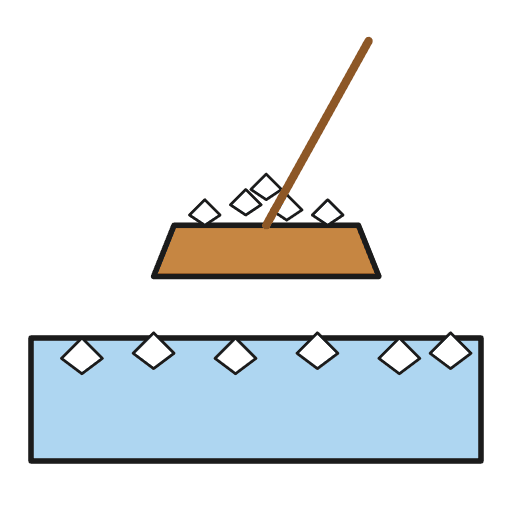
La récolte de la fleur de sel se fait en fin d'après-midi, lorsque la croûte de cristaux s'est bien formée à la surface. Le paludier utilise une lousse à fleur de sel : un outil en bois à long manche terminé par une planche fine et plate (environ 30 cm de large). Il effleure délicatement la surface de l'eau pour cueillir la fine pellicule de cristaux sans toucher le fond. Le geste doit être très délicat et régulier : trop de force brise les cristaux et les envoie au fond. La fleur de sel récoltée est déposée directement sur la ladure (plateforme de séchage en terre battue) à côté de l'œillet. Elle a une texture humide et légèrement croquante, avec un parfum subtil de violette.
必要な工具:
 塩の花のルース(平たい木の掬い)
Récolter le sel gris (gros sel)
Récolter le sel gris (gros sel)
Le sel gris cristallise au fond de l'œillet, au contact de l'argile qui lui donne sa couleur caractéristique gris clair à gris foncé. La récolte du sel gris se fait en fin de journée, après celle de la fleur de sel. Le paludier utilise une lousse à sel gris (las) : un grand râteau en bois à long manche (environ 5 mètres) terminé par une planche de bois de 40 à 60 cm de large. Il racle le fond de l'œillet en poussant le sel vers le bord du bassin, formant un monticule appelé « mulon ». Il faut racler avec fermeté mais sans creuser dans l'argile du fond, ce qui ternirait le sel et endommagerait le bassin. Chaque raclage d'un œillet peut donner 1 à 3 kg de sel gris par jour en bonne saison.
必要な工具:
 灰色塩のルース(ラス、長柄の木の熊手)
Égouttage et mise en mulons
Égouttage et mise en mulons
Le sel gris récolté est poussé sur le bord de l'œillet, sur une zone surélevée appelée ladure. Le sel s'y égoutte pendant plusieurs heures, perdant l'excès de saumure. Ensuite, le paludier forme des mulons : des tas de sel coniques d'environ 1 mètre de haut. Les mulons sont disposés le long des chemins entre les œillets. Le sel continue à sécher à l'air libre dans les mulons pendant plusieurs jours. Le sel n'est jamais lavé — c'est ce qui le distingue du sel industriel et lui confère sa richesse en minéraux (magnésium, potassium, calcium) et en oligoéléments issus de l'argile et de l'eau de mer.
必要な工具:
 塩を積み上げるスコップ
Séchage initial sur les ladures
Séchage initial sur les ladures
La fleur de sel est séchée séparément du sel gris, directement sur les ladures (plateformes en terre battue surélevées le long des œillets). Elle y reste étalée en couche fine pendant 24 à 48 heures selon les conditions météorologiques. Le paludier la retourne délicatement une ou deux fois pour assurer un séchage homogène. Le sel gris, lui, sèche dans les mulons plus longtemps, de quelques jours à une semaine. Le séchage est entièrement naturel : ni four, ni déshydrateur. Le taux d'humidité résiduel de la fleur de sel est d'environ 5 à 10 %, ce qui lui confère sa texture légèrement humide caractéristique.
Transfert vers la salorge
Transfert vers la salorge
Une fois suffisamment sec, le sel est transporté vers la salorge : un grand bâtiment de stockage en pierre ou en bois situé en bordure des marais. Le sel gris est chargé à la brouette depuis les mulons jusqu'à la salorge. La fleur de sel est transportée séparément dans des seaux ou des bacs en plastique alimentaire. Dans la salorge, le sel continue à perdre son humidité pendant plusieurs mois. Le sel gris est stocké en grands tas au sol. La fleur de sel est stockée dans des bacs séparés, à l'abri de l'humidité. La salorge peut contenir la production de toute une saison, soit plusieurs tonnes de sel par paludier.
必要な工具:
一輪車 食品輸送用コンテナ
Tri et contrôle de qualité
Tri et contrôle de qualité
Avant la mise en vente, le sel est trié et contrôlé. Le sel gris est tamisé pour retirer les éventuels débris (petits cailloux, fragments d'argile, débris végétaux). La fleur de sel est inspectée visuellement et triée à la main : les cristaux doivent être blancs, fins et réguliers. Tout cristal gris (ayant touché le fond) est reclassé en sel gris. Le sel de Guérande bénéficie depuis 2012 d'une IGP (Indication Géographique Protégée) qui certifie son origine et sa méthode de récolte artisanale. Le sel ne subit aucun traitement chimique, aucun ajout d'additif antiagglomérant ni de blanchiment — il est vendu tel que récolté.
必要な工具:
 中目の裏ごし器(tamis à mailles moyennes)
Conditionnement et étiquetage
Conditionnement et étiquetage
Le sel est conditionné dans des sacs en toile de jute, en papier kraft ou en sachets plastique alimentaire selon la destination. La fleur de sel est généralement conditionnée en petits pots ou sachets de 125 g, 250 g ou 500 g. Le sel gris est vendu en sacs de 1 kg, 5 kg ou 25 kg. Chaque conditionnement porte l'indication IGP « Sel de Guérande », le nom du paludier ou de la coopérative, le type de sel (gros sel gris, fleur de sel), et le millésime de récolte. Le sel de Guérande se conserve indéfiniment dans un endroit sec et à l'abri de la lumière. La fleur de sel doit être conservée dans un récipient fermé pour préserver son humidité naturelle et son parfum délicat.
必要な工具:
 秤
秤 IGP ラベル
 食品包装袋(sacs de conditionnement alimentaire)
必要な工具
12- プレースホルダー
- プレースホルダー
- プレースホルダー
- プレースホルダー
- プレースホルダー
- プレースホルダー
- プレースホルダー
- プレースホルダー
- プレースホルダー
- プレースホルダー
この設計図で作るもの
CC0 パブリックドメイン
このブループリントはCC0で公開されています。許可を求めずに、自由にコピー、修正、配布、あらゆる目的で使用できます。
メイカーを応援するには、ブループリント経由で製品を購入してください。メイカーには メイカーコミッション がベンダーにより設定されています。または、このブループリントの新しいイテレーションを作成し、自分のブループリントにコネクションとして含めて収益を共有できます。