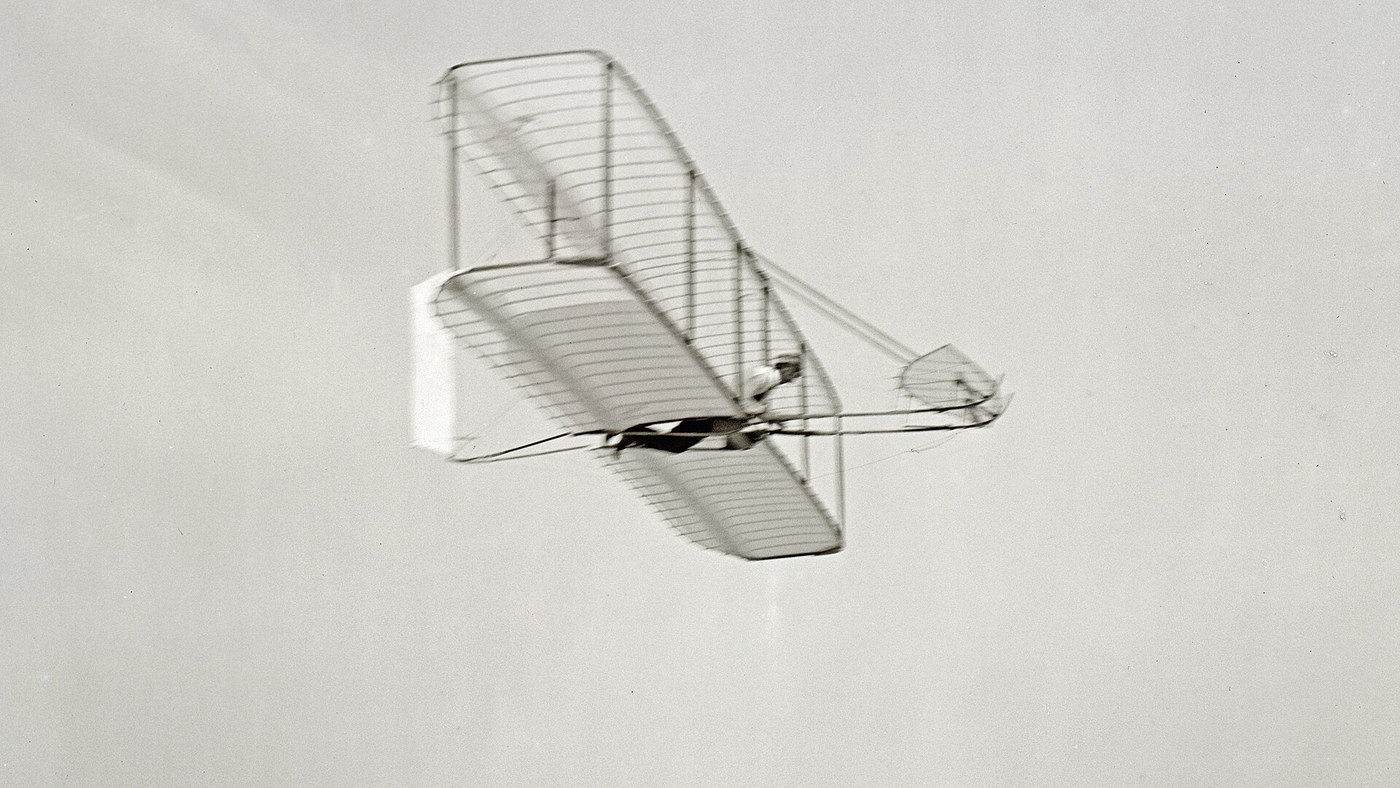


Wright Flying Machine
By 1900 lift was a solved problem. Gliders flew, wings worked, and several people had been carried briefly through the air. What killed them was that nobody could steer.
The Wright patent is not about flying. It is about control. Read US 821,393 and there is almost nothing on engines or propellers — the claims are about twisting the wingtips in opposite directions to roll the machine, and linking that twist to a movable rudder so the aircraft turns instead of spinning into the ground.
Everyone else was building inherently stable machines that resisted disturbance and could not be commanded. The Wrights built a deliberately unstable one and put the pilot in charge of all three axes. US Patent 821,393, "Flying-Machine", filed 23 March 1903 — nine months BEFORE Kitty Hawk — and granted 22 May 1906.
手順
Build models and kites only
Build models and kites only
This is a control-principle model at kite scale. Nothing here is a basis for a piloted aircraft, and testing is done on a line in an open field.
Read US 821,393 and count the words about engines
Read US 821,393 and count the words about engines
There are almost none. The claims are about wing-warping and a linked rudder — the patent is a control patent, and that framing explains everything about it.
Twist a cardboard box and understand the idea
Twist a cardboard box and understand the idea
Hold an open-ended box and twist one end against the other. It deforms without any hinge. Wilbur reportedly had the insight from an inner-tube box in the bicycle shop.
このステップの材料:
 カードストック3 枚
Build a biplane kite with flexible wingtips
Build a biplane kite with flexible wingtips
Make two stacked wings on light spars, braced so the structure is rigid in bending but can be twisted at the tips. The 1899 kite was built exactly to test this.
このステップの材料:
 竹竿4 個
竹竿4 個 キャンバス生地1 メートル
Rig warping lines to opposite corners
Rig warping lines to opposite corners
Run cords so pulling one increases the angle of one wingtip and DECREASES the other. Opposite twist is the whole mechanism.
このステップの材料:
 たこ糸(綿)10 メートル
Fly it and warp one way
Fly it and warp one way
Twist the tips and watch the kite roll. More angle means more lift on that side — you are commanding roll directly.
Discover adverse yaw
Discover adverse yaw
Watch closely: the machine rolls one way and its NOSE swings the other. The rising wing makes more drag as well as more lift — this killed the 1901 machine's turns.
Add a fixed vertical fin and see it get worse
Add a fixed vertical fin and see it get worse
Fit a fixed tail fin. In a slipping turn it makes the yaw worse, not better — this is the trap the Wrights fell into and then diagnosed.
Make the rudder MOVABLE and link it to the warp
Make the rudder MOVABLE and link it to the warp
Hinge the fin and connect it to the warping control so they act together. This linkage is the specific claim that made the patent so powerful.
Fly a coordinated turn
Fly a coordinated turn
Warp and rudder together. The kite now banks and turns cleanly instead of slewing. That is controlled flight, and it is what nobody else had.
Add a forward elevator for pitch
Add a forward elevator for pitch
Fit a movable surface ahead of the wings. Canard layout was the Wrights' choice — visible to the pilot and, they believed, gentler in a stall.
Confirm you now have three axes
Confirm you now have three axes
Roll from warping, yaw from the rudder, pitch from the elevator. Three-axis control is the complete set, and every aircraft since has all three.
Build a wind tunnel and measure a few aerofoils
Build a wind tunnel and measure a few aerofoils
Make a simple duct with a fan and a balance. The Wrights built one in 1901 after finding the published lift tables wrong, and tested some two hundred shapes.
このステップの材料:
 堅木の板1 個
必要な工具:
 手のこぎり
手のこぎりCompare your measurements with a published table
Compare your measurements with a published table
Find any old lift coefficient table and check it against your tunnel. Measuring rather than trusting is the actual method that got them into the air.
Compendium — a patent about steering, not flying
Compendium — a patent about steering, not flying
The patent. US 821,393, "Flying-Machine", filed 23 March 1903 and granted 22 May 1906 to Orville and Wilbur Wright. The filing date matters: it precedes the powered flights at Kitty Hawk on 17 December 1903 by nine months, and the patent describes a glider. The claims cover lateral control by warping the wings in opposite senses, and the coupling of that warping to a movable vertical rudder. Engines and propellers are essentially absent.
Why control was the real problem. Otto Lilienthal had made some two thousand glides before dying in a crash in 1896; his machines were controlled by shifting body weight, which is slow and limited. Most contemporaries pursued inherent stability — a machine that rights itself — which also means a machine that resists being commanded. The Wrights, bicycle makers, reasoned that a rider learns to balance an unstable machine and that the same applies in the air. They built an unstable aircraft and gave the pilot authority over all three axes, then learned to fly it. That is why a Wright Flyer is difficult to fly and why every aircraft since is a descendant of the approach.
Adverse yaw and the linkage. Warping increases lift on one wing, but increased lift comes with increased induced drag, so the rising wing is also dragged back and the nose yaws AWAY from the turn. The 1901 machine could not turn reliably for this reason. Their fix was to make the rear vertical surface movable and link it to the warping controls so that rudder and roll act together — a coordinated turn. This is why the patent claims the COMBINATION rather than wing-warping alone, and it is why the patent was broad enough to cover ailerons too, since ailerons produce the same effect by a different mechanism.
The cost of that breadth. The Wrights enforced the patent aggressively, most famously against Glenn Curtiss, and the litigation is widely held to have slowed American aviation for a decade — while European designers, less constrained, advanced quickly. The US government eventually forced a patent pool in 1917 to get aircraft built for the war. It is a clear case of a strong patent doing exactly what patents are meant to do for the inventor and something less helpful for the field, and it is worth weighing when this programme celebrates patents as records of invention.
材料
5- 3 枚プレースホルダー
- 4 個プレースホルダー
- 1 メートルプレースホルダー
- 10 メートルプレースホルダー
- 1 個プレースホルダー
関連ブループリント
これらのブループリントは知識を共有しています — 技術、材料、原理

CC0 パブリックドメイン
このブループリントはCC0で公開されています。許可を求めずに、自由にコピー、修正、配布、あらゆる目的で使用できます。
メイカーを応援するには、ブループリント経由で製品を購入してください。メイカーには メイカーコミッション がベンダーにより設定されています。または、このブループリントの新しいイテレーションを作成し、自分のブループリントにコネクションとして含めて収益を共有できます。