SANAA
UREMBO NA USTAWI
UJANJA
UTAMADUNI NA HISTORIA
BURUDANI
MAZINGIRA
CHAKULA NA VINYWAJI
UHANDISI WA KINYUME
SAYANSI
MICHEZO
TEKNOLOJIA
VAZI


Sieve of Eratosthenes — Hunt Prime Numbers on a Grid
A hands-on maths project for the classroom: make a hundred-square, then cross out the multiples of each number with counters until only the prime numbers are left. A Python cell checks the 25 primes you find, and a compendium explains why primes are the building blocks of every number.
Mwanzo
30 minutes
Maagizo
1
1
What is a prime?
What is a prime?
A prime number can only be split into equal groups as one big group or as single ones -- 5, 7 and 11 are primes. Every other number can be built by multiplying smaller ones. Around 240 BC Eratosthenes found a simple way to sift the primes out, and you will do it by hand.
2
2
Make a hundred-square
Make a hundred-square
On a sheet of card rule a 10 by 10 grid and write the numbers 1 to 100 in it, ten to a row. This is your sieve.
Vifaa kwa hatua hii:
 Karatasi ngumu1 kipande
Zana zinazohitajika:
 Seti ya penseli za grafiti
 Rula
Rula3
3
Cross out the multiples
Cross out the multiples
Cross off 1 (not prime). Circle 2, then place a counter on -- or cross out -- every other multiple of 2: 4, 6, 8, and so on. Move to the next uncrossed number, 3, circle it, and cross out every third number. Do the same for 5 and 7. Once you pass 10 you can stop. Every number still uncrossed is prime -- count them: there should be 25.
Vifaa kwa hatua hii:
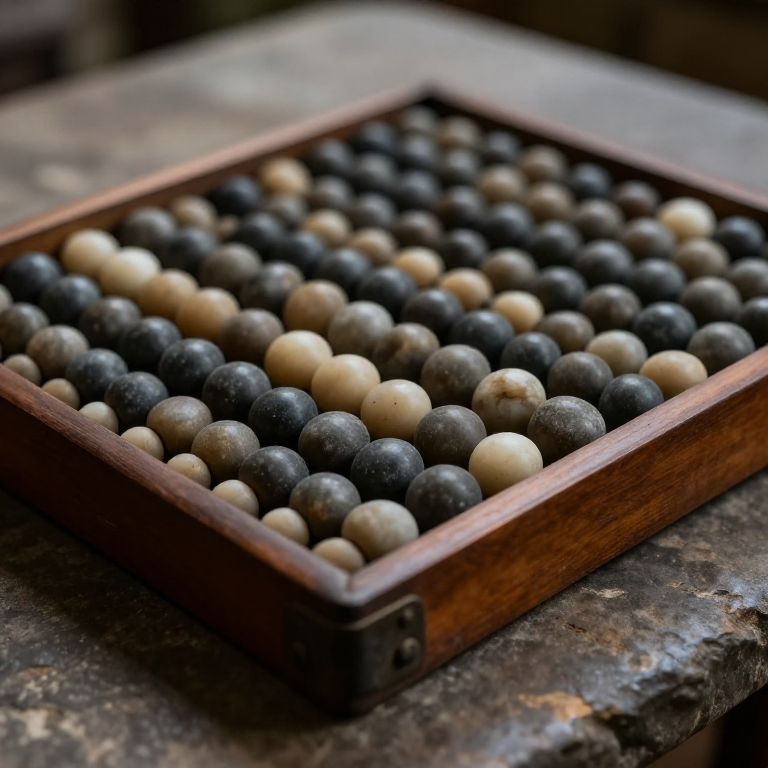
 Shanga za kioo1 kipande
4
4
Check the primes you found
Check the primes you found
Inapakia daftari la Jupyter…
Zana zinazohitajika:
 Kompyuta ya mezani
5
5
Compendium: the atoms of arithmetic
Compendium: the atoms of arithmetic
What your grid shows. (1) Every whole number above 1 is either prime or breaks down into primes in exactly one way -- the Fundamental Theorem of Arithmetic -- so primes are the 'atoms' that build all the other numbers. (2) You only had to cross out multiples up to the square root of 100 (that is, 10), because any larger composite already got crossed by a smaller factor -- a neat shortcut worth thinking about. (3) Primes get rarer as numbers grow, but never run out (Euclid proved there are infinitely many). (4) The hunt for large primes and the difficulty of un-multiplying big numbers is exactly what keeps online banking and messaging secure today.
Vifaa
3- 1 kipandeKishikilia Nafasi
- 1 kipandeKishikilia Nafasi
- 1 karatasiKishikilia Nafasi
Zana Zinazohitajika
3- Kishikilia Nafasi
- Kishikilia Nafasi
- Kishikilia Nafasi
Blueprint zinazohusiana
Blueprint hizi zinashiriki maarifa — mbinu, vifaa au kanuni



CC0 Umma Wote
Mchoro huu umetolewa chini ya CC0. Uko huru kunakili, kubadilisha, kusambaza, na kutumia kazi hii kwa madhumuni yoyote, bila kuomba ruhusa.
Saidia Mtengenezaji kwa kununua bidhaa kupitia Mchoro wao ambapo wanapata Kamisheni ya Mtengenezaji iliyowekwa na Wachuuzi, au unda marudio mapya ya Mchoro huu na uiunganishe kama kiungo katika Mchoro wako kuchangia mapato.