Ushirikiano
SANAA
UREMBO NA USTAWI
UJANJA
UTAMADUNI NA HISTORIA
BURUDANI
MAZINGIRA
CHAKULA NA VINYWAJI
UHANDISI WA KINYUME
SAYANSI
MICHEZO
TEKNOLOJIA
VAZI
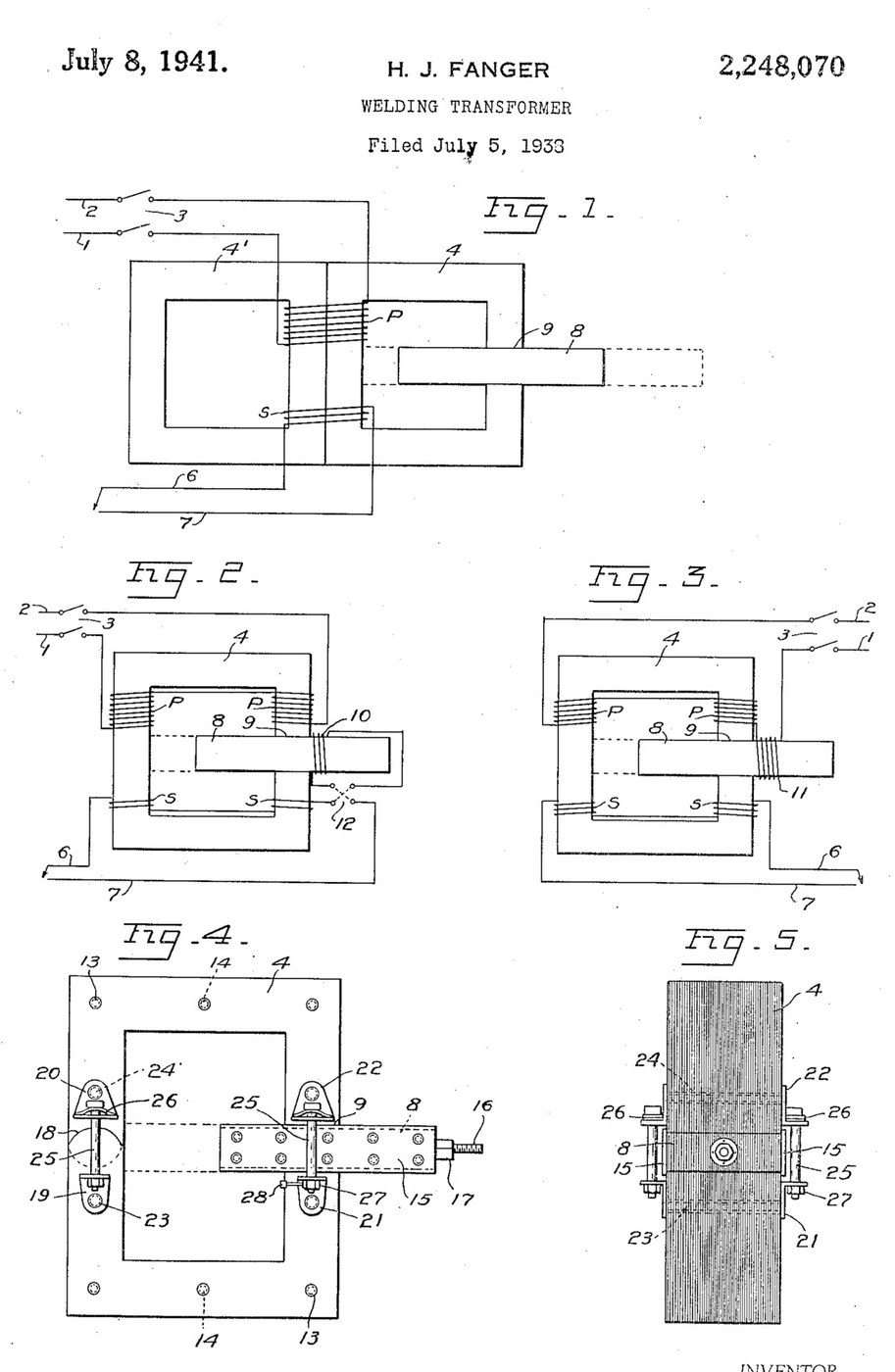


Arc Welder: AC Transformer with a Sliding Shunt Core (Fanger, US 2,248,070)
An AC arc welder is a step-down transformer whose current can be turned up and down. H. J. Fanger (US 2,248,070, 1941) cuts a gap through one leg of a laminated ring core and slides a laminated iron shunt bar through it: pushed in, it carries flux past the secondary and lowers the welding current; pulled out, the current rises.
For arc welding he gives about 60 to 68 volts open circuit, 15 to 200 amps, dropping to 38 or 40 volts at the working arc, with a small coil on the shunt bar in series with the secondary.
Source: H. J. Fanger, "Welding Transformer", US Patent 2,248,070 (filed 1938, granted 1941). Picture: its Figs. 1-5.
Juu
Unknown
Maagizo
1
1
Read Fanger
Read Fanger
"With arc welding, infinite control of the volume of the secondary current, between maximum and minimum is obtained by adjustment of the slidable shunt core without altering the welding characteristics of the current, also better ignition of the arc is had at a given voltage, and greater stability of the arc".
2
2
Stack the core
Stack the core
Build a single rectangular ring core of insulated iron laminations, held together with brass (or insulated) bolts or rivets in insulating tubes (Fig. 4). Cut a gap straight through one leg, accurately machined and finished, and make a circular joint through the opposite leg with the segments staggered to overlap in successive laminations. Core size, lamination iron and thickness are not given (ours: the tools).
Vifaa kwa hatua hii:
 Metali isiyojulikana1 iron laminations
 Mkusanyiko wa bolti za pembe sita1 brass bolts
 Kihami kisichojulikana1 insulating tubes
Zana zinazohitajika:
 Mkasi wa bati
 Kekee cha Nguzo
 Seti ya vichimbuzi
 Tupa (Tupa ya Mkono)
 Vipimo visivyojulikana
3
3
Make the shunt bar
Make the shunt bar
Make the sliding shunt section of the same laminated iron, a snug fit in the gap with its laminations edge-to-edge with the core's, and long enough to fill the gap at every position. Sheath both sides with a slightly wider plate of Bakelite that overlaps the edges of the gap to guide it. Fit a threaded rod on its outer end, working in a nut fixed to the section (or move it by hand, with calibration marks along one edge).
Vifaa kwa hatua hii:
Metali isiyojulikana1 shunt laminations Bakelite2 side platesMkusanyiko wa bolti za pembe sita1 brass bolts
 Fimbo yenye nyuzi1 kipande
 Nati ya pembe sita1 kipande
Zana zinazohitajika:
Kekee cha NguzoSeti ya vichimbuziTupa (Tupa ya Mkono)4
4
Wind the coils
Wind the coils
Wind the primary and secondary windings on both legs of the core (Fig. 2), in series or in parallel to suit the line voltage and the current wanted. Wind a small auxiliary coil round the shunt bar's path, fixed so the bar slides through it, and connect it in series with the secondary through a reversing switch (some jobs weld better with the current through it one way). Turns and wire sizes are not given.
Vifaa kwa hatua hii:
 Waya wa Shaba1 insulation and size not given
Zana zinazohitajika:
Vipimo visivyojulikana5
5
Spring the joints
Spring the joints
On both sides of the gap and of the circular joint fit pairs of confronting angle plates, held by brass bolts in insulating sleeves and drawn together by spring bolts whose heads rest on slightly arched spring plates, so the joints close snugly on the sliding bar. A small lever on the gap-joint nut gives a half turn to release the bar for moving. The angle-plate material is not given.
Vifaa kwa hatua hii:
 Nyenzo isiyojulikana4 angle platesMkusanyiko wa bolti za pembe sita1 brass and spring boltsKihami kisichojulikana1 sleeves
 Utepe wa chuma cha springi1 arched spring platesNati ya pembe sita4 vipande
Zana zinazohitajika:
Kekee cha NguzoSeti ya vichimbuzi Spana inayoweza kurekebishwa
6
6
Connect and set
Connect and set
Connect the primary to the line through a line switch, and the secondary leads to the electrode holder and the work. Pull the shunt bar out for more current, push it in for less: Fanger gives about 60-68 volts open circuit and 15-200 amps, dropping to 38-40 volts at the arc.
Vifaa kwa hatua hii:
 Swichi ya kuwasha/kuzima1 line switch
Zana zinazohitajika:
Spana inayoweza kurekebishwaVifaa
10- 1 shunt laminationsKishikilia Nafasi
- 1 brass and spring boltsKishikilia Nafasi
- 1 sleevesKishikilia Nafasi
- 2 side platesKishikilia Nafasi
- 1 kipandeKishikilia Nafasi
- 5 vipandeKishikilia Nafasi
- 1 insulation and size not givenKishikilia Nafasi
- 4 angle platesKishikilia Nafasi
- 1 arched spring platesKishikilia Nafasi
- 1 line switchKishikilia Nafasi
Mchoro huu unatengeneza

CC0 Umma Wote
Mchoro huu umetolewa chini ya CC0. Uko huru kunakili, kubadilisha, kusambaza, na kutumia kazi hii kwa madhumuni yoyote, bila kuomba ruhusa.
Saidia Mtengenezaji kwa kununua bidhaa kupitia Mchoro wao ambapo wanapata Kamisheni ya Mtengenezaji iliyowekwa na Wachuuzi, au unda marudio mapya ya Mchoro huu na uiunganishe kama kiungo katika Mchoro wako kuchangia mapato.