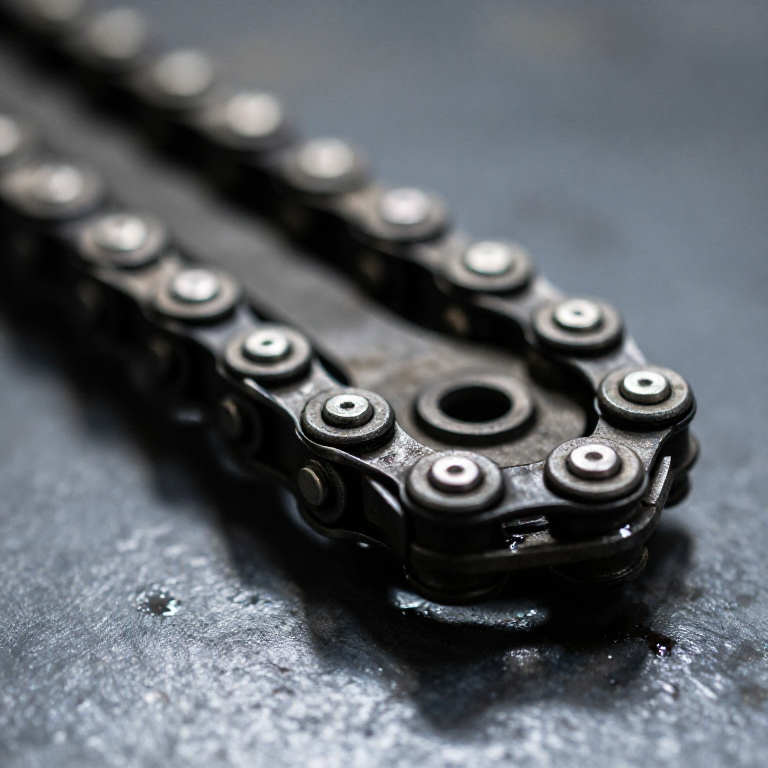


Chain and Sprocket Wear
Every mechanic and every cyclist says a chain stretches. It does not. Hardened steel side plates carrying a few hundred newtons do not elongate measurably, and if they were being plastically stretched the chain would have failed long before you noticed.
What actually happens is wear at the joints. Every link pivots on a pin running inside a bushing, and every pivot happens under load, twice per link per revolution. Metal is removed from both surfaces, the pin sits deeper, and the effective distance from one pin to the next — the pitch — grows. A chain with a hundred joints accumulates a hundred small increases, and the chain measures longer.
The distinction is not pedantry, because it tells you what to do. You cannot stop stretching, but you can slow wear, and the two things that dominate it are lubrication and grit. Abrasive contamination carried into the joint by oil does more damage than load ever will.
It also explains the expensive failure. A worn chain no longer matches the sprocket's tooth spacing, so it rides up the teeth and wears them into a hooked profile. Fit a new chain to hooked sprockets and it will be destroyed in a fraction of its life.
Measure some chains, and you will never guess again.
Maagizo
Measure a new chain and establish the truth
Measure a new chain and establish the truth
Lay a new chain flat under light tension. Measure across 12 complete links, pin centre to pin centre, with calipers or a steel rule.
Record it, and compare with 12 x the nominal pitch.
This is your zero. Everything afterwards is a comparison against a known-good reference, and a workshop without one is guessing.
Zana zinazohitajika:
 Kipima-unene cha dijitali cha inchi 6
 Tepi ya kupimia
 Kifaa cha mnyororo na gia za pikipiki
Measure used chains and compute elongation
Measure used chains and compute elongation
Measure several used chains the same way, over the same 12 links, always under the same light tension.
Compute elongation as a percentage of the new length.
Expect figures from a fraction of a per cent upwards.
Measure in several places along the chain and take the worst. Wear is not uniform — the links that spend most time under load on the small sprocket wear fastest.
Apply the replacement thresholds
Apply the replacement thresholds
Compare each against the standard limits: replace at about 0.5 % elongation on 11- and 12-speed bicycle drivetrains, about 0.75 % on 8- to 10-speed, and industrial roller chain is often run to considerably more before replacement.
Sort your chains into keep and replace.
The tighter modern thresholds are not fussiness — narrower chains have less bearing area per joint and the sprockets they run on are more expensive.
Find the hooked teeth
Find the hooked teeth
Look along the sprocket teeth from the side, on a worn set and a new set. Photograph both.
Expect the worn teeth to have lost their symmetry and to lean into a hook or shark-fin profile on the drive side.
Then lay the new chain on the worn sprocket and try to lift it away from the teeth.
Expect it to lift clear in a way it cannot on a good sprocket.
Zana zinazohitajika:
 Lupu ya Kukuza
Test what actually drives the wear
Test what actually drives the wear
Take three identical chain sections. Run one clean and lubricated, one dry, and one lubricated then deliberately dusted with fine grit, all under the same load and cycles.
Measure elongation after.
Expect the gritty one to be worst — worse than dry.
Oil carrying abrasive is a grinding paste. That is why over-oiling a chain that runs in dust is actively harmful and why cleaning matters more than lubricant choice.
Check alignment, and see it in the wear pattern
Check alignment, and see it in the wear pattern
Sight along the chain run and check that the two sprockets are in the same plane. Then examine the side plates and the sprocket tooth faces for one-sided polishing.
Expect a misaligned drive to show wear concentrated on one side of the teeth.
The component tells you the fault. Reading wear patterns is faster and more reliable than measuring alignment directly, and it is what a good mechanic does first.
Compendium — why the roller chain is such a good machine
Compendium — why the roller chain is such a good machine
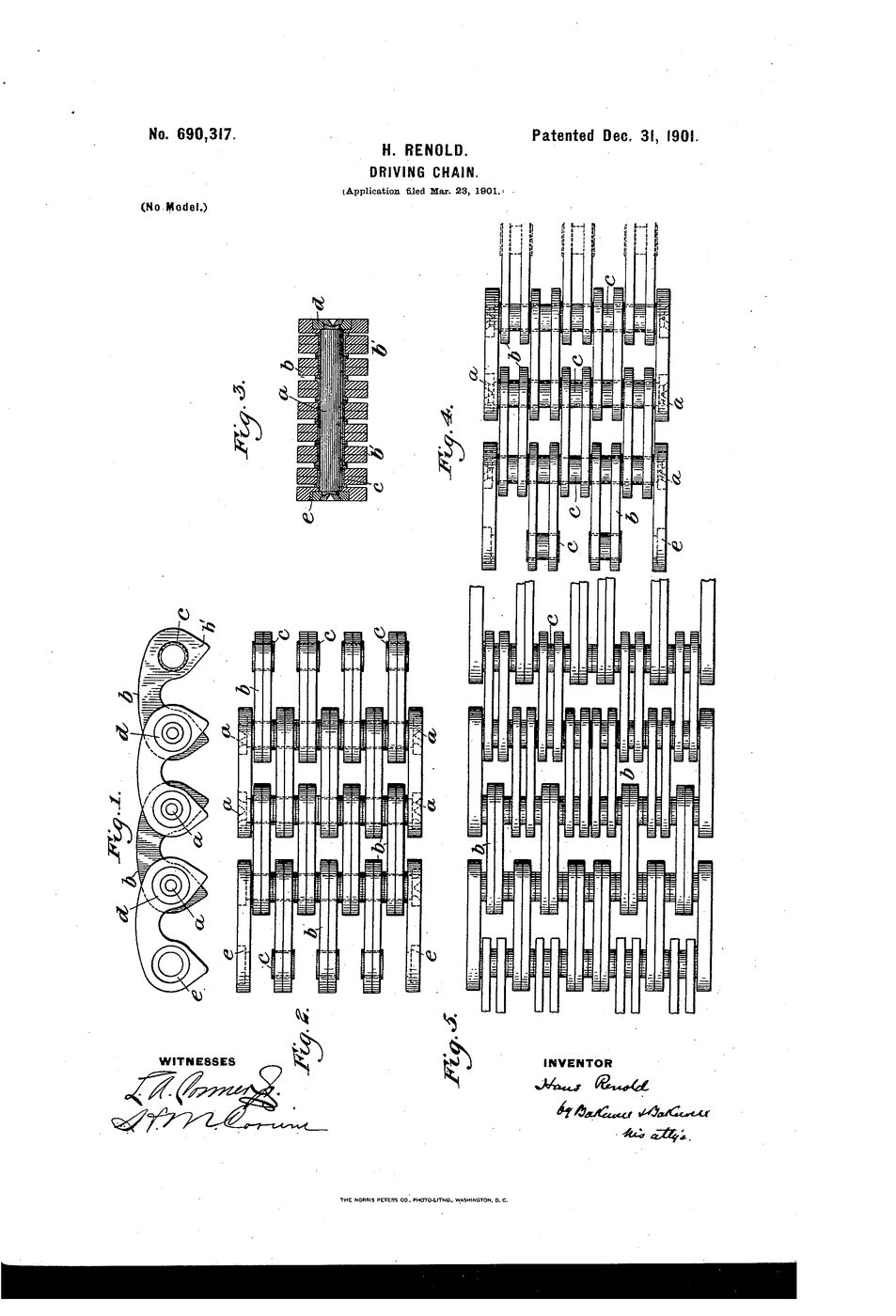
What a roller chain actually is. Inner plates carry a bushing; a roller turns freely on that bushing; outer plates carry the pin that runs inside it. Two independent bearing surfaces are therefore doing different jobs — the roller rotates against the sprocket tooth so the tooth contact rolls rather than slides, and the pin pivots inside the bushing as the chain articulates. The roller is why chain drives are efficient; the pin-bushing pair is where the wear that concerns this blueprint happens. Hans Renold's 1880 bush roller chain is the direct ancestor of every one in use.
Efficiency, honestly. A clean, well-lubricated, correctly-tensioned chain drive is remarkably efficient — high enough that it has never been displaced for bicycles and motorcycles despite a century of alternatives. Belts are quieter and cleaner but slip or need more tension; shafts are sealed and durable but lose more to bevel gears. The chain's advantage is that it transmits by positive engagement with almost no sliding at the tooth, and its disadvantage is that it is an open bearing running in whatever the road throws at it.
Why elongation destroys sprockets rather than just chains. A sprocket's teeth are cut to one pitch. As the chain's pitch grows, each roller sits progressively further out on its tooth, so load concentrates on fewer teeth and higher up the flank. That both accelerates chain wear and cuts the characteristic hook into the tooth. Once hooked, the sprocket imposes the wrong pitch on any new chain fitted to it. This is why chain and sprockets are sold and replaced as a set, and why replacing only the chain on a badly worn drive is a false economy that is usually discovered twice.
Chain wear as a measurement problem. The commercially sold chain checkers are quick but they measure roller-to-roller, which includes roller wear as well as pitch growth and can read pessimistically. Measuring pin centre to pin centre over 12 links with a rule is slower, more honest and is the reference method. Measure under consistent light tension: a slack chain reads short and a heavily tensioned one reads long, and the difference is comparable to the wear you are looking for.
Practical and safe. A chain under tension stores energy and a breaking chain moves fast — never stand in line with a running drive, and never test a chain by loading it in your hands. Rotating chains and sprockets are an obvious entanglement hazard: no loose sleeves, no gloves near a running drive, and never turn a wheel by hand with fingers near the sprocket. And chain lubricant carries fine metal particles — wash hands rather than wiping them, and dispose of degreaser properly.
Zana Zinazohitajika
4- Kishikilia Nafasi
- 1 vendor sell this, none ship to you yetKishikilia Nafasi
- Kishikilia Nafasi
- Kishikilia Nafasi
Vifaa vya Michoro Iliyounganishwa
Blueprint zinazohusiana
Blueprint hizi zinashiriki maarifa — mbinu, vifaa au kanuni
CC0 Umma Wote
Mchoro huu umetolewa chini ya CC0. Uko huru kunakili, kubadilisha, kusambaza, na kutumia kazi hii kwa madhumuni yoyote, bila kuomba ruhusa.
Saidia Mtengenezaji kwa kununua bidhaa kupitia Mchoro wao ambapo wanapata Kamisheni ya Mtengenezaji iliyowekwa na Wachuuzi, au unda marudio mapya ya Mchoro huu na uiunganishe kama kiungo katika Mchoro wako kuchangia mapato.