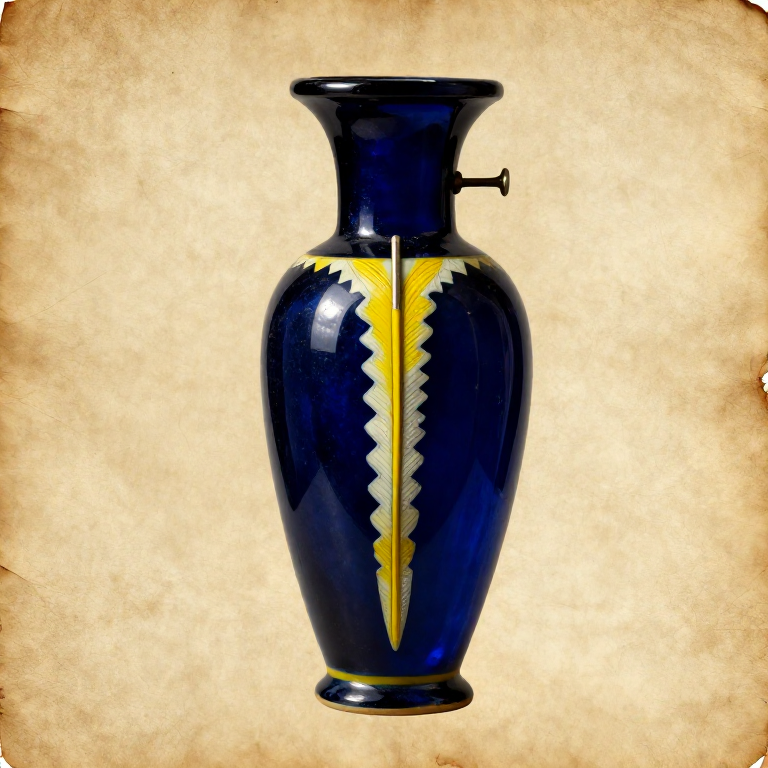


Core-Formed Glass Vessel — Ancient Glass Technique
Core-forming is the oldest method of making hollow glass vessels, predating glass blowing by over 1,500 years. This ancient technique was developed in Mesopotamia and Egypt around 1500 BCE and involves constructing a glass vessel around a removable clay and dung core attached to a metal rod. The glassworker trails molten glass threads around the core, then smoothes the surface — creating elegant perfume bottles, kohl containers, and ceremonial vessels prized throughout the ancient Mediterranean world.
The technique requires no blowing — the craftsperson works entirely with molten glass trails wound around the shaped core. Decorative patterns are created by trailing threads of contrasting colored glass onto the still-hot surface and dragging them with a pointed tool to create feathered, zigzag, or wave patterns. The colors came from metallic oxides: cobalt for deep blue, copper for turquoise, manganese for purple, and antimony for opaque yellow.
Core-formed vessels were luxury goods — the labor-intensive process meant each piece took hours to complete. When the Romans invented glass blowing around 50 BCE, production costs dropped dramatically and core-forming gradually fell out of use. But the technique's 1,500-year run makes it one of the most enduring craft technologies in human history.
Maagizo
Shape the removable core
Shape the removable core
The core is a temporary form around which the glass vessel is built. Mix clay with animal dung and chopped straw or grass in approximately equal parts by volume. Mold the mixture around a metal rod into the shape of the desired vessel interior, typically 8-15 cm long. Allow the core to dry completely, then pre-fire it gently over charcoal to harden the surface.
Vifaa kwa hatua hii:
 Udongo500 g
Zana zinazohitajika:
 Kisu
KisuPrepare the glass batch
Prepare the glass batch
Ancient glass used the soda-lime formula: approximately 70% silica sand, 15% soda, and 15% lime. Soda lowers the melting point from over 1700°C to approximately 1050-1100°C. For colored glass, add metallic oxide colorants: cobalt oxide for deep blue, copper oxide for turquoise, manganese dioxide for purple, or antimony trioxide for opaque yellow-white. Mix each batch thoroughly and place in separate clay crucibles.
Vifaa kwa hatua hii:
 Mchanga laini500 g
 Natroni100 g
 Oksidi ya kobalti5 g
Zana zinazohitajika:
 Kinu na mchi wa jiwe
Melt the glass in crucibles
Melt the glass in crucibles
Place the filled crucibles into a charcoal-fired furnace and raise the temperature to approximately 1050-1100°C. This requires sustained bellows operation for 4-6 hours as the raw batch slowly fuses into molten glass. The glass is ready when a metal rod dipped into the crucible draws out a smooth, continuous thread without lumps or bubbles. Keep the furnace at working temperature throughout the core-forming process.
Vifaa kwa hatua hii:
 Mkaa wa vipande10 kg
Zana zinazohitajika:
 Mivuo
Mivuo Miwani ya kinga dhidi ya kemikali
Trail glass threads around the core
Trail glass threads around the core
Heat the clay core in the furnace opening until it glows red-hot. Dip a metal rod into the crucible and gather molten glass. Trail the gathered glass in a tight spiral around the core, starting from the base and working upward. Each trail must fuse to the previous one while both are still hot. Build up 2-3 mm of glass thickness across the entire surface.
Zana zinazohitajika:
 Koleo la kaure ya kuyeyushia
Marvel the surface smooth
Marvel the surface smooth
While the trailed glass is still hot and pliable, roll the vessel on a flat stone slab to smooth the ridged surface into a uniform wall. Press gently and roll evenly. Reheat the vessel between marveling passes. Two or three marveling passes are needed to achieve a smooth, even surface. Wall thickness should be approximately 2-3 mm.
Zana zinazohitajika:
 Jiwe la Kusagia
Apply decorative glass trails
Apply decorative glass trails
While the body glass is still hot, gather a contrasting color of molten glass on a thin metal rod and trail it in thin lines around the vessel. The classic pattern uses opaque yellow and white trails on a dark blue body. For the 'feather drag' pattern, trail horizontal lines and then drag a pointed metal tool vertically through them. Work quickly while both body and decoration glass are above 600°C.
Zana zinazohitajika:
 Uma wa kutoboa (ushindilio)
Form the rim and handles
Form the rim and handles
Shape the vessel rim by gathering additional glass and trailing it around the top opening. While the rim glass is still hot, use a flat tool to form a smooth, slightly flared edge. For handles on larger vessels, gather a small amount of glass and draw it into a thin trail. Attach securely and reheat to equalize temperature between handle and body.
Anneal and remove the core
Anneal and remove the core
Place the completed vessel in the furnace and reduce temperature slowly over 4-6 hours. This relieves internal stresses that would cause cracking. Once cool, extract the metal rod and scrape out the clay-dung core using a long hooked wire tool. The pre-fired core crumbles easily. Clean the interior thoroughly — the finished vessel should be hollow and translucent, revealing the layered colors of body and decoration glass.
Vifaa
6- 500 gKishikilia Nafasi
- 500 gKishikilia Nafasi
- 100 gKishikilia Nafasi
- Kishikilia Nafasi
- 10 kgKishikilia Nafasi
- 1 kipandeKishikilia Nafasi
Zana Zinazohitajika
7- Kishikilia Nafasi
- Kishikilia Nafasi
- Kishikilia Nafasi
- Kishikilia Nafasi
- Kishikilia Nafasi
- Kishikilia Nafasi
- Kishikilia Nafasi
Vifaa vya Michoro Iliyounganishwa


Blueprint zinazohusiana
Blueprint hizi zinashiriki maarifa — mbinu, vifaa au kanuni


CC0 Umma Wote
Mchoro huu umetolewa chini ya CC0. Uko huru kunakili, kubadilisha, kusambaza, na kutumia kazi hii kwa madhumuni yoyote, bila kuomba ruhusa.
Saidia Mtengenezaji kwa kununua bidhaa kupitia Mchoro wao ambapo wanapata Kamisheni ya Mtengenezaji iliyowekwa na Wachuuzi, au unda marudio mapya ya Mchoro huu na uiunganishe kama kiungo katika Mchoro wako kuchangia mapato.