SANAA
UREMBO NA USTAWI
UJANJA
UTAMADUNI NA HISTORIA
BURUDANI
MAZINGIRA
CHAKULA NA VINYWAJI
UHANDISI WA KINYUME
SAYANSI
MICHEZO
TEKNOLOJIA
VAZI
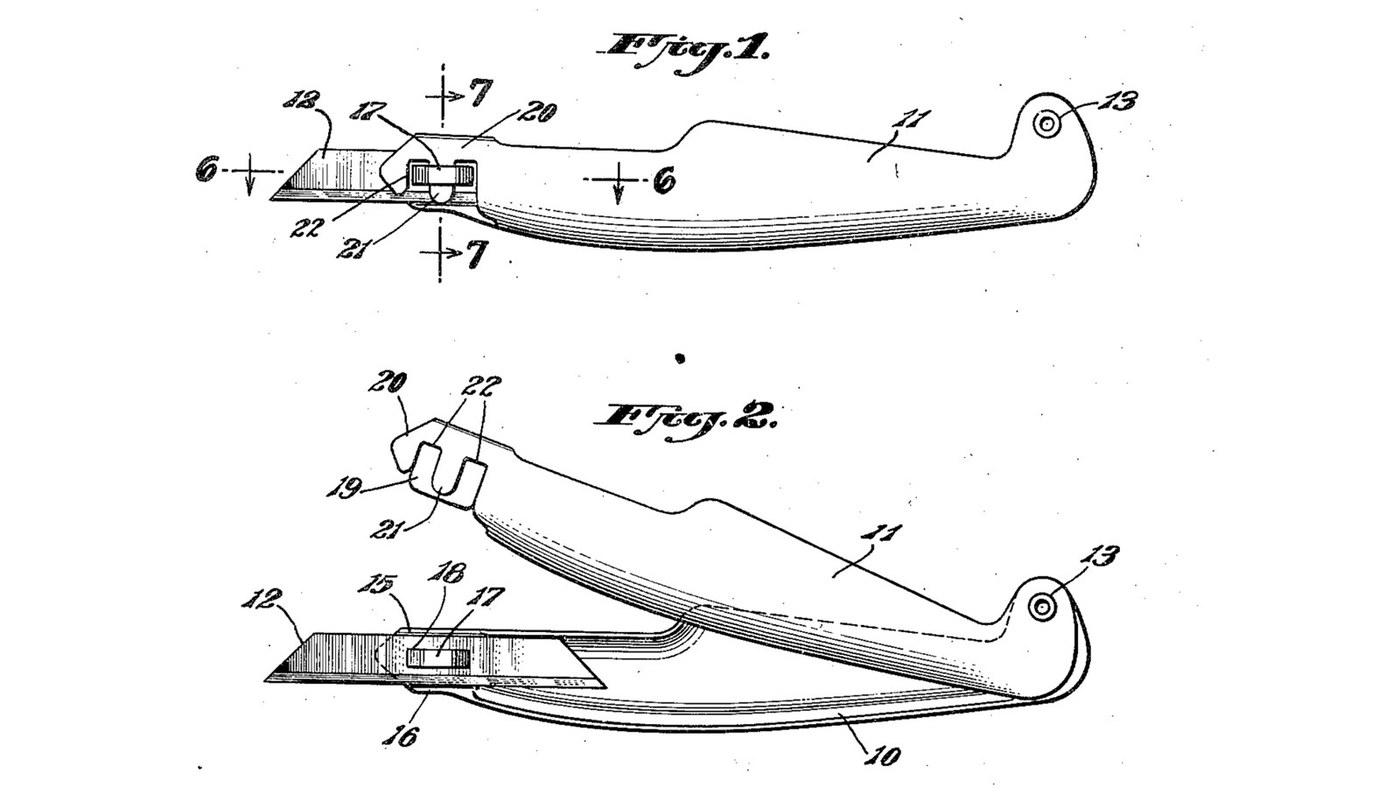


Craft Knife: Doniger's Hinged Handle and Reversible Blade
A knife for model carving and fine cutting, by Sundel Doniger of New York, founder of X-Acto (US 2,463,682, filed 1945, granted 1949). The handle is two shell-like metal halves pivoted at the rear. A thin blade with a slot in its middle drops over a small 'staple' pressed out of one half; closing the other half pushes a tongue into the staple and locks the blade solid. Swing it open to change the blade or turn it end for end: the spare end rests inside the handle.
The patent gives no sizes or metals. Mild steel sheet, the rivet, the spring steel blade and the sizes are ours. The picture: Figs. 1 and 2 of the patent.
Kati
1 day
Maagizo
1
1
Mark out the two handle halves
Mark out the two handle halves
Scribe two mirror-image halves, about 130 mm long, on mild steel sheet about 0.8 mm thick (ours). Give each a flat rear ear for the pivot and a nose at the blade end.
Vifaa kwa hatua hii:
 Bati la Chuma Laini1 kipande
Zana zinazohitajika:
 Kichora Mistari
 Rula
2
2
Cut and file the halves
Cut and file the halves
Cut both halves out with tin snips and file the edges smooth.
Zana zinazohitajika:
 Mkasi wa bati
 Tupa ya chuma
 Kibano cha meza ya kazi
3
3
Dome the grip, keep the ends flat
Dome the grip, keep the ends flat
Hammer the middle of each half into a shallow bulge over a hollow in a hardwood block. Leave the pivot ends flat, so the pivot cannot wobble, and leave the noses flat.
Zana zinazohitajika:
 Nyundo yenye kichwa cha duara
 Kipande cha mbao ngumu
4
4
Form the blade wall and its shoulders
Form the blade wall and its shoulders
On the mounting half (10), the nose is a flat wall (14) in the plane where the halves meet. Turn its top and bottom edges inward into shoulders (15, 16) just as far apart as the blade is wide.
Zana zinazohitajika:
 Koleo la Mdomo BapaNyundo yenye kichwa cha duaraKibano cha meza ya kazi
5
5
Press out the staple
Press out the staple
Slit the middle of the wall along two short parallel lines, lengthwise. Press the strip between the slits outward to form the staple (17).
Zana zinazohitajika:
 Patasi ya chuma baridi
 Kigwe cha KatikatiNyundo yenye kichwa cha duara
 Fuawe
6
6
Bend the locking channel
Bend the locking channel
Bend the nose of the locking half (11) into a springy channel: a broad rear flange (19) about the size of the wall, and a front flange (20) with a tongue (21) and a cut-out (22) each side of it to clear the staple's legs.
Zana zinazohitajika:
Mkasi wa bati Seti ya tupa ndogoKoleo la Mdomo Bapa
7
7
Drill the pivot
Drill the pivot
Clamp the halves together, punch the centre of the rear ear and drill through both.
Zana zinazohitajika:
Kigwe cha Katikati Kekee cha mkonoKibano cha meza ya kazi
8
8
Rivet the pivot
Rivet the pivot
Rivet the flat ends together (Doniger used an eyelet; ours: a steel rivet). Close it firmly: the friction of the flat ends must hold the halves wherever you swing them.
Vifaa kwa hatua hii:
 Rivet za chuma cha pua1 kipande
Zana zinazohitajika:
 Nyundo ya rivetiFuawe
9
9
Anneal and cut the blade blank
Anneal and cut the blade blank
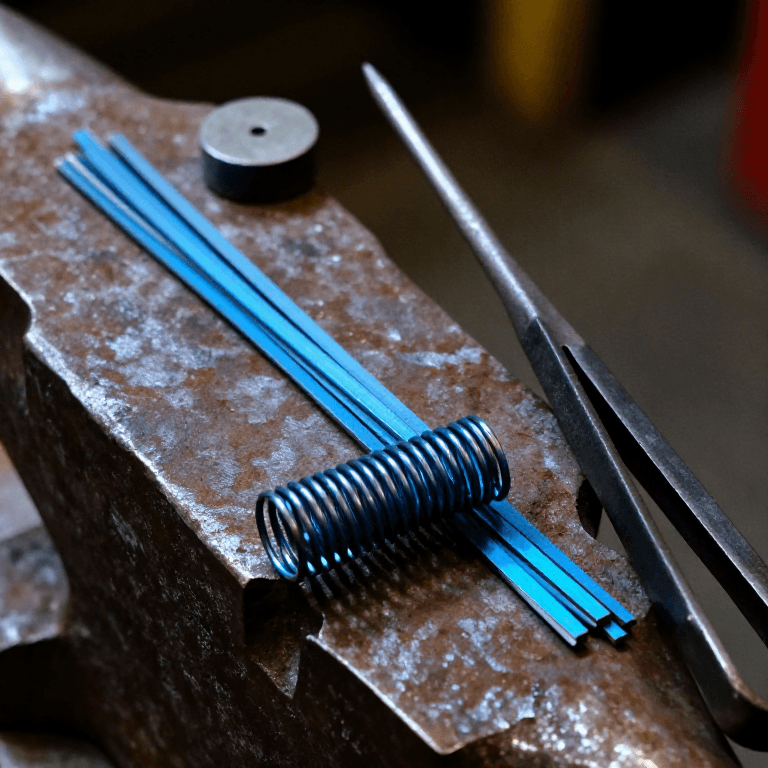
Soften a piece of spring steel strip about 0.4 mm thick (ours), as in the connected spring-steel blueprint. Cut a blank as wide as the gap between the shoulders.
Vifaa kwa hatua hii:
 Utepe wa chuma cha springi1 kipande
Zana zinazohitajika:
 Jiko la Kufua
 Koleo la forji
 Majivu ya Mti MgumuMkasi wa bati
 Glavu za kulehemu
10
10
Cut the centre slot
Cut the centre slot
Cut a slot (18) in the exact middle of the blank that fits closely over the staple. Drill its ends and file out between them.
Zana zinazohitajika:
Kigwe cha KatikatiKekee cha mkonoSeti ya tupa ndogoKibano cha meza ya kazi11
11
Shape both points
Shape both points
Cut each end of the blank to a slanting point, as in Fig. 1, and grind a cutting bevel at both ends.
Zana zinazohitajika:
Mkasi wa bati Jiwe la kunoa la gurudumuTupa ya chuma
12
12
Harden and temper the blade
Harden and temper the blade
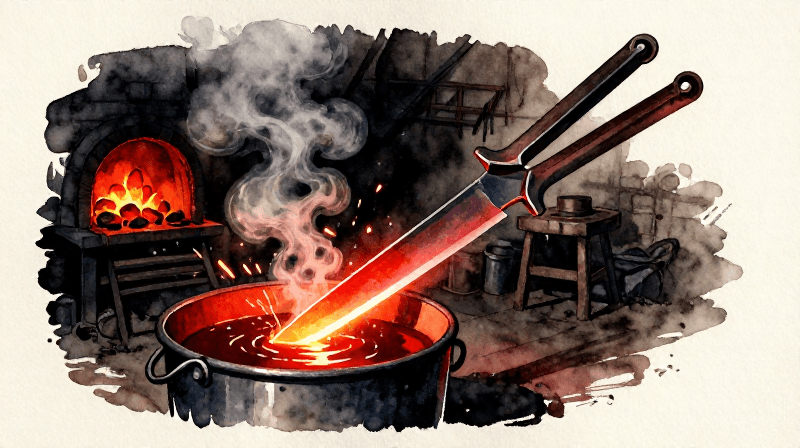
Harden the blade in oil as in the connected spring-steel blueprint. Temper it to the knife colour given in the connected heat-treatment blueprint, not to spring blue.
Zana zinazohitajika:
Jiko la KufuaKoleo la forji Mafuta ya kanolaGlavu za kulehemu
13
13
Hone both edges
Hone both edges
Hone both ends keen on the sharpening stone.
Zana zinazohitajika:
 Jiwe la Kunolea
14
14
Fit and lock the blade
Fit and lock the blade
Swing the halves open. Lay the blade flat on the wall, its slot over the staple and its edges between the shoulders. Swing the locking half shut: the tongue enters the staple and the channel grips the blade. No tools needed.
15
15
Reverse or change the blade
Reverse or change the blade
Swing the locking half up, lift the blade off the staple and turn it end for end, or fit a new one. The spare end sits protected inside the handle.
16
16
What the patent says, and what is ours
What the patent says, and what is ours
The patent fixes the parts and how they lock: hinged shell halves, flat riveted pivot ends that hold by friction, a wall with shoulders and a pressed-out staple, a slotted double-ended blade, a springy channel with tongue and cut-outs. It gives no sizes, no metals and no blade making. All sizes, the mild steel, the rivet and the spring steel blade are our choices. Doniger's better-known X-Acto knives hold the blade in a round collet instead.
Vifaa
3- 1 kipandeKishikilia Nafasi
- 1 kipandeKishikilia Nafasi
- 1 kipandeKishikilia Nafasi
Zana Zinazohitajika
21- Kishikilia Nafasi
- Kishikilia Nafasi
- Kishikilia Nafasi
- Kishikilia Nafasi
- Kishikilia Nafasi
- Kishikilia Nafasi
- Kishikilia Nafasi
- Kishikilia Nafasi
- Kishikilia Nafasi
- Kishikilia Nafasi
- Kishikilia Nafasi
- Kishikilia Nafasi
- Kishikilia Nafasi
- Kishikilia Nafasi
- Kishikilia Nafasi
- Kishikilia Nafasi
- Kishikilia Nafasi
- Kishikilia Nafasi
- Kishikilia Nafasi
- Kishikilia Nafasi
- Kishikilia Nafasi
Mchoro huu unatengeneza

Blueprint zinazohusiana
Blueprint hizi zinashiriki maarifa — mbinu, vifaa au kanuni

CC0 Umma Wote
Mchoro huu umetolewa chini ya CC0. Uko huru kunakili, kubadilisha, kusambaza, na kutumia kazi hii kwa madhumuni yoyote, bila kuomba ruhusa.
Saidia Mtengenezaji kwa kununua bidhaa kupitia Mchoro wao ambapo wanapata Kamisheni ya Mtengenezaji iliyowekwa na Wachuuzi, au unda marudio mapya ya Mchoro huu na uiunganishe kama kiungo katika Mchoro wako kuchangia mapato.