Ushirikiano
SANAA
UREMBO NA USTAWI
UJANJA
UTAMADUNI NA HISTORIA
BURUDANI
MAZINGIRA
CHAKULA NA VINYWAJI
UHANDISI WA KINYUME
SAYANSI
MICHEZO
TEKNOLOJIA
VAZI
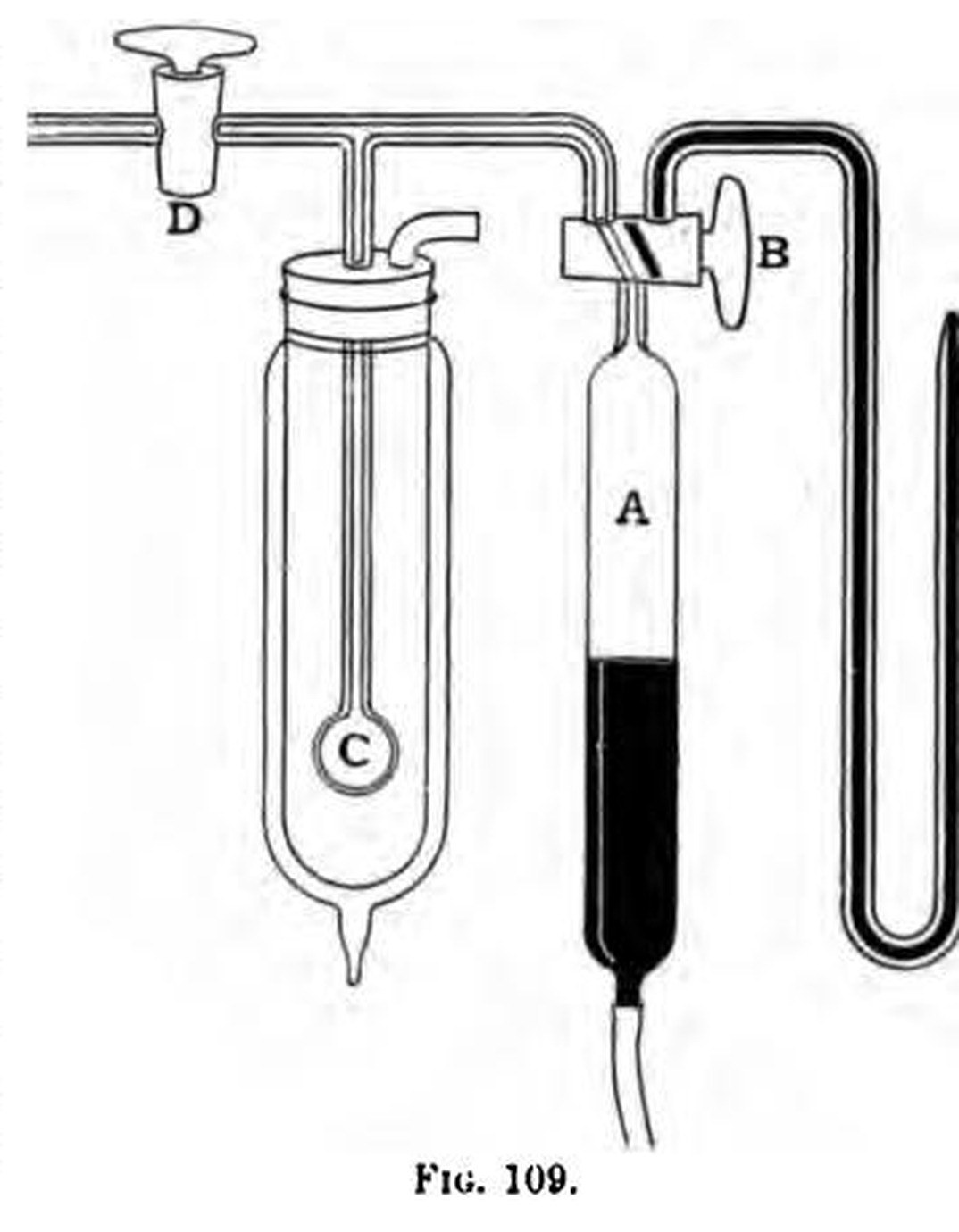

Neon: Atmospheric Argon Fractionated in Liquid Air, then Parted from Helium in Liquid Hydrogen (Ramsay and Travers, 1901)
Argon taken from air carries a little neon and helium. Ramsay and Travers liquefied the argon in liquid air and caught the first gas to boil off, which held the light gases. Repeated fractionation, at the end in a bulb cooled by liquid hydrogen, left pure neon.
Result: neon gas, density 10 (oxygen = 16).
Source: M. W. Travers, The Experimental Study of Gases (1901), pp. 214-218. Liquid air and liquid hydrogen are extremely cold; hydrogen is flammable. Picture: Fig. 109 of the book.
Juu
2 weeks
Maagizo
1
1
Liquefy the argon and take the light part
Liquefy the argon and take the light part
Liquefy atmospheric argon (Travers used 15 litres) in a bulb of about 25 cc set in liquid air, boiled under a few centimetres of mercury by a pump. Open the tap to the first of a row of mercury gasholders and lower the reservoir to draw off the lowest-boiling part, keeping the pressure on the boiling air as low as possible. This gas is rich in neon and holds helium. Let the rest of the argon boil back into its gasholder. Repeat three times.
Vifaa kwa hatua hii:
 Argoni1 about 15 litres
Zana zinazohitajika:
 Mrija wa kioo
 Hewa kiowevu
 Chombo cha ombwe (Dewar)
 Pampu ya utupu
 Hifadhi ya gesi
 Zebaki
2
2
Fractionate the light gas
Fractionate the light gas
Use the apparatus of Fig. 109: a mercury gasholder joined through a stopcock to a small bulb, which also opens to a Topler pump. Pump the bulb empty, cool it in liquid air boiled under reduced pressure inside a second vessel of liquid air (-205 °C), and raise the mercury to drive the gas in. Let it boil off in five roughly equal fractions. Liquefy them again one by one, letting the lighter part go and pumping off the denser rest, until the lightest fraction no longer shows argon in the spectroscope.
Zana zinazohitajika:
Mrija wa kiooHewa kiowevuChombo cha ombwe (Dewar)Pampu ya utupuHifadhi ya gesiZebaki Kiangalia spektra cha mkononi
3
3
Strip out the last argon with oxygen
Strip out the last argon with oxygen
The lightest gas will not condense in liquid air on its own, even at two atmospheres. Mix it with a good volume of oxygen, liquefy and let it boil off in three fractions; repeat with excess oxygen. Remove the oxygen from each fraction (Travers does not say how here) and check each in the spectroscope. Most of the argon is removed this way, but not the helium.
Zana zinazohitajika:
 OksijeniMrija wa kiooHewa kiowevuChombo cha ombwe (Dewar)Pampu ya utupuHifadhi ya gesiKiangalia spektra cha mkononi
4
4
Part neon from helium in liquid hydrogen
Part neon from helium in liquid hydrogen
Condense the gas in a bulb cooled by liquid hydrogen. Neon condenses (vapour pressure no more than 50 mm), helium stays a gas and argon does not evaporate. Pump off the first fraction (much helium). Collect the second, which evaporates slowly. Take away the liquid hydrogen and collect the third (argon) separately.
Zana zinazohitajika:
Mrija wa kioo Hidrojeni kioevuChombo cha ombwe (Dewar)Pampu ya utupuHifadhi ya gesi
5
5
Recondense and collect pure neon
Recondense and collect pure neon
Condense the second fraction again in liquid hydrogen. Let a little evaporate into the pump and throw it away, collect the main bulk as pure neon, and discard the last traces, which may hold argon. Travers found its density 10 (oxygen = 16).
Zana zinazohitajika:
Mrija wa kiooHidrojeni kioevuChombo cha ombwe (Dewar)Pampu ya utupuHifadhi ya gesiKiangalia spektra cha mkononiZana Zinazohitajika
9- Kishikilia Nafasi
- Kishikilia Nafasi
- Kishikilia Nafasi
- 1 vendor sell this, none ship to you yetKishikilia Nafasi
- Kishikilia Nafasi
- Kishikilia Nafasi
- Kishikilia Nafasi
- Kishikilia Nafasi
- Kishikilia Nafasi
Mchoro huu unatengeneza

Blueprint zinazohusiana
Blueprint hizi zinashiriki maarifa — mbinu, vifaa au kanuni

Argon: Air Led over Calcium Carbide and Calcium Chloride at 800 °C (Fischer and Ringe, Thorpe 1912)
na Charlie
Isiyo hai
8
0
0
0
0
0

Liquid Air: Air Compressed to 170 Atmospheres and Expanded through the Hampson Liquefier (Travers 1901)
na Charlie
Isiyo hai
4
0
0
0
0
0

Liquid Hydrogen: Gas at 200 Atmospheres Cooled by Dry Ice and Liquid Air, then Expanded in a Regenerator Coil (Travers, 1901)
na Charlie
Isiyo hai
4
0
0
0
0
0
CC0 Umma Wote
Mchoro huu umetolewa chini ya CC0. Uko huru kunakili, kubadilisha, kusambaza, na kutumia kazi hii kwa madhumuni yoyote, bila kuomba ruhusa.
Saidia Mtengenezaji kwa kununua bidhaa kupitia Mchoro wao ambapo wanapata Kamisheni ya Mtengenezaji iliyowekwa na Wachuuzi, au unda marudio mapya ya Mchoro huu na uiunganishe kama kiungo katika Mchoro wako kuchangia mapato.