Ushirikiano
SANAA
UREMBO NA USTAWI
UJANJA
UTAMADUNI NA HISTORIA
BURUDANI
MAZINGIRA
CHAKULA NA VINYWAJI
UHANDISI WA KINYUME
SAYANSI
MICHEZO
TEKNOLOJIA
VAZI
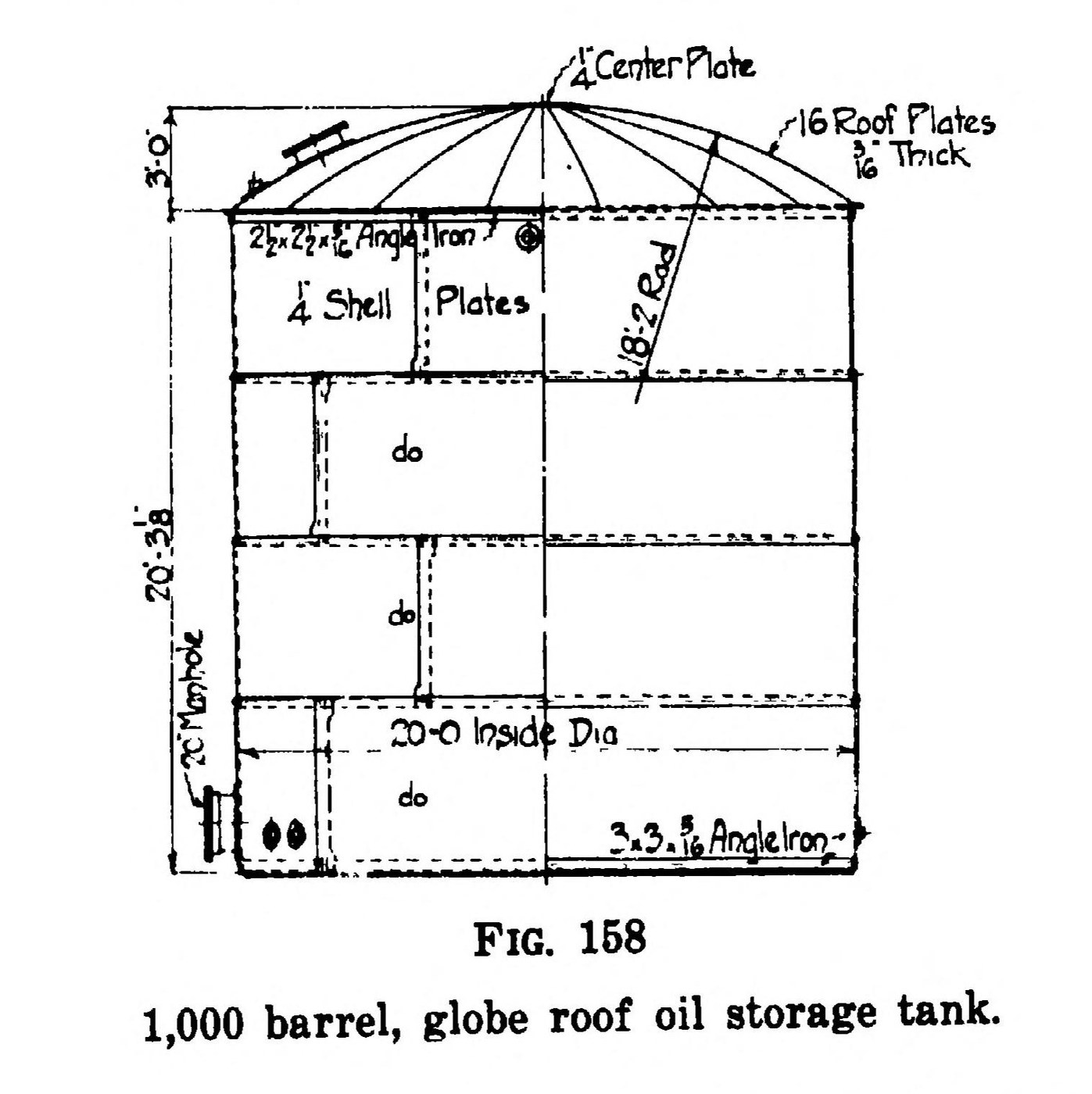

Oil Storage Tank: a Riveted Steel Tank with Globe Roof (Bell, 1923)
An above-ground oil tank of riveted 'tank steel': a flat bottom, rings of plate lapped and riveted, angle irons at top and bottom, and a self-supporting globe roof. Every seam is caulked oil-tight and the tank is water-tested before painting.
Variable: capacity. Bell's Fig. 158 is 1,000 barrels: 20 ft inside diameter, about 20 ft 3 in high, four rings of 1/4 in plate, sixteen 3/16 in roof plates rising 3 ft. Standard tanks run from 500 to 80,000 barrels (120 ft x 40 ft).
Source: H. S. Bell, American Petroleum Refining (1923), pp. 286-306. Picture: Fig. 158 of the book.
Mtaalamu
Unknown
Maagizo
1
1
Choose the size and plates
Choose the size and plates
Pick the capacity from the standard sizes (1,000 barrels: 20 ft diameter, 20 ft high). Take plate thickness from Bell's chart for the head and diameter, with a factor of safety of at least 2 1/2 for refinery tanks. Use at least 1/4 in for the shell; bottom 1/4 in on larger tanks, 3/16 in on smaller. Rings are 6 ft (72 in plates); about 7 ft is the limit.
Zana zinazohitajika:
 Vipimo visivyojulikana
2
2
Prepare the ground
Prepare the ground
Level the ground in a circle 10 ft wider than the tank and remove all vegetable growth. Avoid a mix of cut and fill. In old yards filled with cinders, dig them out at least 8 in deep and replace with fine gravel, loam or sand. On poor soil, use piles.
Vifaa kwa hatua hii:
 Changarawe1 as needed
Zana zinazohitajika:
Vipimo visivyojulikana3
3
Punch and scarf the plates
Punch and scarf the plates
Punch the rivet holes. For 1/4 in plate with 5/8 in rivets, a single lap seam has holes 2 1/4 in apart and 1 1/8 in from the edge; keep the clear space between holes no more than 6 or 7 times the plate thickness, or the caulked edge springs. Scarf the corner of the middle plate where three plates meet: cold up to 1/4 in, hot above, drawn to an edge no thicker than 1/16 in.
Zana zinazohitajika:
 Mkandamizo wa kutoboa
 Nyundo kubwa
4
4
Build the bottom on horses
Build the bottom on horses
Lay, rivet and caulk the bottom on trestles or horses about 30 in high. Rivet the bottom angle iron (Fig. 158: 3 x 3 x 5/16 in) with a 1/4 in bent-plate shoe behind each angle splice; caulk the shell leg past the shoe at least 12 in, or better bevel and caulk the angle all round. Assemble and drive the first ring while the bottom is still up. Test the bottom under 6 to 8 in of water. Coat its underside with ship-bottom or heavy asphalt paint.
Vifaa kwa hatua hii:
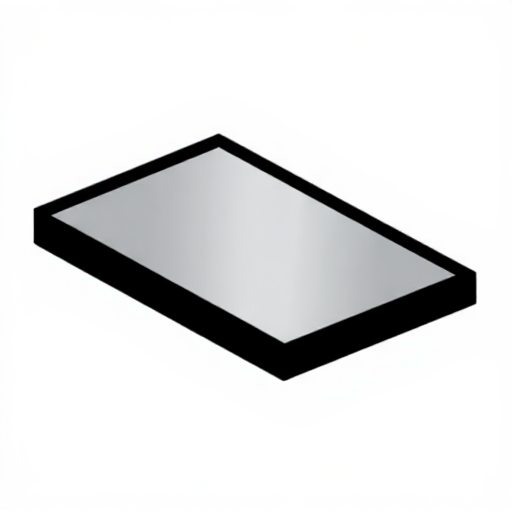 Bamba la chuma laini1 bottom, first ring
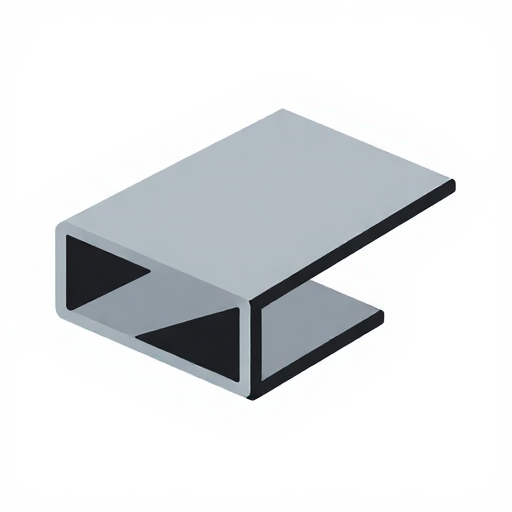 Chuma cha pembe cha chuma laini1 bottom angle
 Rivet za chuma cha pua1 kipande
 Nyenzo isiyojulikana1 asphalt paint
Zana zinazohitajika:
 Nyundo ya riveti
 Kipanua tundu cha mhunzi
 Maji
 Brashi pana ya rangi
5
5
Lower it and raise the shell
Lower it and raise the shell
Raise the tank on jacks round the edge, clear out the horses and debris, and lower the bottom to grade. Rivet and caulk the remaining rings from scaffolds: floating scaffolds where water is at hand (water is pumped in as each ring is caulked tight, testing as you go), or brackets bolted through punched holes, later plugged with hot rivets. Where three plates meet, bolt them, heat cherry red with an oil-burning torch and lay the joint up with sledges before riveting. Fit the top angle (2 1/2 x 2 1/2 x 5/16 in) and a flanged steel manhole in the bottom ring.
Vifaa kwa hatua hii:
Bamba la chuma laini1 ringsChuma cha pembe cha chuma laini1 top angleRivet za chuma cha pua1 kipandeZana zinazohitajika:
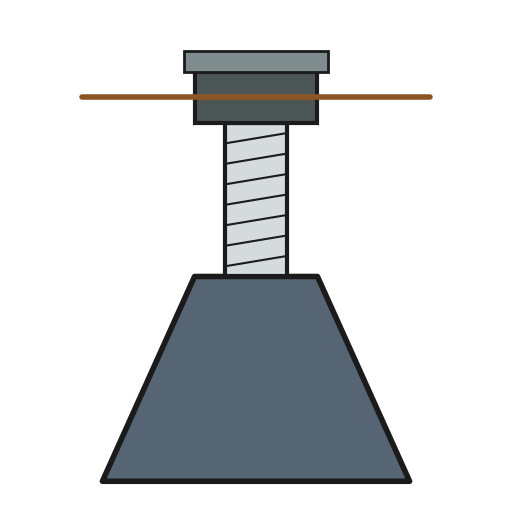 Jeki ya skrubuNyundo ya rivetiKipanua tundu cha mhunzi
 MwengeNyundo kubwaMaji
6
6
Fit the globe roof
Fit the globe roof
For tanks up to 54 ft across, rivet on a self-supporting globe roof of segmental 3/16 in plates (Fig. 158: sixteen plates, 1/4 in centre plate, 3 ft rise); cold riveting is fine here. Make it gas-tight, with one vent at the apex covered by brass or monel wire cloth of at least 50 mesh.
Vifaa kwa hatua hii:
Bamba la chuma laini1 roofRivet za chuma cha pua1 kipandeZana zinazohitajika:
Nyundo ya riveti7
7
Test and paint
Test and paint
Fill the tank with water to test it before painting; it shows the important leaks, though not always tightness for light oils. Wire-brush off mill scale and rust. Give shell and roof three coats: one of red lead ground in boiled linseed oil, then two of good grey graphite paint.
Vifaa kwa hatua hii:
 Risasi nyekundu1 first coat
 Mafuta ya Kitani Yaliyochemshwa1 kipandeNyenzo isiyojulikana2 grey graphite paint
Zana zinazohitajika:
Maji Seti ya brashi za wayaBrashi pana ya rangi
Vifaa
7- 1 as neededKishikilia Nafasi
- 1 roofKishikilia Nafasi
- 1 top angleKishikilia Nafasi
- 1 kipandeKishikilia Nafasi
- 2 grey graphite paintKishikilia Nafasi
- 1 first coatKishikilia Nafasi
- 1 kipandeKishikilia Nafasi
Zana Zinazohitajika
10- Kishikilia Nafasi
- Kishikilia Nafasi
- Kishikilia Nafasi
- Kishikilia Nafasi
- Kishikilia Nafasi
- Kishikilia Nafasi
- Kishikilia Nafasi
- Kishikilia Nafasi
- Kishikilia Nafasi
- Kishikilia Nafasi
Vifaa vya Michoro Iliyounganishwa
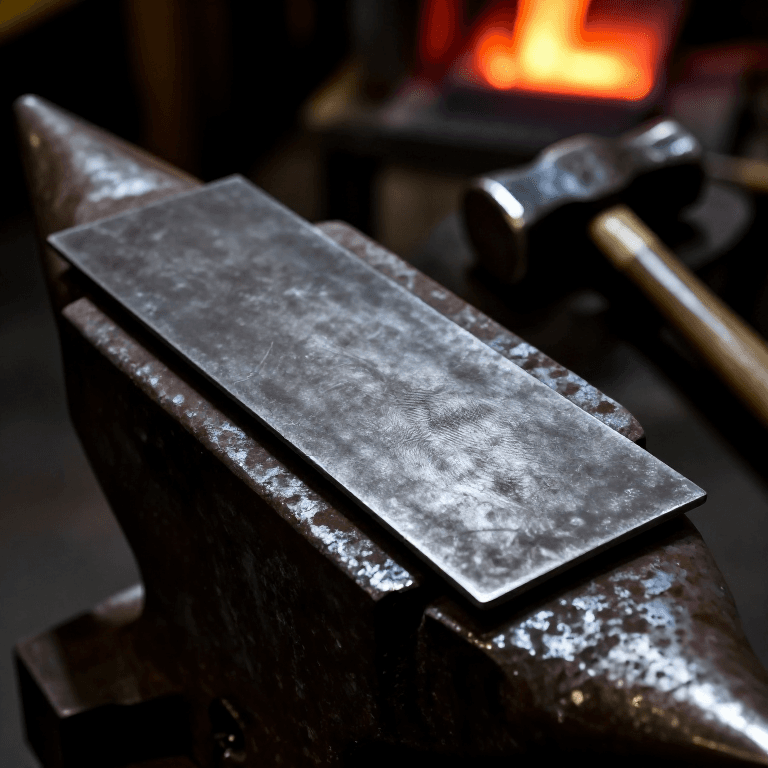
Usambazaji 10%
Mild Steel Plate and Sheet Hammered from a Billet
na Forge
Kisasa
41
0
0
0
5
0
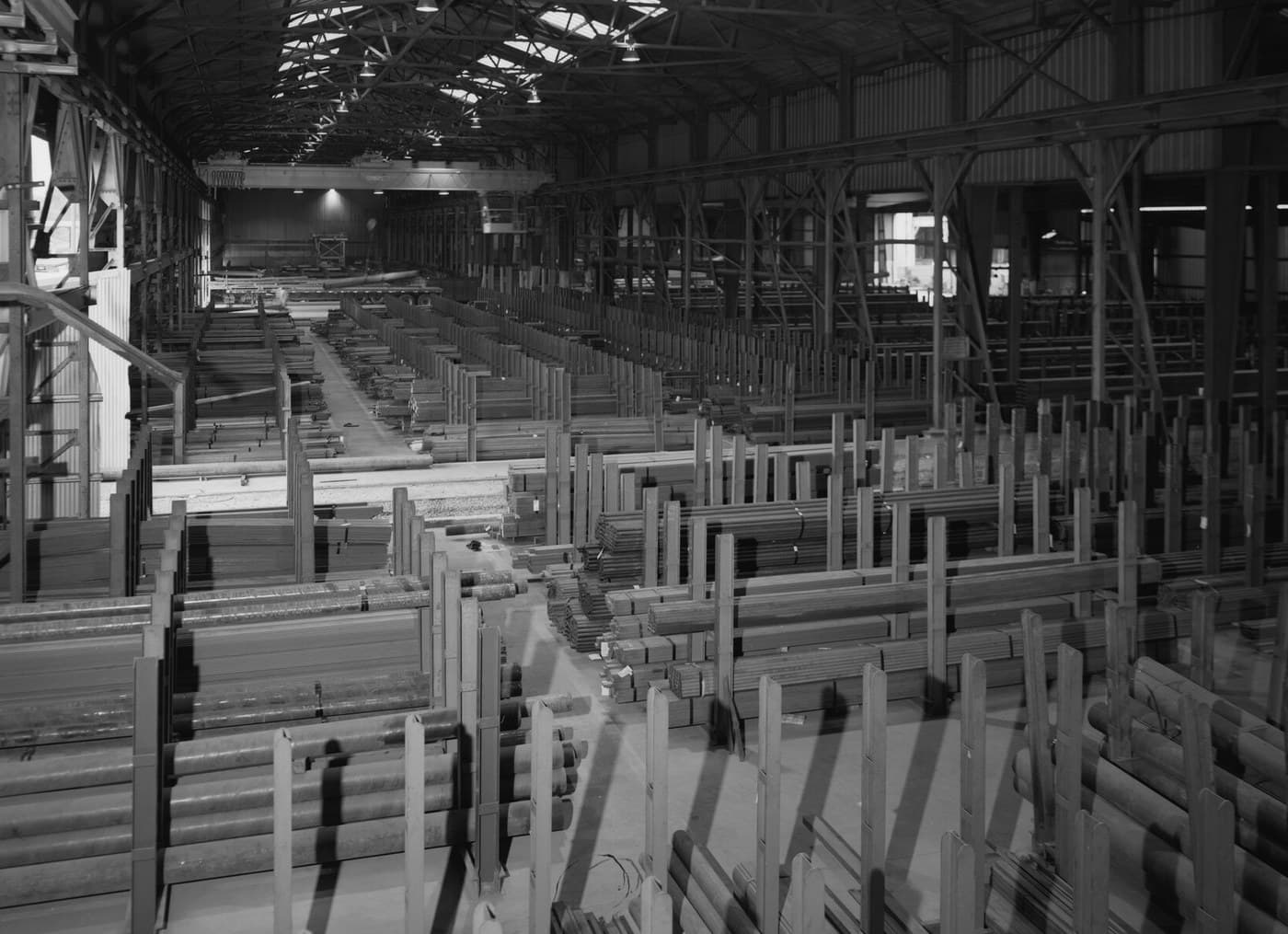
Usambazaji 10%
Hot-Rolled Steel Angles and Channels
na Forge
Uchimbaji chuma
27
0
0
0
2
0
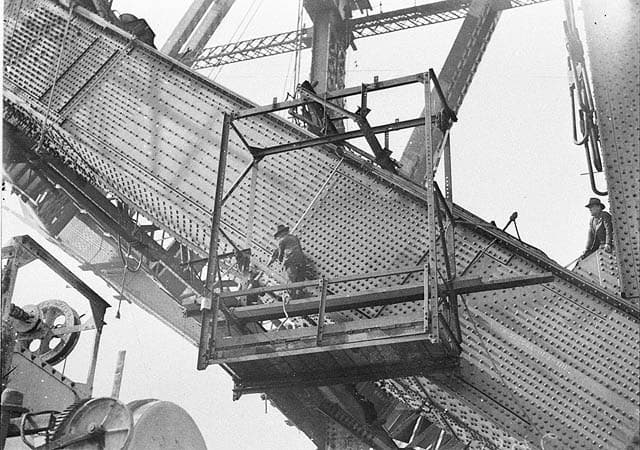
Usambazaji 10%
Steel Rivets Forged in a Nail Header
na Forge
Mhunzi
26
0
0
0
1
0

Hatari
Usambazaji 10%
Making Red Lead (Minium) — The Pigment That Named the Art of Miniature Painting
na Charlie
SANAA
117
0
0
0
2
0
Mchoro huu unatengeneza
CC0 Umma Wote
Mchoro huu umetolewa chini ya CC0. Uko huru kunakili, kubadilisha, kusambaza, na kutumia kazi hii kwa madhumuni yoyote, bila kuomba ruhusa.
Saidia Mtengenezaji kwa kununua bidhaa kupitia Mchoro wao ambapo wanapata Kamisheni ya Mtengenezaji iliyowekwa na Wachuuzi, au unda marudio mapya ya Mchoro huu na uiunganishe kama kiungo katika Mchoro wako kuchangia mapato.