
Ushirikiano
SANAA
UREMBO NA USTAWI
UJANJA
UTAMADUNI NA HISTORIA
BURUDANI
MAZINGIRA
CHAKULA NA VINYWAJI
UHANDISI WA KINYUME
SAYANSI
MICHEZO
TEKNOLOJIA
VAZI
Wishbone-Mast Ice Yacht: 16 ft Backbone, Twin-Pole Mast and Double Lateen Booms (Boy Mechanic, 1919)
Woody

Imeundwa na

Woody

13. Novemba 2026NO
7
0
0
0
0

Wishbone-Mast Ice Yacht: 16 ft Backbone, Twin-Pole Mast and Double Lateen Booms (Boy Mechanic, 1919)

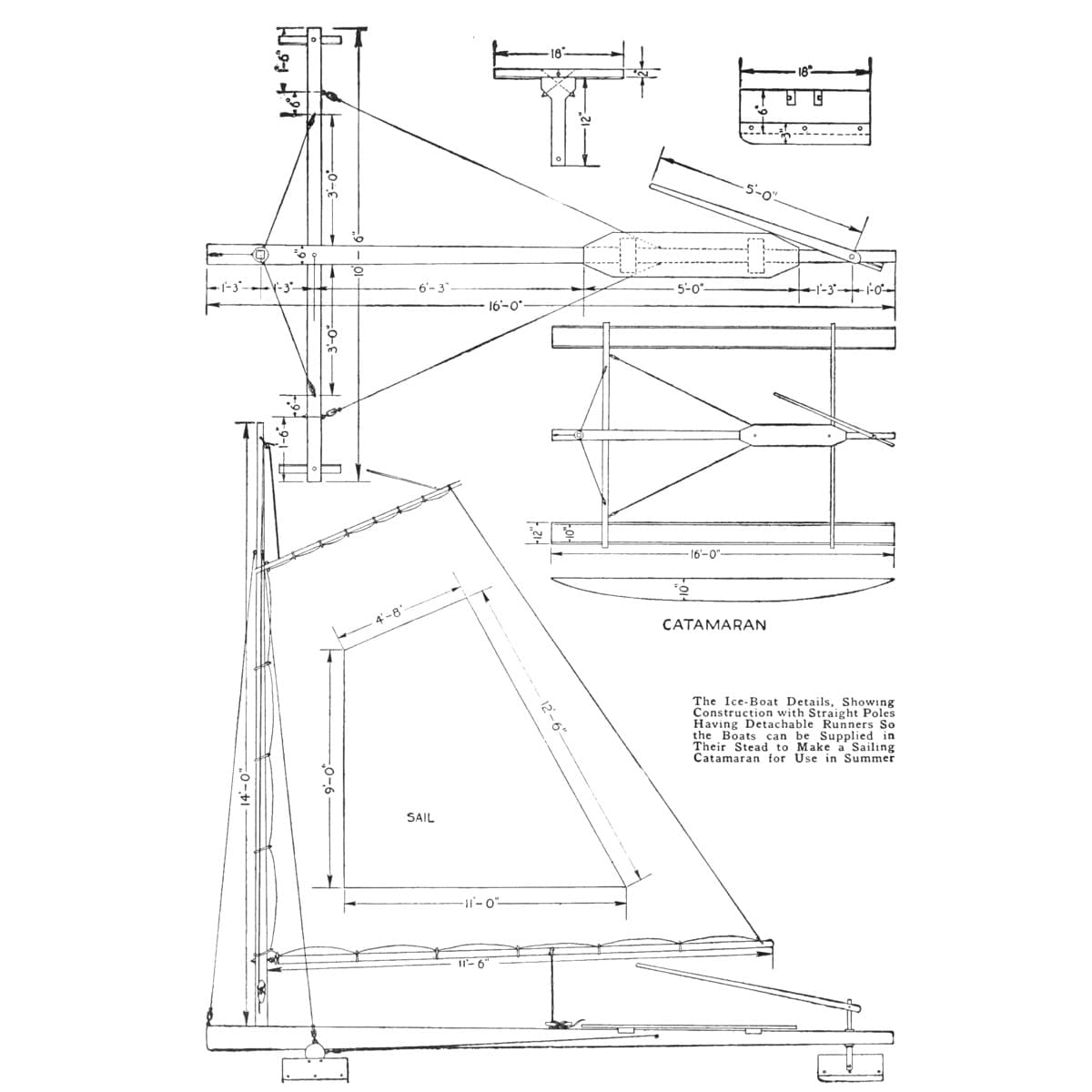
John F. Pjerrou's ice yacht from The Boy Mechanic, Book 3 (1919), for one or two passengers: a 16 ft spruce backbone on a 12 ft 6 in runner plank, oak runners shod with half-round iron, a mast of two 12 ft poles joined at the head, and two lateen sails on a yard and two 16 ft booms that spread into a V when running before the wind. It takes down for storage.
Juu
Several weeks

Maagizo

1

Main sizes and the mast's height

Inapakia daftari la Jupyter…
2

Read The Boy Mechanic, Book 3

"The dimensions given are for a small yacht, and care must be taken, in adapting the design, to maintain proper proportions for stability and safety."
3

Make the backbone and runner plank

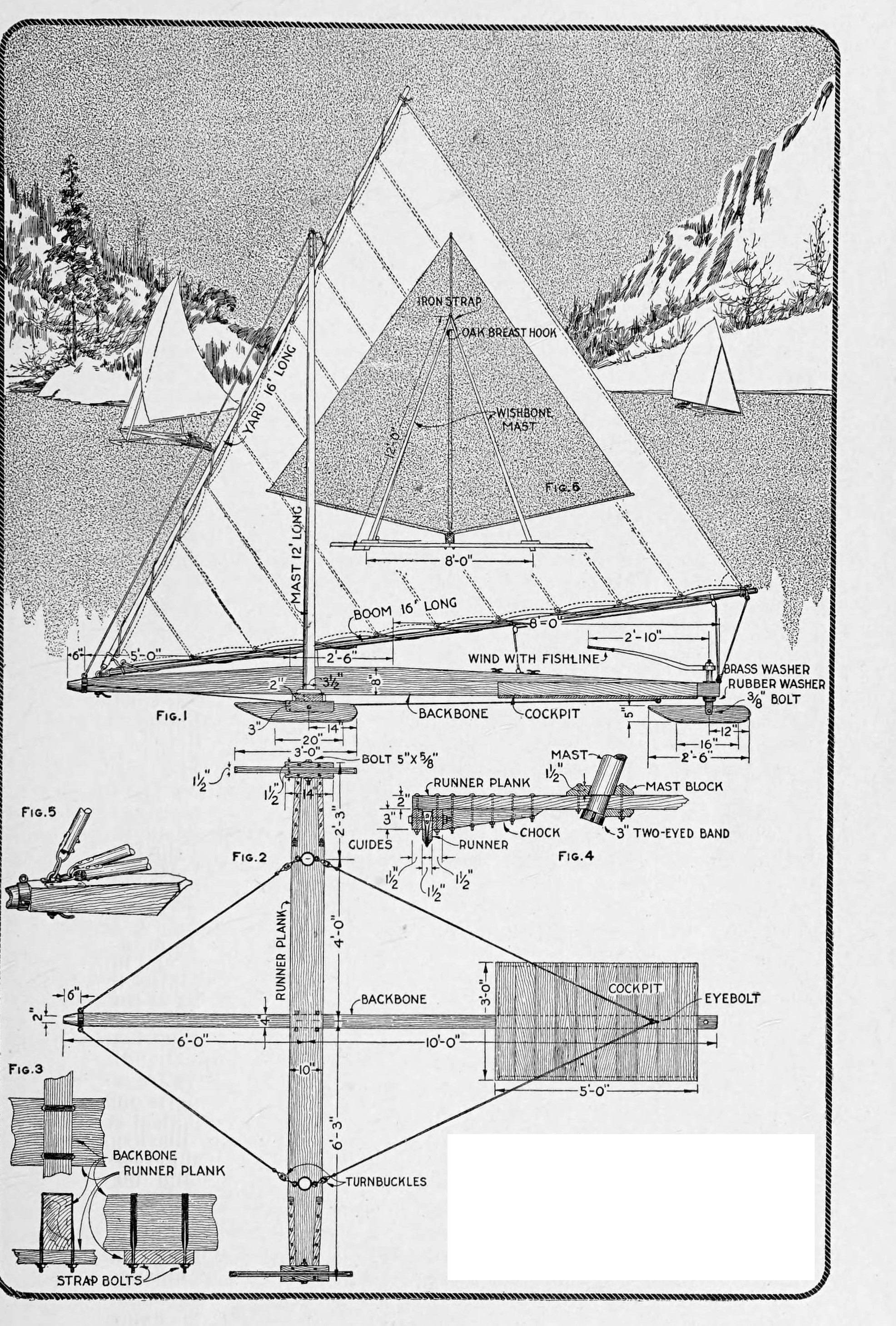
Use only the best straight-grained spruce or white pine. Backbone: 4 in thick, 16 ft long and 8 in high at the centre, with a ridge 8 in high and 2 ft 6 in long; taper it from the middle, 5 ft 6 in from the forward end, to 4 in at each end, and fit a three-eye metal ring at the bow (Figs. 1, 5). Runner plank: 2 in thick, 10 in wide, 12 ft 6 in long, tapered to 8 in at the ends. Set the backbone on the plank at right angles, 6 ft from the bow, and clamp them with two strap bolts, washers and nuts (Figs. 2, 3).

Vifaa kwa hatua hii:

Mbao za msonobariMbao za msonobari2 vipande
Pete ya metaliPete ya metali1 kipande
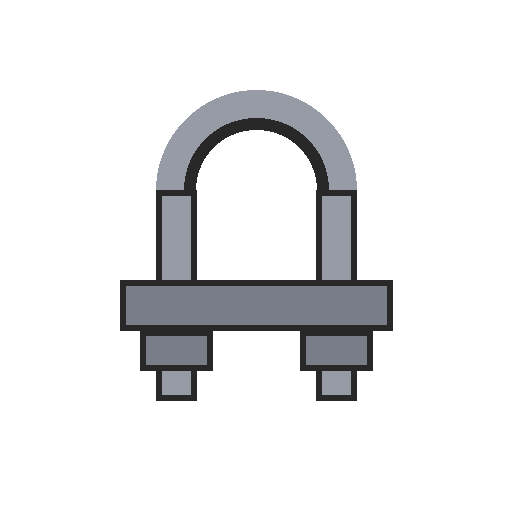
Bolti ya UBolti ya U2 vipande
Washa bapaWasha bapa4 vipande
Nati ya pembe sitaNati ya pembe sita4 vipande

Zana zinazohitajika:

Msumeno wa mkonoMsumeno wa mkono
Randa ya mkonoRanda ya mkono
Kisu cha KuvutaKisu cha Kuvuta
Kekee cha mkono chenye nchaKekee cha mkono chenye ncha
Spana inayoweza kurekebishwaSpana inayoweza kurekebishwa
Tepi ya kupimiaTepi ya kupimia
PenseliPenseli
4

Fit the guides and forward runners

Bolt guides of straight-grained oak, 1-1/2 by 3 by 14 in, to the plank ends with 5/16 in carriage bolts, and bolt oak chocks at each tapered edge (Fig. 4). Make the forward runners of oak, 1-1/2 by 5 by 36 in, shaped at the ends as drawn, and shoe them with half-round strap iron held by screws with carefully countersunk heads. Pivot them on 5/8 in bolts (5 in long in Fig. 1), nuts to the inner side, with washers and jam nuts, or rivet the bolt ends slightly so the nuts cannot work loose.

Vifaa kwa hatua hii:

Ubao wa mwaloni mweupeUbao wa mwaloni mweupe3 vipande
Bolti ya kichwa cha duaraBolti ya kichwa cha duara8 vipande
Upau wa chuma nusu duaraUpau wa chuma nusu duara2 vipande
Parafujo za mbaoParafujo za mbao1 kipande
Washa bapaWasha bapa4 vipande
Nati ya pembe sitaNati ya pembe sita4 vipande

Zana zinazohitajika:

Msumeno wa mkonoMsumeno wa mkono
Randa ya mkonoRanda ya mkono
Kekee cha mkono chenye nchaKekee cha mkono chenye ncha
Kekee cha mkonoKekee cha mkono
Seti ya Ncha za Kupanua MatunduSeti ya Ncha za Kupanua Matundu
Msumeno wa chumaMsumeno wa chuma
Spana inayoweza kurekebishwaSpana inayoweza kurekebishwa
5

Make the stern runner and steering

Make the stern runner of oak, 1-1/2 by 5 by 30 in, shod like the others. Pivot it on a 3/8 in bolt in a hanger of heavy iron strip bent into a U and riveted to a vertical shaft. Put a heavy rubber washer, protected by a metal one, on the shaft; thread its upper end for a washer and nut, slip a section of pipe over the shaft, and clamp the steering handle (2 ft 10 in in Fig. 1) on a squared part of the shaft. The hanger may be forged, or made by a blacksmith.

Vifaa kwa hatua hii:

Ubao wa mwaloni mweupeUbao wa mwaloni mweupe1 kipande
Upau wa chuma nusu duaraUpau wa chuma nusu duara1 kipande
Pau Bapa la Chuma LainiPau Bapa la Chuma Laini1 kipande
Ufito mviringo wa chuma lainiUfito mviringo wa chuma laini1 kipande
Rivet za chumaRivet za chuma2 vipande
Bolti ya kichwa cha duaraBolti ya kichwa cha duara1 kipande
Washa ya mpiraWasha ya mpira1 kipande
Washa bapaWasha bapa2 vipande
Nati ya pembe sitaNati ya pembe sita2 vipande
Bomba la chuma lililopakwa zinkiBomba la chuma lililopakwa zinki1 kipande

Zana zinazohitajika:
Jiko la KufuaJiko la Kufua
FuaweFuawe
NyundoNyundo
Kibano cha meza ya kaziKibano cha meza ya kazi
Msumeno wa chumaMsumeno wa chuma
Kekee cha mkonoKekee cha mkono
Tupa (Tupa ya Mkono)Tupa (Tupa ya Mkono)
Spana inayoweza kurekebishwaSpana inayoweza kurekebishwa
6

Build the cockpit

Fix a cockpit 5 ft long and 3 ft wide, with 4 in coaming, to the lower side of the backbone toward the stern; fasten its floor to the backbone with lag screws and fasten the coaming securely. Square corners are easiest; rounded ends with steamed, bent coaming are better. Larger craft may carry it on ribs.

Vifaa kwa hatua hii:

Ubao wa msonobariUbao wa msonobari4 vipande
Skrubu nzito ya mbao (lag)Skrubu nzito ya mbao (lag)6 vipande
Parafujo za mbaoParafujo za mbao1 kipande

Zana zinazohitajika:

Msumeno wa mkonoMsumeno wa mkono
Kekee cha mkono chenye nchaKekee cha mkono chenye ncha
Spana inayoweza kurekebishwaSpana inayoweza kurekebishwa
Tepi ya kupimiaTepi ya kupimia
7

Square up and stay the frame

Line up runners, plank and backbone at right angles so the craft tracks true. Hold them with four 1/4 in wire-rope stays with turnbuckles, from eyes on the bow band and on the bands at the plank ends to an eyebolt below the cockpit (Fig. 2). Loop each rope end and clamp the eye with steel clamps made for the purpose (wire-rope clips); metal thimbles in the loops make a better finish.

Vifaa kwa hatua hii:

Kamba ya waya wa chumaKamba ya waya wa chuma1 kipande
Kikaza kamba (turnbuckle)Kikaza kamba (turnbuckle)4 vipande
SubanaSubana8 vipande
Kibano cha kamba ya wayaKibano cha kamba ya waya8 vipande
Bolti yenye jichoBolti yenye jicho1 kipande

Zana zinazohitajika:

Msumeno wa chumaMsumeno wa chuma
Spana inayoweza kurekebishwaSpana inayoweza kurekebishwa
Tepi ya kupimiaTepi ya kupimia
8

Make the wishbone mast

Shape two poles of hickory or ash, 3-1/2 in thick at the base and 2 in at the top (12 ft in Fig. 6). Join them carefully at the masthead, bolt them together into an oak breast hook, and reinforce the joint with an iron strap with an eye at its upper end for the forward stay. Step the lower ends in sockets in the runner plank, about 8 ft apart, reinforced with oak mast blocks, and fit their projecting ends with 3 in two-eyed bands for the stays (Figs. 4, 6).

Vifaa kwa hatua hii:

Mti wa mbaoMti wa mbao2 vipande
Ubao wa mwaloni mweupeUbao wa mwaloni mweupe1 kipande
Pau Bapa la Chuma LainiPau Bapa la Chuma Laini1 kipande
Bolti ya kichwa cha duaraBolti ya kichwa cha duara2 vipande
Nati ya pembe sitaNati ya pembe sita2 vipande

Zana zinazohitajika:

Kisu cha KuvutaKisu cha Kuvuta
Randa ya mkonoRanda ya mkono
Msumeno wa mkonoMsumeno wa mkono
Kekee cha mkono chenye nchaKekee cha mkono chenye ncha
PatasiPatasi
Jiko la KufuaJiko la Kufua
FuaweFuawe
NyundoNyundo
9

Make the yard and booms

Make the yard and two booms of hickory or ash, each 16 ft long, 2-3/4 in at the middle tapering to 1-1/2 in at the ends, with metal rings on the ends against splitting. Bolt loops to their forward ends to engage an eyebolt and ring on the backbone at the bow; set the eyebolt in a slotted plate of 3/16 in sheet iron, fastened by a lever nut (Fig. 5).

Vifaa kwa hatua hii:

Mti wa mbaoMti wa mbao3 vipande
Pete ya metaliPete ya metali6 vipande
Bolti yenye jichoBolti yenye jicho1 kipande
Bati la Chuma LainiBati la Chuma Laini1 kipande
Pau Bapa la Chuma LainiPau Bapa la Chuma Laini1 kipande
Bolti ya kichwa cha duaraBolti ya kichwa cha duara3 vipande
Nati ya pembe sitaNati ya pembe sita3 vipande

Zana zinazohitajika:

Kisu cha KuvutaKisu cha Kuvuta
Randa ya mkonoRanda ya mkono
Msumeno wa chumaMsumeno wa chuma
Kekee cha mkonoKekee cha mkono
Tupa (Tupa ya Mkono)Tupa (Tupa ya Mkono)
Kibano cha meza ya kaziKibano cha meza ya kazi
10

Sew the sails

Make two lateen sails of 8-oz unbleached cotton duck: lap the breadths about 1 in and stitch along the edge (or fold 1 in and double-stitch), the seams parallel to the leech. Reinforce each corner with a triangular patch of duck and bind the edges with 1/4 in tarred rope, using a sailor's palm, a diamond-pointed needle and sail twine, well waxed (the wax is ours: beeswax). Along the yard and boom edges punch holes, set two 3/4 in brass grommet rings in each, one each side, and overcast them with buttonhole stitch. Sew in reef points of 1/8 in cotton rope, whipped at the ends.

Vifaa kwa hatua hii:

Kitambaa cha kanvasiKitambaa cha kanvasi1 kipande
Uzi wa matangaUzi wa matanga1 kipande
Nta ya NyukiNta ya Nyuki1 kipande
Kamba iliyopakwa lamiKamba iliyopakwa lami1 kipande
Tundu la shaba (grommet)Tundu la shaba (grommet)40 vipande
Kamba nene ya pambaKamba nene ya pamba1 kipande

Zana zinazohitajika:
Kinga ya kiganja ya mshona matangaKinga ya kiganja ya mshona matanga
Sindano ya matangaSindano ya matanga
Kitoboa karatasiKitoboa karatasi
MkasiMkasi
Tepi ya kupimiaTepi ya kupimia
11

Set up and rig

Fit the forward ring and strap bolts, the runners and steering, then step the mast, clamp the masthead and fit the bands; set the bottom stays and the masthead stay with the turnbuckles. Lace the sails to yard and booms and fix the forward ends at the bow. Run a 3/8 in halyard from the yard through a pulley at the masthead and a second on the runner plank to cleats by the cockpit, and haul up so the sails set. Lash the main sheets to the boom ends, through pulleys at the stern of the backbone and on the booms about 1 ft and 5 ft from their ends, then to cleats at the cockpit; the second boom needs a duplicate set. Taking down is the reverse.

Vifaa kwa hatua hii:

KambaKamba1 kipande
KapiKapi6 vipande
Kifungio cha kamba (cleat)Kifungio cha kamba (cleat)4 vipande
Parafujo za mbaoParafujo za mbao1 kipande

Zana zinazohitajika:

Spana inayoweza kurekebishwaSpana inayoweza kurekebishwa
Kekee cha mkonoKekee cha mkono
12

Finish

Smooth the masts, yard and booms, sandpaper them lightly and give them several coats of spar varnish; paint the other woodwork. He gives the metal fittings two coats of red lead "or other good paint for use on metals exposed to the weather": red lead is a lead poison, so use the other paint.

Vifaa kwa hatua hii:

Sandarusi (karatasi ya kusugua)Sandarusi (karatasi ya kusugua)1 kipande
Varnishi ya milingotiVarnishi ya milingoti1 kipande
Rangi ya mafutaRangi ya mafuta1 kipande

Zana zinazohitajika:
Brashi pana ya rangiBrashi pana ya rangi
13

Sailing and troubleshooting

Ice yacht sailing.

Flow

Loading...
14

History and honest limits

From "A Wishbone-Mast Ice Yacht" by John F. Pjerrou, in **The Boy Mechanic, Book 3**, Popular Mechanics, 1919 (Project Gutenberg 71856; checked on the archive.org scan boymechanic0003unse, pp. 17-20). He gives no sail outline sizes. The tools, the metric figures and the choice of the non-lead paint he allows are ours.

Vifaa

35

Zana Zinazohitajika

21

CC0 Umma Wote

Mchoro huu umetolewa chini ya CC0. Uko huru kunakili, kubadilisha, kusambaza, na kutumia kazi hii kwa madhumuni yoyote, bila kuomba ruhusa.

Saidia Mtengenezaji kwa kununua bidhaa kupitia Mchoro wao ambapo wanapata Kamisheni ya Mtengenezaji iliyowekwa na Wachuuzi, au unda marudio mapya ya Mchoro huu na uiunganishe kama kiungo katika Mchoro wako kuchangia mapato.

Majadiliano

(0)

Ingia kujiunga na majadiliano

Inapakia maoni...