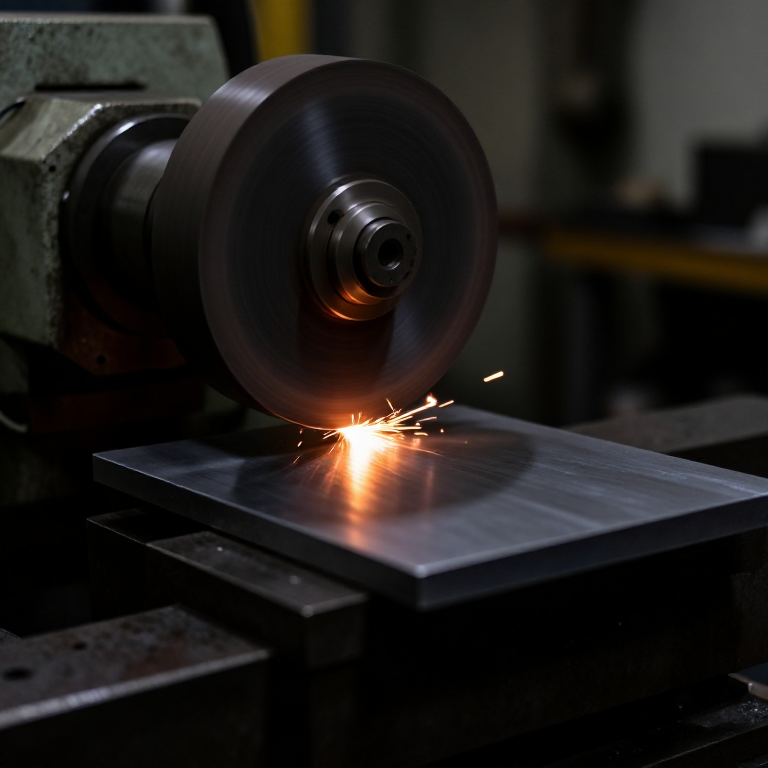


Surface Grinder
Maagizo
Build a rigid table on straight ways
Build a rigid table on straight ways
Grinding removes little metal, so every error in the machine shows in the work.
- Build a bed 400 × 200 mm from 18 mm ply with aluminium angle ways.
- Make a table that slides back and forth on those ways, driven by hand or by a leadscrew.
- Fix the ways with M5 × 30 socket head cap screws × 8, M5 flat washers × 16 and M5 hex nuts × 8.
- Check the table stays at a constant height along its whole travel using a dial indicator against a fixed reference.
Height variation along the travel is copied directly into the work. A planer taking a 0.3 mm cut can tolerate a few hundredths of way error; a grinder taking 0.01 mm cannot. This is the same slideway problem the planer solved, now at a tolerance a hundred times tighter — which is why surface grinders arrive decades later, once planers and scraping could produce ways good enough.
Measure the table height at ten points along the travel and plot it. That plot is your machine's accuracy limit, and no amount of careful grinding will beat it.Vifaa kwa hatua hii:
 Bati la mbao za kubandika1 karatasi
 Pembe ya alumini2 vipande
 Washa bapa16 vipande
 Nati ya pembe sita8 vipande
Zana zinazohitajika:
 Msumeno wa Kupinda
 Kekee cha Betri
 Seti ya vichimbuzi
 Seti ya funguo za pembe sita
 Skwea ya mchanganyiko
 Kipima-unene cha dijitali cha inchi 6
Mount the wheelhead with fine vertical feed
Mount the wheelhead with fine vertical feed
Depth of cut is measured in hundredths, so the feed screw must resolve it.
- Mount a 100 mm grinding wheel on a spindle in two 608 bearings, in a head that slides vertically on the column.
- Feed it with an M8 screw — 1.25 mm pitch, so one turn is 1.25 mm.
- Fit a handwheel with 50 divisions, giving 0.025 mm per division.
- Take up backlash by always approaching the work in the same direction.
Work out your resolution before you rely on it. A 50-division dial on a 1.25 mm pitch screw resolves 25 microns per division, which is coarse for grinding — real machines use a finer pitch or a larger dial to reach a micron or two. Knowing the number matters more than the number itself: it tells you what the machine can and cannot promise.
Always approach in one direction. Backlash in a threaded feed means a reversal moves the dial without moving the wheel, and the dial then lies to you by the full amount of the slack.Vifaa kwa hatua hii:
 Fani ya Mipira2 vipande
 Ufito wa mviringo wa alumini1 kipandeBati la mbao za kubandika1 karatasiWasha bapa8 vipandeNati ya pembe sita4 vipande
Zana zinazohitajika:
Kekee cha BetriSeti ya vichimbuzi Seti ya tupaSeti ya funguo za pembe sitaKipima-unene cha dijitali cha inchi 6
 Kigwe cha Katikati
Make a workholding chuck and dress the wheel
Make a workholding chuck and dress the wheel
Thin work must be held without being bent, and the wheel must be true and open.
- Make a fixture plate with clamps, or fit permanent magnets under a thin steel plate as a simple magnetic chuck.
- Ensure the holding surface is itself flat — grind it in place if you can.
- Dress the wheel with a diamond or a dressing stick, traversing steadily across its face.
- Re-dress whenever the wheel glazes or the work starts to burn.
Why a magnetic chuck rather than clamps. A clamp squeezes thin work, you grind it flat while distorted, and it springs back curved when released. A magnet pulls it evenly against a flat surface and imposes no bending. That distinction — hold without distorting — is the central problem of precision workholding.
Dressing does two things at once: it trues the wheel's shape and it fractures away loaded grains to expose sharp ones. A glazed wheel rubs rather than cuts, and rubbing means heat, and heat means the hardened part you are grinding gets softened exactly where it matters.Vifaa kwa hatua hii:
 Bamba la Alumini1 kipande
 Ubao bapa wa alumini1 kipande
 Skrubu Yenye Kichwa cha Soketi4 vipandeWasha bapa8 vipande
Zana zinazohitajika:
Kekee cha BetriSeti ya vichimbuziSeti ya tupaSeti ya funguo za pembe sitaKipima-unene cha dijitali cha inchi 6Skwea ya mchanganyikoGrind, and find the point where heat takes over
Grind, and find the point where heat takes over
Grinding is a heat process disguised as a cutting process. Find the boundary.
- Take passes at 0.01 mm depth across a test piece and note the finish.
- Increase to 0.05 mm and watch the surface colour and the sound.
- Increase again until the work discolours — straw, then blue.
- Stop, let it cool, and measure the flatness of each region.
Vifaa kwa hatua hii:
Ubao bapa wa alumini1 kipandeZana zinazohitajika:
Kipima-unene cha dijitali cha inchi 6Skwea ya mchanganyiko Saa ya kupima muda
Why hardened parts changed everything, and history
Why hardened parts changed everything, and history
Precision grinding developed through the second half of the nineteenth century and became a production process once artificial abrasives arrived — carborundum in 1891 and aluminium oxide shortly after, both already in this catalogue. Natural emery was variable and slow; manufactured grit made grinding predictable enough to be scheduled rather than hoped for.
The reason it mattered is heat treatment. Harden a steel part and it warps: a ground flat surface goes convex, a bore goes oval, a shaft bends. Before grinding, the answer was to make the part slightly wrong, harden it, and then have a fitter scrape and lap it back — expensive, slow and dependent on skill. Grinding let a part be machined soft, hardened, and then finished to size on a machine. That sequence is the foundation of modern manufacturing, and it is why interchangeable hardened parts became possible at all.
Its place in this chain. The planer of 1817 made flat surfaces on soft metal. This machine makes them on hard metal, to a finer tolerance, at the cost of removing metal far more slowly. The two are not competitors: work is planed or milled first, hardened, then ground. Each machine occupies a different point in the sequence, which is the more useful way to see a workshop than as a set of alternatives.
Honest limits: slow metal removal, a wheel that must be dressed and eventually replaced, sensitivity to heat, and an absolute dependence on the machine's own slideway accuracy. And this plywood build will demonstrate the method while achieving nothing like real grinder accuracy — the lesson is the process and its heat limit, not the tolerance.
Vifaa
10- 1 karatasiKishikilia Nafasi
- 2 vipandeKishikilia Nafasi
- 24 vipandeKishikilia Nafasi
- 12 vipandeKishikilia Nafasi
- Kishikilia Nafasi
- 1 kipandeKishikilia Nafasi
- 1 kipandeKishikilia Nafasi
- 1 kipandeKishikilia Nafasi
- 4 vipandeKishikilia Nafasi
- 8 vipandeKishikilia Nafasi
Zana Zinazohitajika
9- 1 vendor sell this, none ship to you yetKishikilia Nafasi
- 1 vendor sell this, none ship to you yetKishikilia Nafasi
- Kishikilia Nafasi
- Kishikilia Nafasi
- Kishikilia Nafasi
- Kishikilia Nafasi
- Kishikilia Nafasi
- Kishikilia Nafasi
- Kishikilia Nafasi
Blueprint zinazohusiana
Blueprint hizi zinashiriki maarifa — mbinu, vifaa au kanuni

CC0 Umma Wote
Mchoro huu umetolewa chini ya CC0. Uko huru kunakili, kubadilisha, kusambaza, na kutumia kazi hii kwa madhumuni yoyote, bila kuomba ruhusa.
Saidia Mtengenezaji kwa kununua bidhaa kupitia Mchoro wao ambapo wanapata Kamisheni ya Mtengenezaji iliyowekwa na Wachuuzi, au unda marudio mapya ya Mchoro huu na uiunganishe kama kiungo katika Mchoro wako kuchangia mapato.