SANAA
UREMBO NA USTAWI
UJANJA
UTAMADUNI NA HISTORIA
BURUDANI
MAZINGIRA
CHAKULA NA VINYWAJI
UHANDISI WA KINYUME
SAYANSI
MICHEZO
TEKNOLOJIA
VAZI
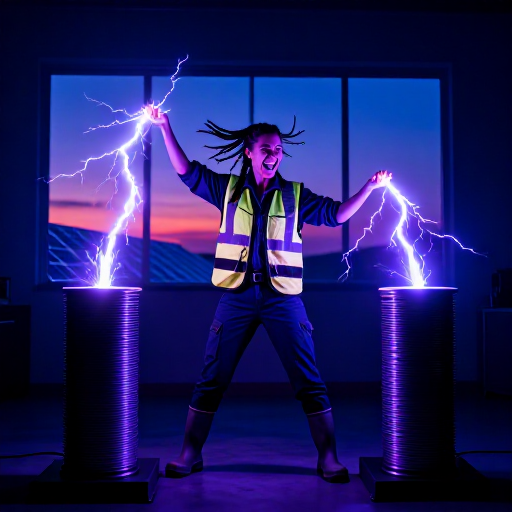

The Savonius Rotor: Two Hollow Vanes, Any Wind, Always Starts
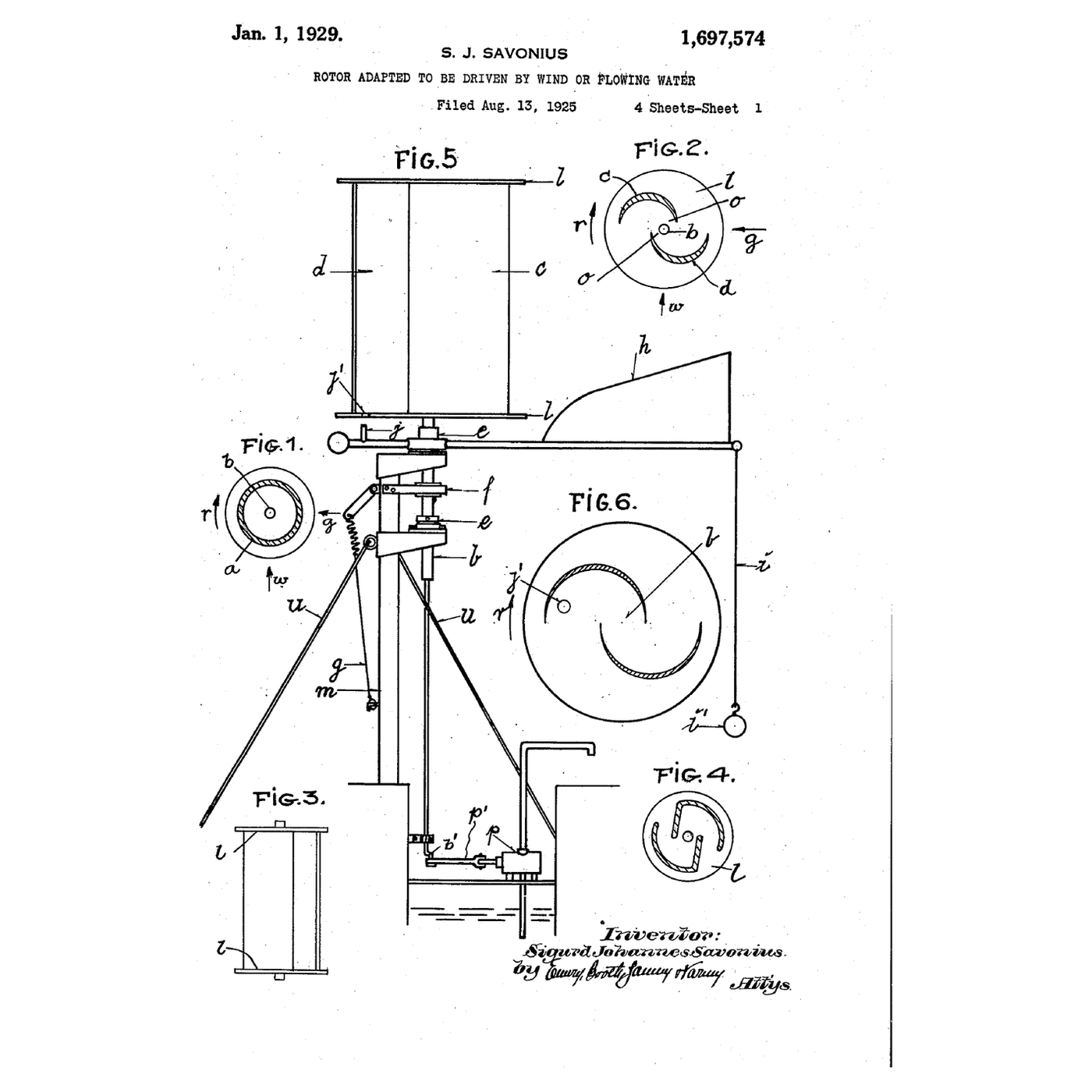
Cut a cylinder in half lengthwise, slide the halves apart so they overlap, and stand them on a vertical shaft: that is the rotor Sigurd Savonius of Finland patented in 1924–29. The wind pushes harder on the hollow of one vane than on the back of the other, and air flowing through the overlap from one hollow into the other helps it along.
It turns in wind from any direction without steering, starts itself in the lightest breeze, and gives strong torque at low speed — for pumping water, ventilating, or driving a current meter. It is also slow and inefficient, because it is pushed by drag.
This rung works out the drag machine's ceiling and builds a Savonius rotor from a PVC pipe, measuring its torque with a string brake.
Mwanzo
About 4 hours
Maagizo
1
1
Read Savonius's overlap
Read Savonius's overlap
US 1,697,574, 'Rotor Adapted to be Driven by Wind or Flowing Water', Sigurd J. Savonius. The vanes are *"hollow-shaped"* and *"overlapping"*, so that the space between them forms an air passage *"from the hollow side of the vane d, to the hollow side of the other vane c"*. His text compares it with the rotating cylinder then being studied at the Aerodynamische Versuchsanstalt in Göttingen, which it cites.
The overlap is the detail that separates a Savonius rotor from two cups on a stick.
2
2
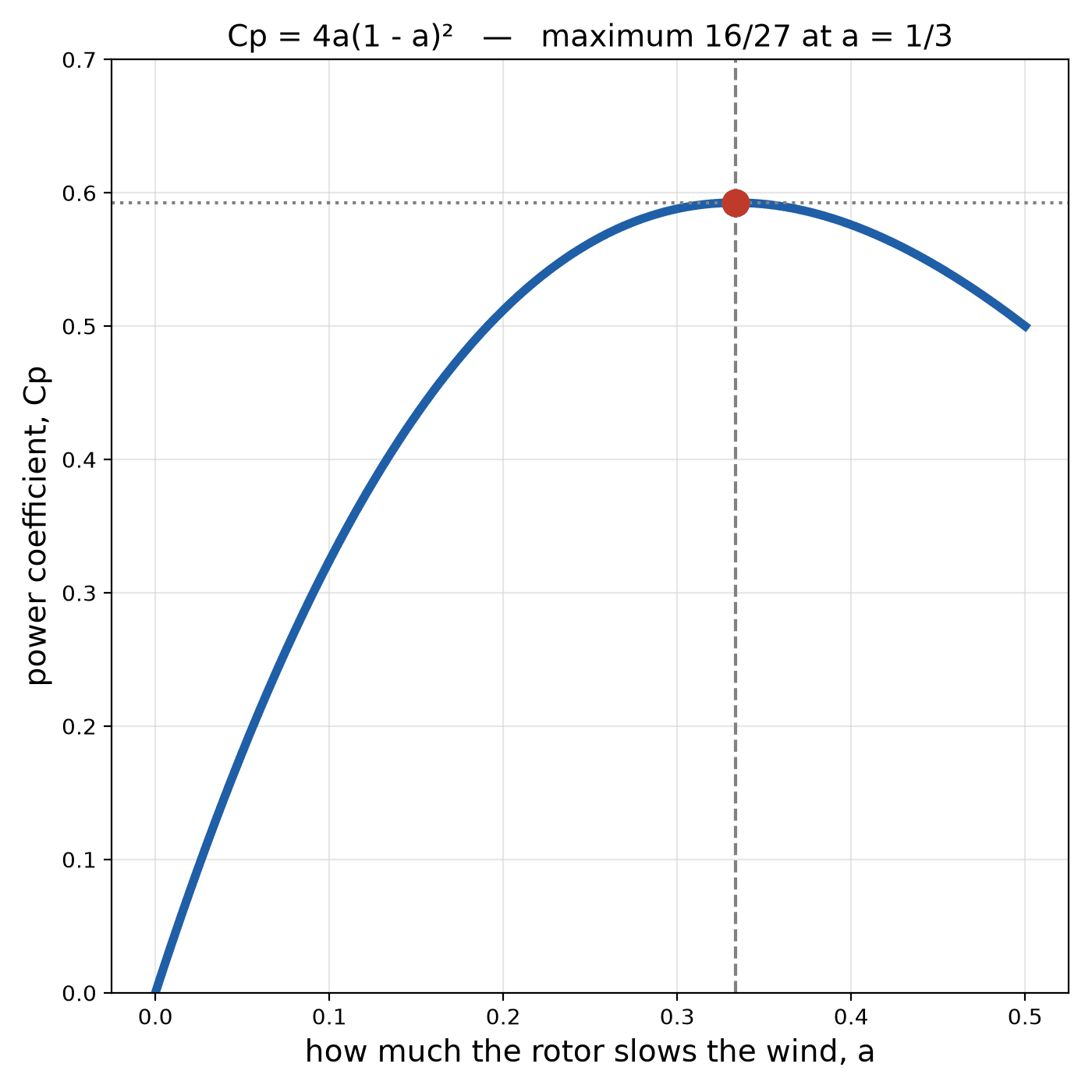
The drag machine's ceiling
The drag machine's ceiling
Inapakia daftari la Jupyter…
3
3
Build it from a PVC pipe
Build it from a PVC pipe
Cut a 300 mm length of 110 mm PVC pipe in half lengthwise with a saw. Cut two plywood end discs 240 mm across. Screw the two half-pipes between the discs, hollow faces opposite, each shifted towards the centre so they **overlap by about a fifth of a half-pipe's width**, leaving the air passage Savonius describes.
Run a threaded-rod shaft through the centre of both discs, held by nuts, and carry it vertically in two skateboard bearings in a plywood frame.
Vifaa kwa hatua hii:
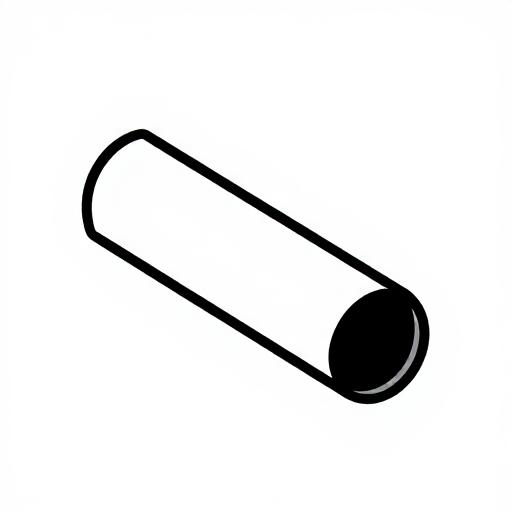 Bomba la PVC1 kipande
 Bati la mbao za kubandika1 karatasi
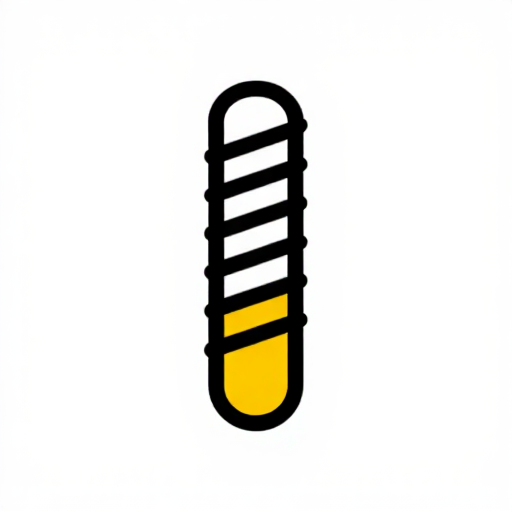 Fimbo yenye nyuzi1 kipande
 Fani ya Mipira2 vipande
 Skrubu za mashine12 vipande
Zana zinazohitajika:
 Kekee cha Betri
 Seti ya vichimbuzi
 Spana inayoweza kurekebishwa
 Rula
 Kikata Bomba
4
4
Measure torque with a string brake
Measure torque with a string brake
Wrap fishing line once round the shaft. Tie one end to the spring scale fixed to the frame, and hang a small weight on the other end, so the line rubs on the turning shaft as a brake. The braking torque is **(weight − scale reading) × shaft radius**.
Put the rotor in front of the box fan. Start with a light weight: the rotor spins fast. Add weight step by step, reading the speed with the tachometer and the scale each time, until it stalls. Power = torque × angular speed.
Turn the rotor to face the wind at a different angle: it does not care. Start the fan at its lowest setting with the rotor stopped: it starts by itself. Those two facts are why Savonius rotors exist.
Vifaa kwa hatua hii:
 Mshipi wa kuvulia (uzi mmoja)1 rolii
 Uzani1 seti
Zana zinazohitajika:
 Feni ya kisanduku (kasi inayobadilika)
 Kipima upepo cha mkononi
 Kipimamzunguko cha Dijitali
 Kipima-nguvu (mizani ya springi)
 Kipima-unene cha dijitali cha inchi 6
5
5
History and context
History and context
**US 1,697,574, 'Rotor Adapted to be Driven by Wind or Flowing Water', Sigurd J. Savonius; filed 13 August 1925 (Serial 49,985), claiming a Finnish filing of 12 December 1924; granted 1 January 1929.** The title names water as well as wind: the same rotor turns in a current.
**Honest limits.** Low efficiency — a drag machine cannot beat the notebook's ceiling by much. Heavy for its power, because the whole swept area is solid vane. Its torque pulses twice per turn, which is why many are built as two stages twisted 90° apart, or with helical vanes.
Vifaa
7- 1 kipandeKishikilia Nafasi
- 1 karatasiKishikilia Nafasi
- 1 kipandeKishikilia Nafasi
- Kishikilia Nafasi
- 12 vipandeKishikilia Nafasi
- Kishikilia Nafasi
- 1 setiKishikilia Nafasi
Zana Zinazohitajika
10- 1 vendor sell this, none ship to you yetKishikilia Nafasi
- Kishikilia Nafasi
- Kishikilia Nafasi
- Kishikilia Nafasi
- Kikata BombaKamisheni 10%Kishikilia Nafasi
- Kishikilia Nafasi
- Kishikilia Nafasi
- Kishikilia Nafasi
- Kishikilia Nafasi
- Kishikilia Nafasi
Blueprint zinazohusiana
Blueprint hizi zinashiriki maarifa — mbinu, vifaa au kanuni
CC0 Umma Wote
Mchoro huu umetolewa chini ya CC0. Uko huru kunakili, kubadilisha, kusambaza, na kutumia kazi hii kwa madhumuni yoyote, bila kuomba ruhusa.
Saidia Mtengenezaji kwa kununua bidhaa kupitia Mchoro wao ambapo wanapata Kamisheni ya Mtengenezaji iliyowekwa na Wachuuzi, au unda marudio mapya ya Mchoro huu na uiunganishe kama kiungo katika Mchoro wako kuchangia mapato.