SANAA
UREMBO NA USTAWI
UJANJA
UTAMADUNI NA HISTORIA
BURUDANI
MAZINGIRA
CHAKULA NA VINYWAJI
UHANDISI WA KINYUME
SAYANSI
MICHEZO
TEKNOLOJIA
VAZI
Understanding Rhodium from Platinum Group Ore — The Most Expensive Industrial Metal
Kati
Maagizo
1
1
Understand Rhodium's Discovery
Understand Rhodium's Discovery
William Hyde Wollaston discovered rhodium in 1803 while working with crude platinum ore from South America. After dissolving platinum in aqua regia and precipitating it out, a rose-red solution remained — he named the new element rhodium from Greek 'rhodon' (rose) after the color of its salts. Wollaston also discovered palladium the same year, both extracted from the same platinum residue. He kept his methods secret for years to maintain commercial advantage.
2
2
Identify Rhodium in Platinum Group Deposits
Identify Rhodium in Platinum Group Deposits
Rhodium occurs at just 0.001 ppm in Earth's crust — one of the rarest elements. It is found only as a minor component of platinum group deposits, primarily in the Bushveld Complex (South Africa), the Norilsk-Talnakh deposits (Russia), and the Stillwater Complex (Montana). Rhodium concentrates in the UG2 chromitite layer rather than the Merensky Reef. South Africa produces approximately 80% of global supply — about 25 tonnes annually.
Vifaa kwa hatua hii:
 Sampuli ya kundi la platinamu
Zana zinazohitajika:
 Kioo cha kukuza cha mkono 10xKioo cha kukuza cha mkono 10x
 Bamba la mstari (kaure isiyong'arishwa)
 Ncha za Ugumu wa Mohs
3
3
Trace Rhodium Separation from Other PGMs
Trace Rhodium Separation from Other PGMs
Rhodium is the most difficult platinum group metal to refine because it resists dissolution in all single acids, including aqua regia at room temperature. After removing platinum and palladium, the residue is fused with sodium bisulfate at 500°C to form soluble rhodium sulfate. Alternatively, chlorine gas at high temperature converts rhodium to soluble RhCl₃. Multiple precipitation and redissolution cycles achieve 99.9% purity over several weeks.
4
4
Examine Rhodium Metal Properties
Examine Rhodium Metal Properties
Rhodium is a hard, silvery-white metal with the highest reflectance of any metal — it reflects 80% of visible light compared to silver's 95%, but unlike silver, rhodium never tarnishes. Melting point is 1964°C, density 12.41 g/cm³, and Mohs hardness 6. It has excellent electrical conductivity and the lowest electrical resistivity of any platinum group metal. Rhodium is completely inert to atmospheric corrosion at any temperature.
Zana zinazohitajika:
 Miwani ya usalama iliyofungwa
5
5
Understand Catalytic Converter Technology
Understand Catalytic Converter Technology
The three-way catalytic converter in every gasoline car uses rhodium to reduce nitrogen oxides (NOₓ) back to nitrogen gas: 2NO + 2CO → N₂ + 2CO₂. No other element catalyzes this reaction as effectively — rhodium is literally irreplaceable in automotive emissions control. Each converter contains 1-2 grams of rhodium alongside platinum and palladium. This single application consumes over 80% of global rhodium production.
6
6
Explore Rhodium Plating Applications
Explore Rhodium Plating Applications
Rhodium electroplating deposits a mirror-bright, tarnish-proof coating just 0.5-2 micrometers thick. White gold jewelry is almost always rhodium-plated to achieve its bright white appearance — without it, white gold appears yellowish-gray. Electrical contacts in high-reliability applications (aerospace, telecommunications) use rhodium plating for its low contact resistance and corrosion immunity. The plating bath uses rhodium sulfate in sulfuric acid.
7
7
Discover Chemical Catalysis Uses
Discover Chemical Catalysis Uses
Rhodium catalysts are essential in the Monsanto process (and its successor, the Cativa process) for manufacturing acetic acid from methanol — the world produces 15 million tonnes of acetic acid annually. Rhodium-phosphine complexes catalyze hydroformylation, converting alkenes to aldehydes for detergent and plasticizer production. Wilkinson's catalyst, RhCl(PPh₃)₃, was one of the first practical homogeneous hydrogenation catalysts.
8
8
Understand Rhodium Price Volatility
Understand Rhodium Price Volatility
Rhodium is the most volatile precious metal — its price swung from $500/oz in 2016 to $29,000/oz in March 2021, then back to $4,000/oz by 2023. This extreme volatility stems from the tiny market (25 tonnes/year), concentrated supply (80% South Africa), inelastic demand (no substitute in catalytic converters), and long mine-to-market lead times (5-7 years to develop new capacity). Rhodium's price has exceeded gold's by up to 15 times.
9
9
Survey Recycling and Recovery
Survey Recycling and Recovery
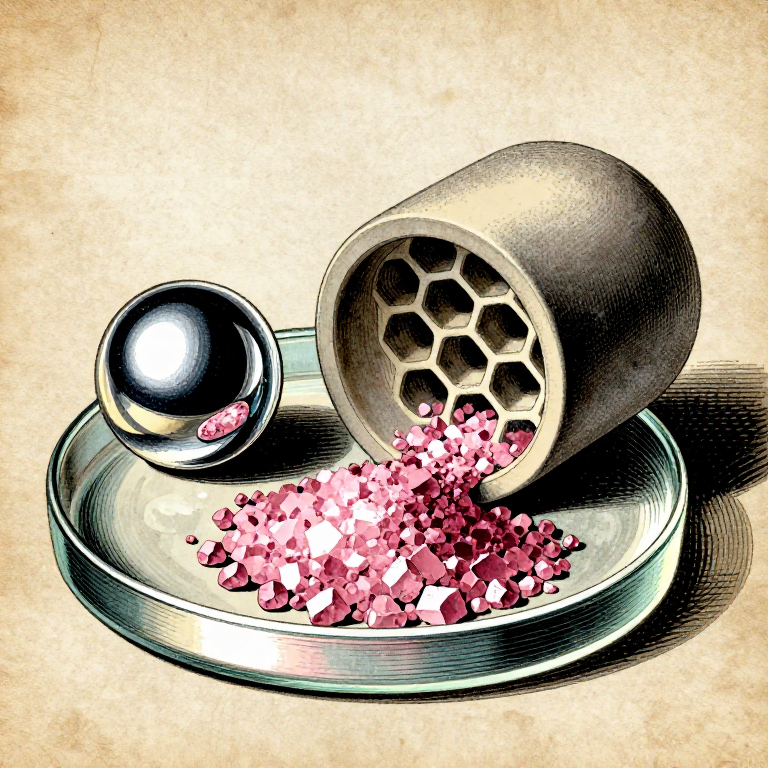
Catalytic converter recycling recovers approximately 25% of annual rhodium supply. Spent converters are collected by specialized recyclers who crush the ceramic honeycomb and smelt it with copper or iron to concentrate the PGMs. The high value of rhodium has made catalytic converter theft a global crime epidemic — a single converter contains $200-500 worth of PGMs. Closed-loop recycling in chemical plants achieves 95%+ rhodium recovery.
Zana zinazohitajika:
 Mizani ya usahihi
10
10
Document Findings and Strategic Context
Document Findings and Strategic Context
Record rhodium's key data: atomic number 45, density 12.41 g/cm³, melting point 1964°C, silvery-white metal with unmatched tarnish resistance. The transition to electric vehicles threatens long-term rhodium demand — EVs have no catalytic converters. However, stricter emissions standards for remaining combustion vehicles (Euro 7, China 7) require more rhodium per vehicle, partially offsetting EV adoption through the 2030s. Hydrogen fuel cells may create new PGM demand.
11
11
Ore grade: how much platinum group per kilogram
Ore grade: how much platinum group per kilogram
Inapakia daftari la Jupyter…
Vifaa
1- 1 kipandeKishikilia Nafasi
Zana Zinazohitajika
5- Kishikilia Nafasi
- Kishikilia Nafasi
- Kishikilia Nafasi
- Kishikilia Nafasi
- Kishikilia Nafasi
Vifaa vya Michoro Iliyounganishwa
Hatari
Usambazaji 10%
Isolating Platinum from Alluvial Deposits — The Unwanted Silver of the Conquistadors
na Peter
Uchimbaji madini
66
0
0
0
6
0
Hatari
Usambazaji 10%
Extracting Nickel from Pentlandite — The Devil's Copper That Wouldn't Behave
na Peter
Uchimbaji chuma
51
0
0
0
5
0

Usambazaji 10%
Understanding Ruthenium from Platinum Group Ore — The Hardest Platinum Metal
na Peter
Uchimbaji madini
20
0
0
0
6
0
Usambazaji 10%
Smelting Copper from Malachite — From Green Ore to Red Metal
na Peter
Uchimbaji chuma
108
0
0
0
10
0

Usambazaji 10%
Gold Panning
na Peter
MAZINGIRA
23
0
0
0
1
0
Blueprint zinazohusiana
Blueprint hizi zinashiriki maarifa — mbinu, vifaa au kanuni
CC0 Umma Wote
Mchoro huu umetolewa chini ya CC0. Uko huru kunakili, kubadilisha, kusambaza, na kutumia kazi hii kwa madhumuni yoyote, bila kuomba ruhusa.
Saidia Mtengenezaji kwa kununua bidhaa kupitia Mchoro wao ambapo wanapata Kamisheni ya Mtengenezaji iliyowekwa na Wachuuzi, au unda marudio mapya ya Mchoro huu na uiunganishe kama kiungo katika Mchoro wako kuchangia mapato.