
Extracting Potash from Wood Ash — The Alkali Element Hidden in Every Fire
Potassium (K, element 19) makes up about 2% of Earth's crust and is one of the three primary nutrients plants need, alongside nitrogen and phosphorus. Its symbol K comes from the Latin name 'kalium', built on 'kali', from the Arabic al-qalī, the ashes of plants. The English word 'potash' is even more direct: it means 'pot ash', the residue left in the pot after boiling wood-ash lye to dryness. This blueprint teaches the process that gave the element its name.
Humphry Davy isolated potassium metal in October 1807 by passing a current from a large voltaic battery through caustic potash (potassium hydroxide) — making potassium the first metal isolated by electrolysis. His cousin Edmund recorded that Davy danced about the room in delight when he saw tiny globules of silvery metal burst through the crust of the alkali and take fire. The pure metal is extraordinary: soft enough to cut with a knife (Mohs 0.4), light enough to float on water (density 0.862 g/cm³), and so reactive that it reacts violently with water, releasing hydrogen that ignites.
But potash itself — mainly potassium carbonate, K₂CO₃ — was used for thousands of years before anyone knew what potassium was. Ancient Mesopotamians made soap from fats and wood ash. Medieval glassmakers north of the Alps used wood-ash potash as the flux in their 'forest glass'. Colonial Americans exported thousands of tons of potash to Britain, and the very first United States patent (Samuel Hopkins, 31 July 1790) was for an improved way of making potash and pearl ash. This is the substance that connects soap, glass, gunpowder and agriculture — all from the ash left behind after a fire.
ការណែនាំ
Understand potassium's properties and place in the periodic table
Understand potassium's properties and place in the periodic table
Potassium (K, element 19) sits in Group 1 (alkali metals), Period 4 of the periodic table. It has an atomic weight of 39.098 and electron configuration [Ar] 4s¹. Like all alkali metals, potassium has one valence electron it gives up easily, making it extremely reactive. The pure metal is silvery-white, soft enough to cut with a butter knife (Mohs hardness 0.4), and has a density of 0.862 g/cm³ — the second lightest metal after lithium. It melts at just 63.5 °C (146 °F).
Potassium reacts violently with water: 2K + 2H₂O → 2KOH + H₂↑. The hydrogen gas ignites spontaneously, burning with a characteristic lilac flame. This reaction is why potassium metal must be stored under mineral oil or inert gas — it cannot exist in metallic form in nature. In the Earth's crust, potassium occurs only as K⁺ ions in minerals like feldspar (KAlSi₃O₈), muscovite mica (KAl₂(AlSi₃O₁₀)(OH)₂), and sylvite (KCl). Plants absorb K⁺ from soil through their roots; when wood burns, the potassium remains in the ash as potassium carbonate (K₂CO₃).
Select hardwood species for maximum potassium yield
Select hardwood species for maximum potassium yield
Choose hardwoods: oak, beech, elm, maple or ash. Hardwoods were the traditional potash woods in Europe and colonial America; softwoods such as pine, spruce and fir leave less ash. How much alkali an ash holds varies widely with the species, the share of bark and twigs, and the soil the tree grew in, so treat any single figure with caution and judge your own ash by the tests in steps 11 and 12.
The wood must be well seasoned (air-dried for at least 6 months). Green wood wastes energy evaporating moisture and burns incompletely, leaving grey ash mixed with charcoal rather than the pale ash needed for efficient leaching.
សម្ភារៈសម្រាប់ជំហាននេះ៖
 អុសឈើរឹង
Build a fire pit and burn the hardwood to white ash
Build a fire pit and burn the hardwood to white ash
Build a fire in a sheltered fire pit — rain will wash away the soluble potassium before you can collect it. Burn the hardwood in a hot, well-ventilated fire. Add wood gradually, letting each load burn down before adding more. A hot fire with good airflow produces white or pale grey ash; a smoldering fire produces dark ash full of unburned carbon, which is less useful.
Continue burning until you have accumulated a substantial volume of ash — at least 20–30 liters for a meaningful yield. The fire must be allowed to burn completely to ash; remove any large charcoal chunks that did not burn through. Wood leaves only a small fraction of its weight as ash, so this volume takes a large amount of firewood — far more than a single evening's fire; many makers collect ash from a stove or fire pit over a whole season.
សម្ភារៈសម្រាប់ជំហាននេះ៖
អុសឈើរឹងឧបករណ៍ដែលត្រូវការ៖
 រណ្ដៅភ្លើង
 ដែកកាយភ្លើង
Let the ash cool completely and collect it
Let the ash cool completely and collect it
Allow the ash to cool for at least 24 hours, and stir it to check for embers before moving it: ash can hide live coals for days. Hot ash can cause severe burns, melt plastic and start fires. Once cool to the touch, scoop the ash into a dry metal bucket using a metal shovel or scoop. Keep the ash dry — if rain wets the ash pile before collection, much of the soluble K₂CO₃ will leach into the ground and be lost.
សម្ភារៈសម្រាប់ជំហាននេះ៖
 ផេះឈើរឹង
ឧបករណ៍ដែលត្រូវការ៖
 ធុងលោហៈ
Sift ash through a coarse sieve to remove charcoal
Sift ash through a coarse sieve to remove charcoal
Pass the cooled ash through a coarse sieve (5–10 mm mesh) to separate fine ash from charcoal chunks, nails, stones, and unburned wood fragments. The fine white or light grey powder that passes through is your potash-rich material. The charcoal pieces retained by the sieve can be saved for other uses (fuel, water filtration, soil amendment) but contain very little extractable potassium.
សម្ភារៈសម្រាប់ជំហាននេះ៖
ផេះឈើរឹងឧបករណ៍ដែលត្រូវការ៖
 ចម្រោះគ្រើម
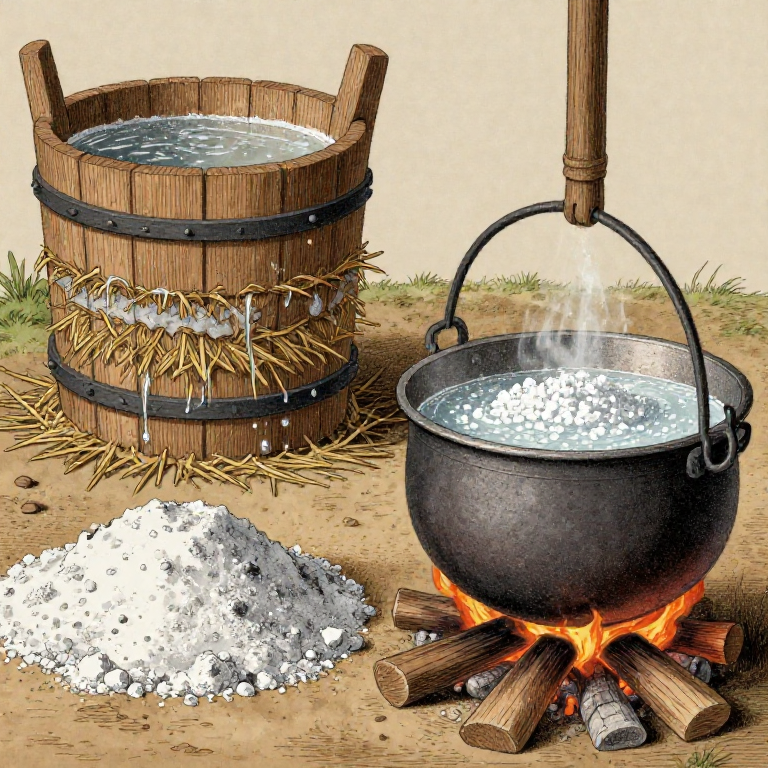
Build a leaching barrel with a straw filter
Build a leaching barrel with a straw filter
Use a wooden barrel or a large bucket with a hole drilled near the bottom. Place a thick layer (5–8 cm) of straw or dried grass at the bottom of the barrel — this acts as a filter to prevent fine ash from clogging the drain hole and passing into the lye. The straw must be clean and dry. Position the barrel on a raised platform (stones, bricks, or a wooden stand) so a collection bucket can sit underneath the drain hole.
Wooden barrels are traditional; lye attacks aluminium, zinc and tin, while iron and stainless steel resist it. If using a plastic bucket, ensure it is HDPE (recycling code 2), which resists alkaline solutions.
សម្ភារៈសម្រាប់ជំហាននេះ៖
 ចំបើងកាត់
ឧបករណ៍ដែលត្រូវការ៖
 ធុងឈើ
ធុងឈើ ធុងប្រមូល
Pack the barrel with sifted ash
Pack the barrel with sifted ash
Fill the barrel with the sifted white ash, packing it down firmly in layers. Tamp each layer lightly — too loose and the water channels through without dissolving much K₂CO₃; too tight and the water will not percolate at all. Fill the barrel to within 10 cm of the rim, leaving room for the water you will pour on top. A barrel packed with 25–30 liters of dry ash is a good working quantity.
សម្ភារៈសម្រាប់ជំហាននេះ៖
ផេះឈើរឹងPour water slowly through the ash to leach the potassium
Pour water slowly through the ash to leach the potassium
Pour soft water slowly over the top of the packed ash. Rainwater is ideal: it carries almost no dissolved calcium or magnesium, which would react with the carbonate and settle out as a scale. The water percolates downward through the ash, dissolving the soluble potassium carbonate (K₂CO₃) and smaller amounts of potassium sulfate (K₂SO₄) and potassium chloride (KCl). This process is called lixiviation.
Pour a little at a time and let each pour soak in. If you pour too fast, the water runs through channels without contacting enough ash. The liquid that drips out the bottom is lye (potash solution), brown in colour from dissolved organic compounds.
សម្ភារៈសម្រាប់ជំហាននេះ៖
 ទឹកស្អាត (សម្រាប់លាង)
ឧបករណ៍ដែលត្រូវការ៖
 ធុង
ធុងCollect the lye runoff in a bucket below the barrel
Collect the lye runoff in a bucket below the barrel
The brown liquid draining from the barrel is your raw lye — an alkaline solution of potassium carbonate in water. Collect it in a clean bucket (wood, HDPE plastic or iron — never aluminium, zinc or tin, which lye attacks). The first runnings will be the strongest; subsequent pours produce progressively weaker lye as the ash is depleted of soluble potassium.
SAFETY: Wear eye protection and gloves when handling lye. Potash lye is strongly alkaline (typically pH 11–13) and will cause chemical burns to skin and eyes. If it splashes on skin or into an eye, rinse at once with plenty of clean running water for at least 15 minutes, and get medical help for an eye. Do not put vinegar or other acids in an eye; keep a bucket of clean water within reach.
ឧបករណ៍ដែលត្រូវការ៖
ធុងប្រមូលPour the weak lye back through the ash for stronger concentration
Pour the weak lye back through the ash for stronger concentration
Pour the collected lye back through the same barrel of ash a second and third time. Each pass dissolves more K₂CO₃, increasing the concentration. Alternatively, pour the lye from the first barrel through a second barrel of fresh ash. Historical potash producers often operated cascading series of barrels, running lye through progressively fresher ash to build concentration before evaporation — this saved fuel by starting the boiling step with already-concentrated lye.
Test lye strength with the feather test
Test lye strength with the feather test
Dip the tip of a feather into the lye. This is a traditional soapmaker's test: lye strong enough for soapmaking visibly eats away the feather's barbs, because the keratin breaks down in a strong alkali. It is rough and qualitative — it tells you whether the lye is strong, not how strong. If the feather is unchanged, the lye is too weak and needs another pass through fresh ash or some evaporation before the boiling step.
Test lye concentration with the egg float test
Test lye concentration with the egg float test
Place a fresh, clean egg gently into the lye. This is another traditional test: when the lye is dense enough, the egg floats with a patch of shell about the size of a coin showing above the surface. If the egg sinks, the lye needs further concentration — either pass it through more ash or begin a preliminary evaporation to reduce the volume. Eggs vary in density as they age, so use a fresh one, and treat the result as a guide.
Pour strong lye into an iron pot for evaporation
Pour strong lye into an iron pot for evaporation
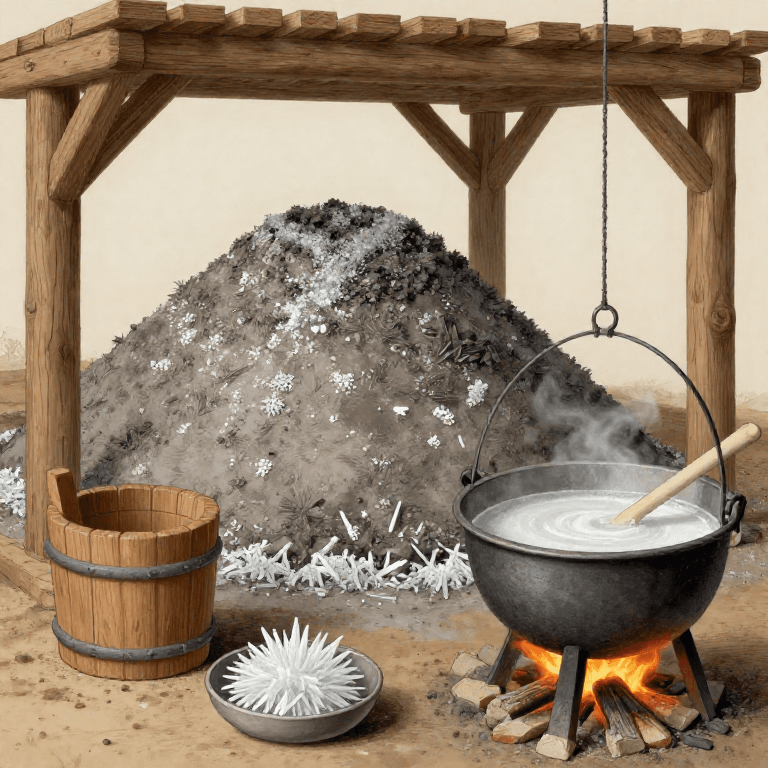
Transfer the concentrated lye into a large cast iron pot or cauldron. Iron resists potash lye, while aluminium dissolves in it quickly and zinc and tin corrode, so use iron. Large iron potash kettles were the standard vessel of the 18th- and 19th-century potash trade. The pot gives us the word: 'pot-ash' is the ash-like residue left in the pot after this evaporation.
ឧបករណ៍ដែលត្រូវការ៖
 ខ្ទះដែកចាក់ធំ
 ដង្កាប់ដងវែង
Boil the lye over a steady fire
Boil the lye over a steady fire
Set the iron pot over a steady fire and bring the lye to a rolling boil. Maintain a consistent heat — too aggressive and the lye spits dangerously; too low and evaporation takes excessively long. As water evaporates, the lye darkens and thickens. Add more lye from your reserve as the volume decreases, keeping the pot roughly half full. For a large batch this takes many hours of continuous boiling.
SAFETY: Boiling lye spits, and the spray and mist are caustic. Work outdoors or in a very well-ventilated area. Wear eye protection and heavy gloves. Never leave a boiling lye pot unattended.
សម្ភារៈសម្រាប់ជំហាននេះ៖
 អុសដុត
ឧបករណ៍ដែលត្រូវការ៖
ដែកកាយភ្លើងContinue evaporating until a thick paste forms
Continue evaporating until a thick paste forms
As the water evaporates, the liquid thickens into a dark brown, syrupy paste. Reduce the fire intensity to prevent scorching. Stir occasionally with a long iron rod or wooden paddle (the paddle will slowly char but works for short-term use). When the paste becomes thick enough that a spoon drawn through it leaves a trail that fills in slowly, the evaporation is nearly complete. At this stage, the paste is crude 'black salts' — a mixture of K₂CO₃ with organic residue, potassium sulfate, and other ash minerals.
ឧបករណ៍ដែលត្រូវការ៖
ដង្កាប់ដងវែងCalcine the residue at red heat to burn off organic matter
Calcine the residue at red heat to burn off organic matter
Transfer the thick paste into a shallow iron vessel or spread it on a flat iron surface. Heat it over a strong fire until it reaches a dull red glow (roughly 600–700 °C). The organic compounds that give the crude salts their dark colour burn away as carbon dioxide and water vapour, leaving a grey-white crude potash. Historically, black salts melted down in the kettle were sold as potash, and black salts baked in a kiln to burn off the organic matter came out whiter and were sold as pearl ash. Stir the material now and then for even heating. Keep it below a bright red heat: potassium carbonate melts at about 890 °C, and the salts would fuse into a hard lump that is difficult to handle.
ឧបករណ៍ដែលត្រូវការ៖
 ដង្កាប់ជាងដែក
 ជើងក្រាន (ភ្លើងជាងដែក)
Cool and collect the crude potash
Cool and collect the crude potash
Remove the vessel from heat and let the potash cool completely — several hours in still air. The result is crude potash: a grey-white powder of potassium carbonate (K₂CO₃) with impurities including potassium sulfate (K₂SO₄), potassium chloride (KCl), silica, and trace minerals. This crude potash can be used as a fertiliser, as a glass-making flux and for soapmaking without further purification. Store in a sealed, dry container — K₂CO₃ is hygroscopic and will absorb moisture from air, turning into a wet, sticky mass.
ឧបករណ៍ដែលត្រូវការ៖
 ធុងរក្សាទុក
Purify to pearl ash by dissolving, filtering, and re-evaporating
Purify to pearl ash by dissolving, filtering, and re-evaporating
For a whiter, purer potassium carbonate, dissolve the crude potash in hot water, then filter it through a fine cloth to remove the insoluble impurities (silica, calcium carbonate, iron oxides). The filtrate still carries the other soluble salts, mainly potassium sulfate and potassium chloride, so it is purer but not pure K₂CO₃. Evaporate the solution slowly in an iron pot until dry. The white powder is close to the pearl ash of the 18th-century trade: purified potassium carbonate used in fine glassmaking, as a leavening agent in baking (before baking soda), and in chemistry. Pearl ash sold for more than crude potash.
សម្ភារៈសម្រាប់ជំហាននេះ៖
ទឹកស្អាត (សម្រាប់លាង)ឧបករណ៍ដែលត្រូវការ៖
 រែងសំណាញ់ម៉ដ្ឋ
Understand potash's connections to civilization
Understand potash's connections to civilization
Potash links to nearly every branch of early technology. Soap: potash lye boiled with fat makes soft soap; soapmakers often added slaked lime to the lye to turn some of the carbonate into the more caustic potassium hydroxide. Hard soap was made with soda from plant ash instead. Glass: potash acts as a flux, letting glass be melted far below the melting point of pure silica (about 1700 °C). Northern European 'forest glass' (Waldglas) used wood-ash potash; Mediterranean glass used soda (Na₂CO₃), from natron in antiquity and later from the ash of salt-tolerant coastal plants. Gunpowder: saltpetre (KNO₃) came from niter beds, where rotting organic matter and soil bacteria produced nitrates, mostly of calcium. The nitrate liquor leached from the beds was then run through wood ash or mixed with potash, which turned the calcium nitrate into potassium nitrate and dropped the calcium out as carbonate. Agriculture: potassium is one of the three macronutrients in the N-P-K fertiliser system. Every fire in a farmer's field was returning potassium to the soil long before anyone understood why.
From the Arabic name al-qalī to Humphry Davy's delight in 1807, potassium's story runs through the history of chemistry — a useful substance known for millennia, isolated as a metal only a little over two centuries ago.
សម្ភារៈ
6- 1 ដុំកន្លែងទុក
- 1 ដុំកន្លែងទុក
- 1 ដុំកន្លែងទុក
- កន្លែងទុក
- 1 ដុំកន្លែងទុក
- 1 ដុំកន្លែងទុក
ឧបករណ៍ចាំបាច់
13- កន្លែងទុក
- កន្លែងទុក
- កន្លែងទុក
- កន្លែងទុក
- កន្លែងទុក
- កន្លែងទុក
- កន្លែងទុក
- កន្លែងទុក
- កន្លែងទុក
- កន្លែងទុក
- កន្លែងទុក
- កន្លែងទុក
- កន្លែងទុក
សម្ភារៈប្លង់ដែលបានភ្ជាប់
CC0 សាធារណៈ
ប្លង់នេះត្រូវបានចេញផ្សាយក្រោម CC0។ អ្នកមានសិទ្ធិចម្លង កែប្រែ ចែកចាយ និងប្រើប្រាស់ដោយមិនចាំបាច់សុំអនុញ្ញាត។
គាំទ្រអ្នកបង្កើតដោយទិញផលិតផលតាមរយៈប្លង់របស់ពួកគេ ដែលពួកគេទទួលបាន កម្រៃជើងសារអ្នកបង្កើត កំណត់ដោយអ្នកលក់ ឬបង្កើតកំណែថ្មីនៃប្លង់នេះ ហើយបញ្ចូលជាការតភ្ជាប់ក្នុងប្លង់របស់អ្នកដើម្បីចែករំលែកចំណូល។