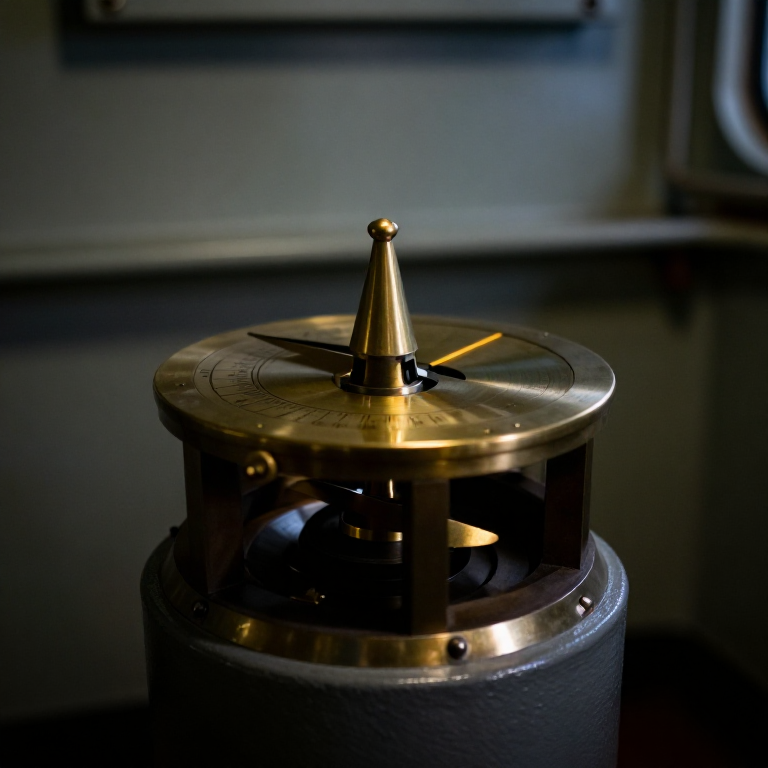


Sperry Gyrocompass
A magnetic compass on a steel ship is pointing partly at the ship. Every iron plate and every electric motor deflects it, the error changes as the vessel turns and as cargo shifts, and near the poles the field dips so steeply the needle is useless. Warships had the worst of it — and the most to lose.
A gyrocompass ignores magnetism entirely and finds north from the Earth's rotation. A spinning wheel resists having its axis tilted. Constrain it so that it may only turn horizontally, hang a weight below it, and the planet's own rotation produces a torque that swings the axis round to true north — where the torque vanishes and it settles.
It seeks the geographic pole, not the magnetic one, and no steel affects it. US Patent 1,242,065, "Ship's gyroscopic-compass set", filed 25 September 1909 and granted 2 October 1917 to Elmer A. Sperry.
ការណែនាំ
A heavy rotor at speed stores real energy
A heavy rotor at speed stores real energy
Enclose the rotor before running it, balance it carefully, and run up slowly. A flywheel that leaves its bearings at speed is dangerous out of all proportion to its size.
Read US 1,242,065 and note the float
Read US 1,242,065 and note the float
Sperry claims an electrically driven gyro wheel with a float supporting it in stable equilibrium. The suspension is as much of the invention as the gyroscope.
Show a magnetic compass failing beside steel
Show a magnetic compass failing beside steel
Put a compass on a table and bring a steel bar near it. The needle swings. Now imagine the bar is the ship — that is deviation, and it changes with every heading.
Build and spin a simple gyroscope
Build and spin a simple gyroscope
Mount a heavy balanced wheel in gimbals and spin it hard. Try to tilt the axis and feel it resist — angular momentum wants to stay pointing where it points.
សម្ភារៈសម្រាប់ជំហាននេះ៖
 រ៉ូលម៉ង់គ្រាប់ដែក (ឈុត)4 ដុំ
 ដែកទន់ដុំមូល1 ដុំ
Discover precession by pushing it
Discover precession by pushing it
Apply a torque and watch the axis move at RIGHT ANGLES to your push, not along it. Precession is counter-intuitive and it is the mechanism the whole instrument uses.
Note that a free gyro does NOT find north
Note that a free gyro does NOT find north
A gyroscope in full gimbals holds a fixed direction in space and appears to drift as the Earth turns beneath it. That is a directional gyro, and it is not a compass.
Constrain the spin axis to the horizontal plane
Constrain the spin axis to the horizontal plane
Remove one degree of freedom so the axis cannot tip freely. This constraint is what converts a direction-holder into a north-seeker.
Hang a mass below the spin axis
Hang a mass below the spin axis
Add a weight underneath, or use a mercury reservoir as Sperry did. Gravity now produces a torque whenever the axis tilts — and the tilt is produced by the Earth turning.
Work out why it settles pointing north
Work out why it settles pointing north
Earth's rotation tilts the axis; the pendulous weight resists; the resulting torque precesses the axis horizontally. The precession only stops when the axis lies north-south, where the tilting vanishes.
Support the whole assembly on a float
Support the whole assembly on a float
Carry the mass in a liquid so bearings take almost no load. Friction is the enemy: a stiff bearing produces a torque indistinguishable from the signal and the compass settles on the wrong heading.
Spin it up and time the settle
Spin it up and time the settle
Run it and watch the axis oscillate slowly about north, swinging less each time. That long approach is why a gyrocompass takes hours to settle and is left running.
Add damping and watch the oscillation die faster
Add damping and watch the oscillation die faster
Introduce a small offset in the pendulous torque. The path spirals in rather than swinging forever — undamped, the instrument oscillates about north indefinitely and never gives a reading.
Bring a magnet near it and confirm nothing happens
Bring a magnet near it and confirm nothing happens
Repeat the step 3 test on your gyrocompass. It does not move. This is the entire point: it is immune to every steel plate and every motor on the ship.
Move it north or south and note the error
Move it north or south and note the error
The settling torque depends on the horizontal component of Earth's rotation, which falls with latitude and vanishes at the poles. A gyrocompass is weakest exactly where a magnetic compass is worst.
Compendium — north from the planet's own spin
Compendium — north from the planet's own spin
The patent. US 1,242,065, "Ship's gyroscopic-compass set", filed 25 September 1909 and granted 2 October 1917 to Elmer A. Sperry. The gap between filing and grant is unusually long and worth noting, because Sperry is routinely credited with "the 1908 gyrocompass" — that refers to his working system, not to this grant. He patented in England first and faced sustained opposition from Hermann Anschütz-Kaempfe, whose German gyrocompass of 1908 preceded his; the resulting litigation is famous partly because Albert Einstein served as an expert witness for Anschütz-Kaempfe. Sperry's device was adopted by the US Navy in 1911.
Why a gyroscope alone is not a compass. A freely gimballed gyro holds its axis fixed relative to the stars, so as the Earth turns it appears to wander — useful as a short-term heading reference, useless as a compass. The conversion requires deliberately REMOVING freedom: constrain the spin axis to the horizontal plane and make the system pendulous. Earth's rotation then tilts the axis, gravity acting on the offset mass produces a torque, and because a gyroscope responds to torque at right angles, that torque precesses the axis in azimuth. The motion only ceases when the axis lies in the meridian — so it settles pointing at the geographic pole.
It finds TRUE north, and that is the practical prize. A magnetic compass points at the magnetic pole, which is in the wrong place and moving, and is deflected by the ship's own iron and electrical machinery. Deviation had to be measured for every vessel and corrected with compensating magnets, and it changed with heading, latitude and cargo. A gyrocompass has none of this: it references the planet's rotation, so no amount of steel affects it, and it needs no variation correction because it already points true.
Its own weaknesses, honestly. The settling torque depends on the horizontal component of Earth's rotation, which is proportional to the cosine of latitude — so a gyrocompass grows sluggish and finally useless above roughly 75-80 degrees, the region where magnetic compasses also fail. It must be running for hours before it is trustworthy, and it needs damping or it oscillates about north forever. It also requires speed and latitude corrections, because a moving ship adds its own component to the apparent rotation. Sperry's company went on to build autopilots, bombsights and inertial navigation from the same principles, and merged with Burroughs — whose calculating machine is elsewhere in this batch — to form Unisys.
សម្ភារៈ
2- កន្លែងទុក
- 1 ដុំកន្លែងទុក
ប្លង់ពាក់ព័ន្ធ
ប្លង់ទាំងនេះចែករំលែកចំណេះដឹង — បច្ចេកទេស សម្ភារៈ ឬគោលការណ៍




CC0 សាធារណៈ
ប្លង់នេះត្រូវបានចេញផ្សាយក្រោម CC0។ អ្នកមានសិទ្ធិចម្លង កែប្រែ ចែកចាយ និងប្រើប្រាស់ដោយមិនចាំបាច់សុំអនុញ្ញាត។
គាំទ្រអ្នកបង្កើតដោយទិញផលិតផលតាមរយៈប្លង់របស់ពួកគេ ដែលពួកគេទទួលបាន កម្រៃជើងសារអ្នកបង្កើត កំណត់ដោយអ្នកលក់ ឬបង្កើតកំណែថ្មីនៃប្លង់នេះ ហើយបញ្ចូលជាការតភ្ជាប់ក្នុងប្លង់របស់អ្នកដើម្បីចែករំលែកចំណូល។