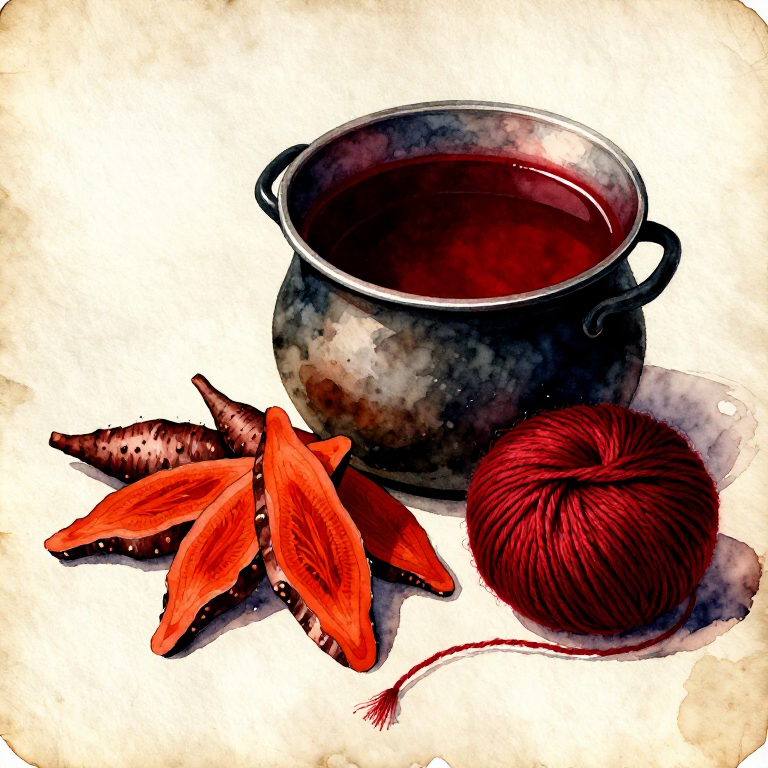

Dyeing Turkey Red with Madder — The Most Important Red Dye in Human History
Madder (Rubia tinctorum) is the single most important red dye plant in human history. Cultivated for at least 5,000 years, madder root has been found in Egyptian tombs, Indian textiles dating to the third millennium BCE, and throughout the ancient Mediterranean. The root contains alizarin and purpurin — anthraquinone pigments that produce a permanent, lightfast red on alum-mordanted wool that no other plant dye can match. Alizarin from madder was so important that when William Henry Perkin and the BASF chemists synthesised it in 1869, it collapsed the entire global madder-growing industry within a decade.
The key to madder's supremacy among red dyes is the alizarin-alum-fibre complex. When alizarin bonds with aluminium ions from the alum mordant, it forms an insoluble lake pigment inside the wool fibre — a molecular lock that resists washing, light, and time. This chemistry makes madder-dyed textiles among the most permanent of all natural dyes. Fragments of madder-dyed cloth from Mohenjo-daro (c. 2500 BCE) still show red colour after four and a half thousand years.
The famous 'Turkey red' process — developed in the Ottoman Empire and brought to France and Scotland in the 18th century — combined madder with an elaborate multi-step mordanting sequence involving alum, tannin, and oil to produce an exceptionally deep, fast red on cotton. The simpler process described here — madder on alum-mordanted wool — produces a warm, rich red that has been the workhorse of European dyers from antiquity through the Industrial Revolution.
안내
Weigh the dried madder root
Weigh the dried madder root
Use 100% WOF of dried, chopped madder root. For 100 g of wool, weigh out 100 g of madder root. Commercially available madder root is sold chopped or ground — chopped root gives a cleaner dye bath, while ground root extracts faster but can leave particles on the wool. The root should be a deep red-orange inside, indicating high alizarin content. Pale or yellowish root is old or low-quality and will give weak colour.
이 단계의 재료:
 꼭두서니 뿌리(말려 썬 것)100 g
필요한 도구:
 디지털 주방 저울
Soak the madder root overnight in warm water
Soak the madder root overnight in warm water
Place the chopped madder root in a dye pot with 4 litres of warm water (not hot — below 40°C) and soak overnight (8-12 hours). The water will turn a deep orange-red as the alizarin and purpurin dissolve. Madder root is dense and releases dye slowly — the overnight soak is essential for thorough extraction. By morning, the liquid should be a rich, opaque red-orange.
필요한 도구:
 스톡 팟(깊은 냄비)
Heat slowly to 70°C and hold for 60 minutes
Heat slowly to 70°C and hold for 60 minutes
This is the critical step that separates good madder red from dull brown. Raise the temperature SLOWLY — no more than 1°C per minute — to 70°C. Hold at 70°C for 60 minutes. NEVER exceed 80°C. Above 80°C, alizarin degrades and the unwanted yellow-brown pigments (purpurin and pseudopurpurin) dominate, producing dull brick-red instead of the brilliant Turkey red. Temperature control is the single most important skill in madder dyeing. Use a thermometer and adjust heat constantly. Stir occasionally.
필요한 도구:
 조리용 온도계
 나무 젓는 주걱
Strain out the root material
Strain out the root material
Strain the dye liquor through a fine mesh strainer into a clean pot. Press the root pieces to extract all remaining red liquid. Root particles left in the dye bath will cause speckled, uneven colour on the wool. For ground madder, strain through muslin cloth. The strained liquor should be a deep, clear red — not brown. If it looks brown, the temperature went too high during extraction.
필요한 도구:
 고운 체
고운 체Dye alum-mordanted wool at 70°C for 60 minutes
Dye alum-mordanted wool at 70°C for 60 minutes
Pre-wet the alum-mordanted wool in lukewarm water for 15 minutes, squeeze gently, and lower it into the madder dye bath at room temperature. Slowly raise to 70°C over 30 minutes — the same temperature discipline applies here. Hold at 70°C for 60 minutes. Turn gently every 10 minutes. The wool will develop a rich, warm red. The alizarin-alum complex forms an insoluble lake pigment inside the fibre — this is what gives madder its exceptional permanence. A well-mordanted, carefully dyed madder red will outlast the fabric it colours.
이 단계의 재료:
 양모 실타래100 g
 백반(칼륨 명반)10 g
Cool overnight, rinse, and dry
Cool overnight, rinse, and dry
Turn off the heat and let the wool cool in the dye bath overnight — the colour deepens significantly during the cooling period as additional alizarin is absorbed. Remove, squeeze gently, and rinse in lukewarm water until the runoff is mostly clear. Some initial washout is normal — the colour that remains is permanently bonded. The final colour is a warm, rich red — the legendary madder red that dyed Roman legionary cloaks, medieval guild robes, and British Redcoat uniforms. Lightfastness is excellent — among the best of all natural dyes. Dry in shade.
연결된 블루프린트 재료
이 블루프린트로 만드는 것

관련 블루프린트
이 블루프린트들은 지식을 공유합니다 — 기술, 재료 또는 원리
Dyeing Red with Sappanwood — The Asian Heartwood Dye That Preceded Brazilwood
Tex 작성
직물 및 가죽
Dyeing Purple with Alkanet Root — The Mediterranean Pigment of Antiquity
Tex 작성
직물 및 가죽
Dyeing Golden-Yellow with Saffron — The Most Precious Dye Spice in History
Tex 작성
직물 및 가죽
Making a Lake Pigment from Plant Dye — Precipitating Soluble Colour onto an Insoluble Substrate
Charlie 작성
예술
CC0 퍼블릭 도메인
이 블루프린트는 CC0로 공개되었습니다. 어떤 목적으로든 자유롭게 복사, 수정, 배포 및 사용할 수 있습니다.
제품 구매를 통해 메이커를 지원하세요. 판매자가 설정한 메이커 커미션 을 받거나, 이 블루프린트의 새로운 반복을 만들어 연결로 포함시킬 수 있습니다.