예술
뷰티 및 웰니스
공예
문화 및 역사
엔터테인먼트
환경
음식 및 음료
역공학
과학
스포츠
기술
웨어러블
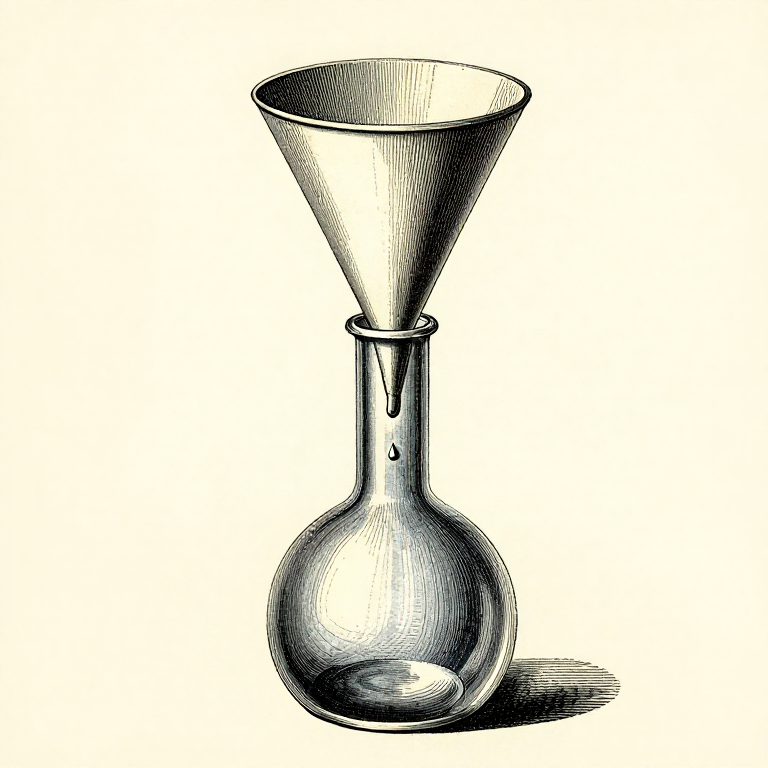


Filtering Properly: Which Half Are You Trying to Keep?
Filtration separates a solid from a liquid, and every decision about how to do it follows from one question: **which half do you want?**
Keeping the liquid and throwing away the solid is a different operation from keeping the solid and throwing away the liquid — different apparatus, different paper, different technique, and opposite mistakes.
It is also where a great deal of material is quietly lost. A filter cake holds solvent, filter paper holds product, and a solution poured too fast goes round the paper instead of through it.
초급
2 hours
안내
1
1
Gravity filtration: when the liquid is the product
Gravity filtration: when the liquid is the product
**Gravity filtration** is a cone of paper in a funnel, and the liquid runs through under its own weight. Use it when the solid is unwanted — dust, insoluble impurity, a drying agent.
**Flute the paper.** A fan-folded fluted filter has several times the surface area of a plain cone and runs far faster, because the liquid is not sitting against the glass. For anything but a trivial volume this is the difference between a minute and half an hour.
**Wet the paper first** with the solvent being used, and seat it against the funnel. A dry paper floats off its seat and lets liquid past.
**Do not fill above the paper.** Liquid poured over the top goes straight down the outside, and this is the commonest way an otherwise careful filtration is ruined.
**Use a stirring rod** to direct the pour down onto the paper rather than splashing.
**For a hot filtration**, warm the funnel first and keep everything moving. Any cooling crystallises product in the paper.
이 단계의 재료:
 여과지1 개
 에탄올 - 실험실 등급, 95 %1 개
필요한 도구:
 삼각 플라스크
 유리 젓개
유리 젓개 붕규산 비커
2
2
Vacuum filtration: when the solid is the product
Vacuum filtration: when the solid is the product
A **Buchner funnel** on a filter flask with suction pulls the liquid through and leaves a compact cake. Use it when the solid is what you want.
**A flat paper cut to the plate**, not a cone. It must cover every hole and not turn up the sides — a paper that is too large curls and lets solid past its edge.
**Wet the paper and apply suction before adding anything.** The paper seats down onto the plate and seals.
**Pour with the suction running**, and rinse the last of the crystals out of the flask with a little of the mother liquor, not with fresh solvent — fresh solvent dissolves the crop.
**Wash the cake with ice-cold solvent.** Release the vacuum, add just enough solvent to cover, stir the cake gently with a spatula so the wash reaches all of it, then re-apply suction. Pouring wash straight onto a cake under suction channels through one spot and washes nothing.
**Pull air through to dry**, then press the cake with a clean stopper to squeeze the last liquid out.
**Use a trap** between the flask and the pump. Without one, a pressure change pulls pump oil or water back into the product — an unpleasant and entirely avoidable loss.
이 단계의 재료:
여과지1 개 잔 얼음1 개에탄올 - 실험실 등급, 95 %1 개
필요한 도구:
 뷰흐너 깔때기(자기)
 진공 펌프삼각 플라스크
3
3
Choosing the paper, and what it costs
Choosing the paper, and what it costs
Filter papers differ in **pore size** and in **speed**, and the two trade against each other directly.
**Coarse and fast** — for bulky precipitates and for removing a drying agent. Fine particles go straight through.
**Medium** — the general-purpose choice, and right for most crystallisations.
**Fine and slow** — for fine precipitates that pass through anything coarser. It can take a very long time, and it is worth it only when the product actually requires it.
**Ashless paper** is made for gravimetric work: it burns to almost nothing, so a precipitate can be ignited in the paper and weighed. Expensive, and pointless for anything else.
**Sintered glass** replaces paper entirely where the paper would be attacked — strong acids, strong alkali — or where paper fibres would contaminate. It is reusable and needs cleaning immediately, because a dried cake in a sinter is very difficult to remove.
**Every paper holds liquid**, and that liquid contains dissolved product. On a small preparation this is a real fraction of the yield, and it is the argument for using the smallest funnel the job allows.
이 단계의 재료:
여과지2 개필요한 도구:
뷰흐너 깔때기(자기) 정밀 저울
정밀 저울4
4
Decanting, centrifuging and knowing when not to filter
Decanting, centrifuging and knowing when not to filter
Filtration is not always the right answer.
**Decanting** — letting the solid settle and pouring the liquid off — costs nothing, loses nothing to a filter, and is the right first move whenever the solid settles well. Follow it with a filtration of the last portion if needed.
**Washing by decantation** is better than washing on a filter for a fine solid: add solvent, stir, settle, pour off, repeat. The solid is properly mixed with each wash rather than channelled through.
**Centrifuging** settles what will not settle by itself, and loses nothing to paper. It is the right answer for small volumes and for very fine or gelatinous solids that blind a filter instantly.
**A gelatinous precipitate should not be filtered at all** if it can be avoided. It clogs the paper in seconds and then nothing moves. Digest it — stand it warm for a while — and the particles coarsen enough to filter. This genuinely works and it is the standard fix.
**Do not filter a hot saturated solution unless you have to.** Every degree it cools in the funnel is product in the paper.
이 단계의 재료:
에탄올 - 실험실 등급, 95 %1 개필요한 도구:
붕규산 비커유리 젓개관련 블루프린트
이 블루프린트들은 지식을 공유합니다 — 기술, 재료 또는 원리

CC0 퍼블릭 도메인
이 블루프린트는 CC0로 공개되었습니다. 어떤 목적으로든 자유롭게 복사, 수정, 배포 및 사용할 수 있습니다.
제품 구매를 통해 메이커를 지원하세요. 판매자가 설정한 메이커 커미션 을 받거나, 이 블루프린트의 새로운 반복을 만들어 연결로 포함시킬 수 있습니다.