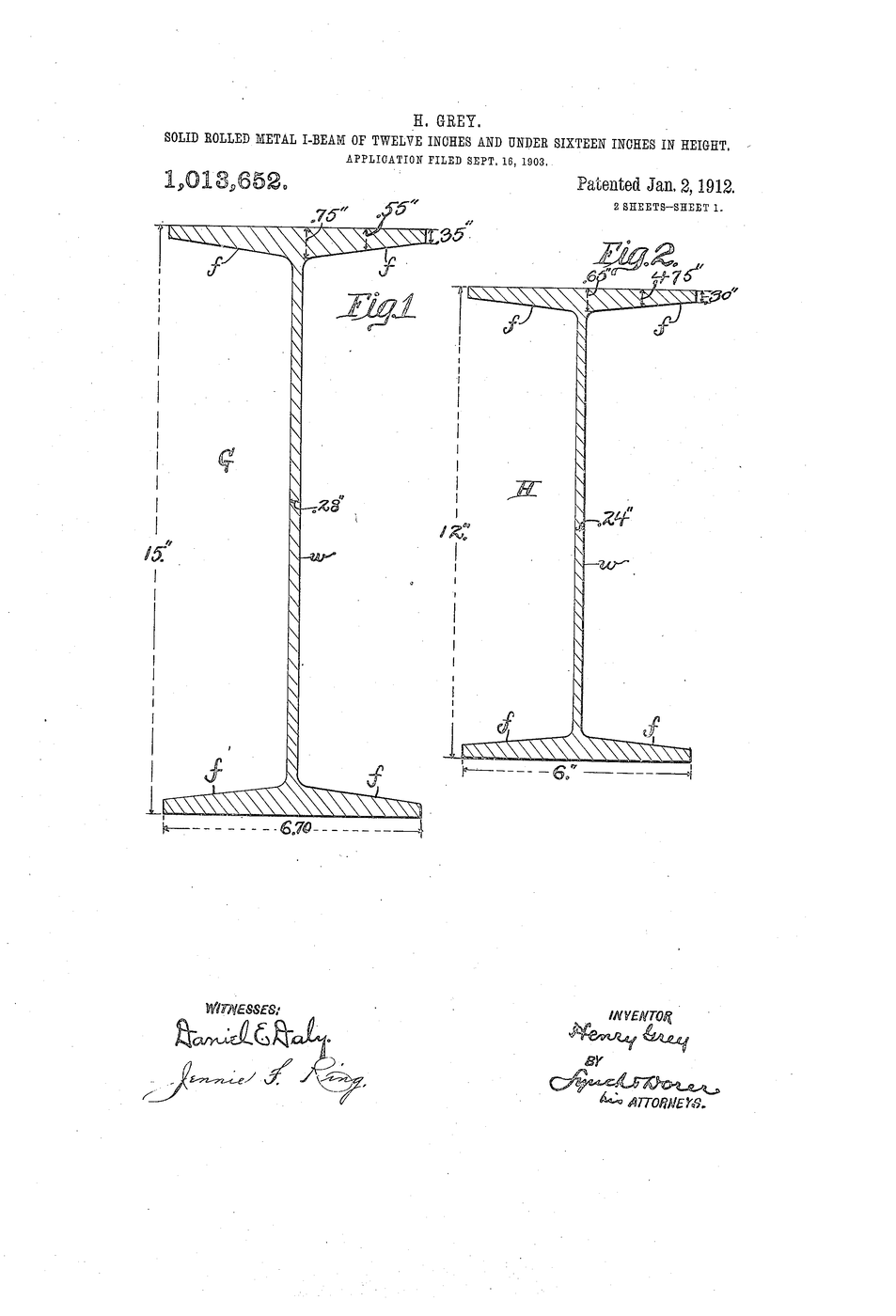


I-Beam
When a beam bends, its top squeezes and its bottom stretches, while the material in the middle — near the centre line — barely does anything. So a solid rectangular bar is wasteful: most of its metal sits near the middle carrying almost no load, just adding weight. The clever move is to take that lazy middle material and move it out to the top and bottom, where the bending forces actually are.
That shape is the I-beam: two wide horizontal flanges held apart by a thin vertical web. The flanges, far from the centre line, do the heavy work of resisting the bend; the web just holds them apart. Pound for pound, an I-beam is dramatically stiffer and stronger in bending than a solid bar of the same weight.
Grey's patent is about ROLLING that shape — especially the wide-flange beam — in a single pass through the mill, as one solid piece, instead of riveting a beam together from separate plates and angles. A beam rolled whole is stronger, cheaper and faster than a built-up one.
US Patent 1,013,652, "Solid rolled metal I-beam…", filed 1903 and granted 2 January 1912 to Henry Grey.
안내
Read the two claims: the shape and the rolling
Read the two claims: the shape and the rolling
Grey claims a solid rolled I-beam — the efficient shape AND the fact that it is rolled whole in one piece, not riveted up. Note both.
Bend a flat strip on its flat face
Bend a flat strip on its flat face
Lay a flat strip across a gap, flat side up, and load the middle. It bends easily. Record the sag for a set weight.
이 단계의 재료:
 바스우드 판1 장
필요한 도구:
 힘 측정기(스프링 저울)
Turn the same strip on edge and bend it
Turn the same strip on edge and bend it
Stand the identical strip on its edge and load it. It is far stiffer — same material, same weight, just deeper. Depth in the bending direction is what counts.
Understand where the work happens
Understand where the work happens
Draw the beam bending: the top fibres squeeze, the bottom stretch, and the middle (the neutral axis) does almost nothing. Write down: the useful material is at the top and bottom.
Cut two flanges and a web
Cut two flanges and a web
Cut two wide strips (the flanges) and one narrow strip (the web) from card or basswood. You will build an I-section from them.
이 단계의 재료:
 골판지 시트1 장
필요한 도구:
 공예용 칼
공예용 칼Assemble the I-section
Assemble the I-section
Glue a flange to the top and bottom of the web to make an I. The wide flanges now sit far from the centre line, where the bending forces are largest.
Weigh your I-beam against the flat strip
Weigh your I-beam against the flat strip
Make the I-beam use about the same amount of material as the flat strip from step 2. Weigh both to confirm — a fair fight is same weight, different shape.
필요한 도구:
 접시 저울
접시 저울Load the I-beam and compare
Load the I-beam and compare
Load the I-beam over the same span. It sags far less than the flat strip of equal weight. Same steel, cleverer shape, much stiffer beam.
Widen the flanges and test again
Widen the flanges and test again
Rebuild with wider flanges (a wide-flange "H" beam) for the same weight. It is stiffer still — the wider the flanges, the more work they do. This is Grey's wide-flange section.
Build a beam by 'riveting' plates instead
Build a beam by 'riveting' plates instead
Make an I by fastening separate strips together with pins or staples (a built-up beam). Load it: the joints flex and slip, and it is weaker than the one-piece beam. Note where it gives.
필요한 도구:
 펜치(콤비네이션 플라이어)
Compare one-piece versus built-up
Compare one-piece versus built-up
The solid, rolled-whole I-beam beats the fastened-together one — no joints to loosen, no rivets to fail. This is exactly why rolling the beam in one pass was worth patenting.
Find where an I-beam is weak
Find where an I-beam is weak
Now push the I-beam sideways or twist it. It is much floppier that way — an I-beam is strong in ONE plane. You must orient it with the web vertical, which is why beams are installed upright.
History & Context — the shape that framed the skyscraper
History & Context — the shape that framed the skyscraper
The patent. US 1,013,652, "Solid rolled metal I-beam…", filed 1903 and granted 2 January 1912 to Henry Grey. The Google Patents date reads 1912 (the grant); the work runs from his 1903 filing. Grey, a British-born engineer working in America and Europe, developed the universal mill that could roll a wide-flange beam directly, and his beams were first produced at scale by Bethlehem Steel (the "Bethlehem beam").
The I-section is a piece of applied mathematics. When a beam bends, the stress grows with distance from the neutral axis, so material far from the centre line resists the bend powerfully while material near it barely helps (step 4). The I-shape removes the lazy middle metal and concentrates it in two flanges as far apart as possible, held by a thin web — giving, pound for pound, far more bending stiffness than any solid bar (step 8). The engineer's measure of this is the section modulus, and the I-beam maximises it for a given weight. Grey's wide-flange (H) beam pushes the idea further with broad, thick flanges, which is why it dominates building frames (step 9).
Why rolling it whole was the real advance. The efficient I-shape was known and used long before Grey — but big beams were made by riveting plates and angles together, which is slow, heavy with the extra metal of the connections, and dependent on thousands of rivets that add cost and can work loose. Grey's contribution was a mill that rolls the wide-flange beam as a single solid piece, in one heat, to final shape — stronger (no joints, step 11), lighter, and vastly cheaper per beam. Industrialising the making of the beam is what turned it from a special order into a stock item you buy by the tonne.
What it built. The rolled steel I-beam is the bone of the modern built environment. It is the beam and column of the steel-framed skyscraper — a skeleton of rolled beams that carries the whole building so the walls can be mere weatherproof cladding — and of factories, warehouses, stadiums and bridges. Together with reinforced and prestressed concrete, the wide-flange beam is one of the two structural systems on which the twentieth-century city stands. Look up at any steel building going up and you are watching Grey's one-piece rolled beam, bolted into a frame.
관련 블루프린트
이 블루프린트들은 지식을 공유합니다 — 기술, 재료 또는 원리


CC0 퍼블릭 도메인
이 블루프린트는 CC0로 공개되었습니다. 어떤 목적으로든 자유롭게 복사, 수정, 배포 및 사용할 수 있습니다.
제품 구매를 통해 메이커를 지원하세요. 판매자가 설정한 메이커 커미션 을 받거나, 이 블루프린트의 새로운 반복을 만들어 연결로 포함시킬 수 있습니다.