예술
뷰티 및 웰니스
공예
문화 및 역사
엔터테인먼트
환경
음식 및 음료
역공학
과학
스포츠
기술
웨어러블
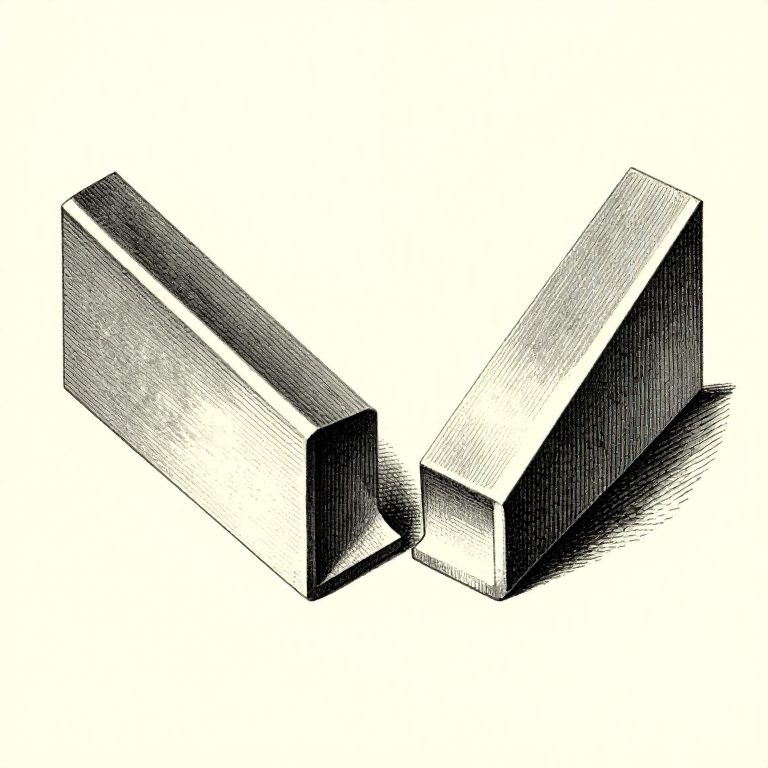


Joint Preparation: Most of a Weld Is Decided Before the Arc Is Struck
An arc melts a shallow pool. On thin sheet that is enough to fuse right through; on anything thicker it is not, and no amount of skill with the torch makes up for a joint the heat cannot reach.
So the joint is shaped first: edges cut square, faces cleaned back to bright metal, a bevel where the plate is too thick to fuse in one pass, a root gap so the first run can reach the bottom, and the parts clamped where they are meant to stay.
This rung covers the four decisions — cleanliness, fit-up, bevel and gap — and works out what a bevel costs in filler metal, because that number is also the heat that will pull the work out of shape.
초급
2 hours
안내
1
1
Bright metal, or the weld is full of the coating
Bright metal, or the weld is full of the coating
Mill scale, rust, paint, galvanising, oil and cutting fluid all end up in the weld pool if they are still there when the arc arrives.
Scale and rust are oxides — they make slag inclusions and porosity. Paint and oil burn to gas under the arc and that gas is trapped as the pool freezes. Zinc from galvanising boils at 907 C, well below the pool temperature, so it comes off as a white fume that is genuinely dangerous to breathe (the hazard rung covers it).
Clean 25 mm back from the joint on both faces, not just the edge, because the arc wanders and the pool is wider than the gap. A wire brush takes loose rust; a flap disc or grinding wheel takes mill scale. Wipe solvent off and let it dry — a solvent-wet joint is worse than a dirty one.
이 단계의 재료:
 연강판2 개
 연강 평강1 개
필요한 도구:
 앵글 그라인더
 연삭 숫돌바퀴
 와이어 브러시 세트
 투명 보안경
2
2
Fit-up: the gap you leave is the gap you have to fill
Fit-up: the gap you leave is the gap you have to fill
Two plates that meet with a 3 mm gap in one place and touch in another cannot be welded at one setting. Where they touch the arc burns a hole; where they gape the pool falls through.
Cut both edges square and check them against each other, not against a rule — a pair of edges that match make a good joint even if neither is exactly straight.
For a butt joint in plate up to about 5 mm, a root gap of roughly the electrode core diameter is the usual start: about 2.5 mm for a 2.5 mm rod. Less and the root does not fuse; more and the pool drops through. Clamp so the gap is held, and tack it (step 4 of the distortion rung explains the order).
이 단계의 재료:
연강판2 개필요한 도구:
 조합 직각자
 C형 클램프
 바 클램프
바 클램프 자
자 동석 블록
동석 블록3
3
The bevel, and what it costs
The bevel, and what it costs
Jupyter 노트북 불러오는 중…
이 단계의 재료:
연강판2 개필요한 도구:
앵글 그라인더연삭 숫돌바퀴 디지털 각도계
 데스크톱 컴퓨터
4
4
Which joint, and why it is that one
Which joint, and why it is that one
Five joints cover nearly everything: butt, lap, tee, corner and edge.
A **butt** joint puts the two parts in the same plane and is the only one that can be made as strong as the parent metal, because the weld replaces the section rather than adding to it. It is also the one that needs the most preparation.
A **lap** joint overlaps the parts and welds along the exposed edges. It needs no edge preparation at all, which is why it is everywhere in sheet metal, but the load path bends through the overlap so it is poor in fatigue.
A **tee** joint stands one part on another and is welded with fillets in the two inside corners. This is the workhorse of frames and brackets.
A **corner** joint meets at the edges, and an **edge** joint welds two parallel faces along their common edge — useful for sheet, not for load.
Choose by the load first, then by how much preparation the job is worth. A handrail bracket does not need a bevelled butt weld.
이 단계의 재료:
연강판2 개 연강 앵글1 개
필요한 도구:
조합 직각자동석 블록관련 블루프린트
이 블루프린트들은 지식을 공유합니다 — 기술, 재료 또는 원리

CC0 퍼블릭 도메인
이 블루프린트는 CC0로 공개되었습니다. 어떤 목적으로든 자유롭게 복사, 수정, 배포 및 사용할 수 있습니다.
제품 구매를 통해 메이커를 지원하세요. 판매자가 설정한 메이커 커미션 을 받거나, 이 블루프린트의 새로운 반복을 만들어 연결로 포함시킬 수 있습니다.