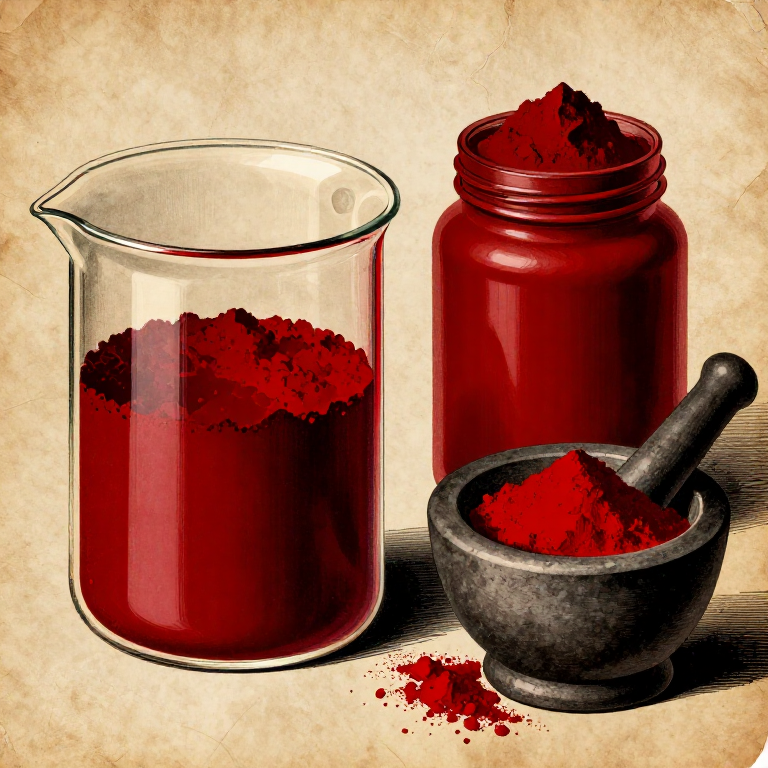

Making Cadmium Red — The Brilliant Cadmium Selenide Pigment of the 20th Century
Cadmium Red (cadmium sulfo-selenide, CdS₁₋ₓSeₓ) was the last great addition to the painter's palette of permanent inorganic pigments. First produced around 1910 and commercially available by 1919, it offered what no earlier red could: brilliance, opacity, permanence, and resistance to light, heat, and alkali — all in a single pigment. It replaced vermilion (mercury sulfide, toxic and prone to darkening), red lead (lead tetroxide, toxic and unstable), and the various alizarin lakes (beautiful but fugitive).
The chemistry exploits a solid-solution series between cadmium sulfide (yellow) and cadmium selenide (deep red). By varying the selenium-to-sulfur ratio, the artist can produce any hue from cadmium orange (low Se) through cadmium red light to cadmium red deep (high Se). In this blueprint we target a medium cadmium red by mixing cadmium carbonate with selenium and sulfur powders and calcining the intimate mixture at 500–600 °C in a sealed crucible.
SAFETY WARNING: This process is EXTREMELY HAZARDOUS. Cadmium compounds are toxic heavy metals classified as Group 1 carcinogens — they cause lung cancer via inhalation and accumulate in kidneys with chronic exposure. Selenium is also toxic: inhalation of selenium dust or fumes causes serious respiratory injury, and heated selenium produces a characteristic garlic-like odour that indicates dangerous exposure levels. Both cadmium and selenium fumes are released during calcination. Work OUTDOORS ONLY with a P100 respirator, full-face goggles, and leather gauntlets. Never handle cadmium or selenium with bare hands. Dispose of all wash water and by-products as hazardous waste.
이 블루프린트로 만드는 것

관련 블루프린트
이 블루프린트들은 지식을 공유합니다 — 기술, 재료 또는 원리
Synthesising Vermillion from Mercury and Sulfur — The King of Red Pigments
Charlie 작성
예술
Making Red Lead (Minium) — The Pigment That Named the Art of Miniature Painting
Charlie 작성
예술
Making Cinnabar Red Pigment — Grinding Mercury Sulfide into the Most Vivid Red of the Ancient World
Charlie 작성
예술
Making Chrome Yellow — The Brilliant Lead Chromate Pigment of the 19th Century
Charlie 작성
예술
Making Manganese Violet — The Affordable Violet Pigment That Democratised the Palette
Charlie 작성
예술
Making Realgar Orange Pigment — The Arsenic Companion to Orpiment
Charlie 작성
예술
Making DPP Red (Pyrrole Red) — The Accidental Ferrari Pigment That Ended the Synthetic Colour Revolution
Charlie 작성
예술
CC0 퍼블릭 도메인
이 블루프린트는 CC0로 공개되었습니다. 어떤 목적으로든 자유롭게 복사, 수정, 배포 및 사용할 수 있습니다.
제품 구매를 통해 메이커를 지원하세요. 판매자가 설정한 메이커 커미션 을 받거나, 이 블루프린트의 새로운 반복을 만들어 연결로 포함시킬 수 있습니다.