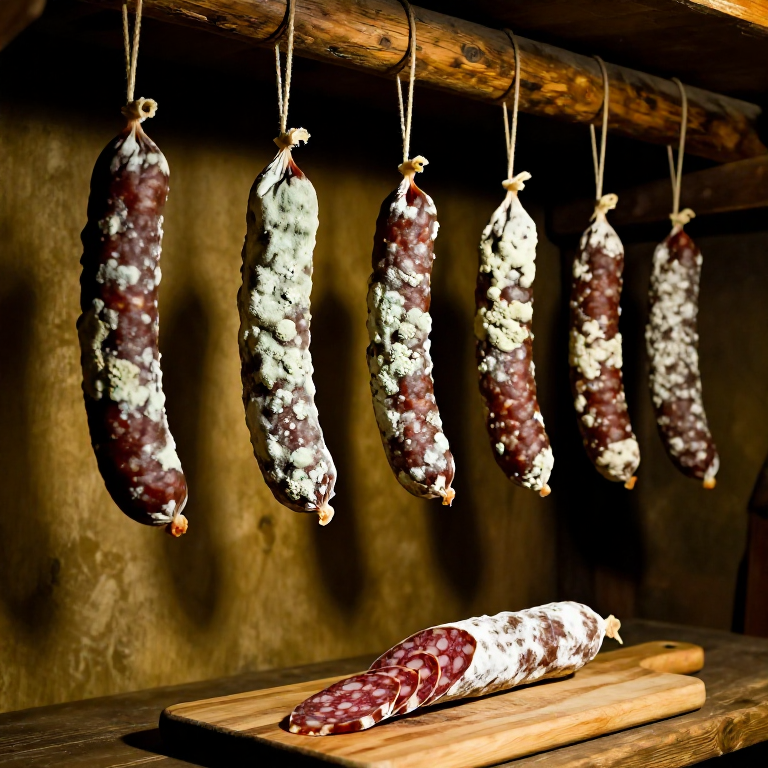


Making Dried Salt-Cured Sausage — Medieval Meat Preservation
안내
Season the Meat
Season the Meat
Combine the coarsely ground pork with the salt, curing salt (or medieval saltpetre — potassium nitrate — which converts to nitrite during curing), black pepper, minced garlic, and red wine in a large bowl. Mix thoroughly by kneading and folding the meat for 5 to 10 minutes until the mixture becomes tacky and cohesive — this indicates the salt has begun extracting myosin protein from the meat, which acts as a natural binder. The salt concentration of 2.5 to 3 percent by weight is critical: too little salt risks spoilage, too much produces an unpleasantly salty product. The curing salt prevents the growth of Clostridium botulinum (the bacterium causing botulism) and gives the sausage its characteristic reddish-pink cured colour by forming nitrosomyoglobin. Cover and refrigerate (or store in a cold cellar at 2-4 degrees Celsius) overnight for the cure to penetrate evenly.
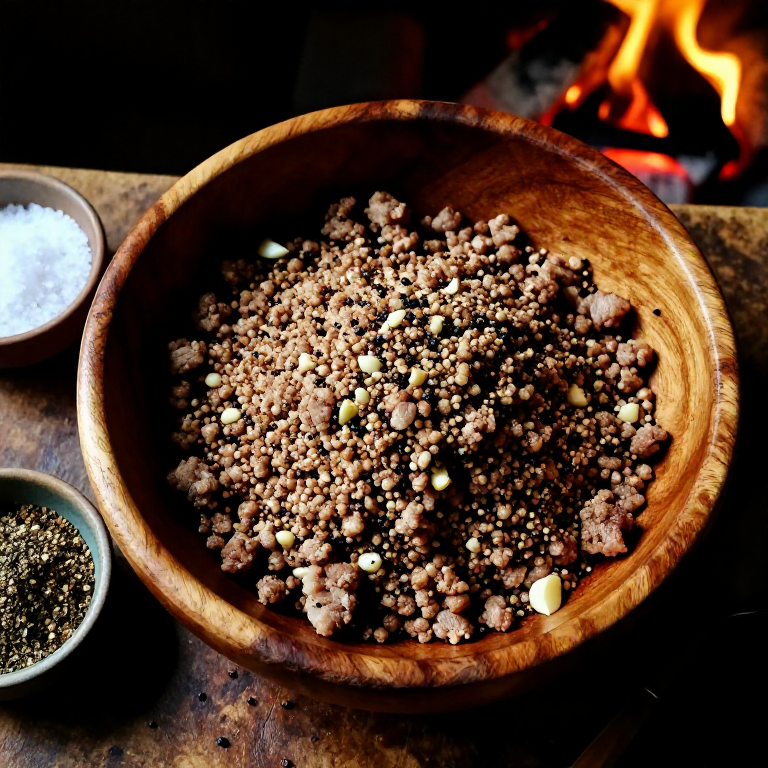
이 단계의 재료:
 돼지 앞다릿살 (뼈 붙은 것)2 kg kg
 고운 바닷소금50-60 grams (2.5-3% of meat weight) 개
 염지용 소금5 grams 개
 굵게 부순 검은 후추8-10 grams 개
 마늘10-15 grams 개
 적포도주(조리용)50 ml ml
필요한 도구:
 믹싱 볼 세트
 소시지 충전기
 조리용 무명실
 고기 분쇄기
 걸이 고리 (고기 염장)
Prepare and Stuff the Casings
Prepare and Stuff the Casings
Soak the natural hog casings in warm water for 30 minutes to soften them, then flush each casing by running water through its entire length to check for holes. Thread a casing onto the sausage stuffer tube. Pack the seasoned meat mixture into the stuffer and push it into the casing firmly, eliminating air pockets as much as possible — trapped air creates voids where unwanted bacteria can grow. Fill the casing until it is firm but not so tight that it bursts. Twist or tie off individual sausage links at 15 to 20 cm intervals using kitchen twine. Prick any visible air bubbles with a sterilised pin to allow the trapped air to escape.
Hang and Begin Drying
Hang and Begin Drying
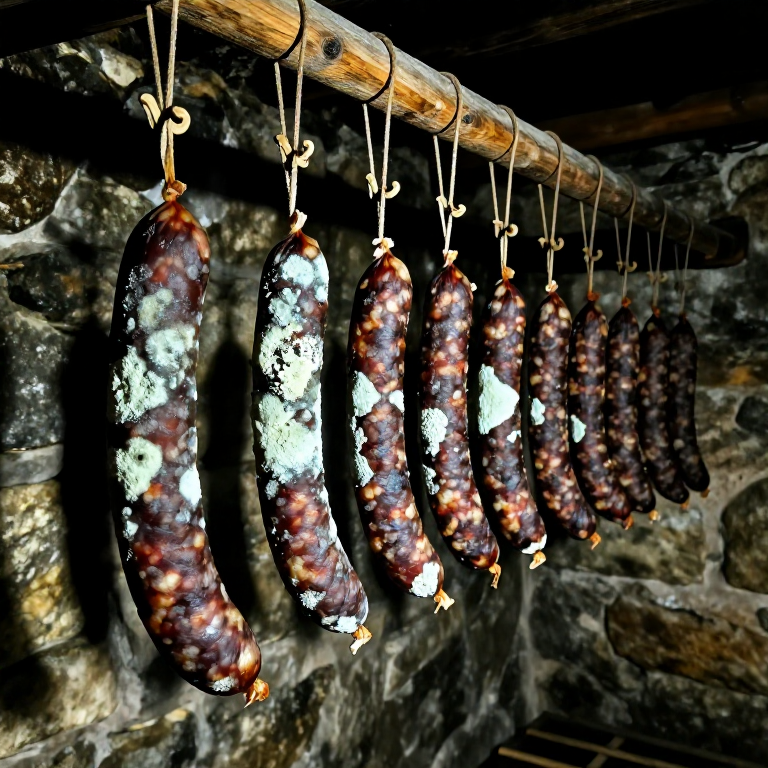
Hang the sausage links from hooks in a cool, well-ventilated space with a temperature of 10 to 15 degrees Celsius and humidity of 70 to 80 percent. A medieval root cellar, stone larder, or chimney recess provided these conditions naturally. The sausages should not touch each other or any surface to allow uniform air circulation. During the first 2 to 3 days, a beneficial white mould (Penicillium nalgiovense) may develop on the casing surface — this is desirable, as it protects the sausage from harmful moulds and contributes to flavour development. If green, black, or fuzzy coloured moulds appear, wipe them off with a cloth dampened in vinegar and improve air circulation.
Monitor the Drying Process
Monitor the Drying Process
Over the next 3 to 6 weeks, the sausages will lose approximately 30 to 40 percent of their original weight as moisture evaporates. The casings will firm up and the interior will become progressively denser. Squeeze the sausages periodically — they should feel firm throughout with no soft or squishy areas, which could indicate the centre has not dried sufficiently. If the outer casing hardens too quickly (case hardening) before the interior dries — creating a hard shell that traps moisture inside — increase the humidity slightly or wrap the sausages in damp cloth for a day. The drying environment must remain consistently cool; temperatures above 20 degrees Celsius allow dangerous bacterial growth before the sausage has dried enough to be safe.
Test and Store
Test and Store
The sausages are ready when they have lost approximately 35 percent of their original weight and feel uniformly firm throughout — pressing firmly should leave no soft spot. Cut one sausage to inspect the interior: it should be a uniform dark reddish-pink colour with no grey areas (which indicate insufficient curing) and a dense, slightly translucent texture. The flavour should be rich, meaty, and slightly tangy from lactic acid fermentation. Properly dried sausages do not require refrigeration and can be stored hanging in a cool dry place for months — this was their entire purpose in the medieval economy, providing protein through the winter months when fresh meat was unavailable. Slice thinly and serve as medieval households did — as a component of the first course alongside bread, cheese, and preserved fruits.
재료
10- 50-60 grams (2.5-3% of meat weight) 개플레이스홀더
- 5 grams 개플레이스홀더
- 10-15 grams 개플레이스홀더
- Natural hog casings (32-35 mm diameter)3-4 metres 개
- 2 kg 개플레이스홀더
- 50-60 grams (2.5-3% of meat weight) 개플레이스홀더
- 8-10 grams 개플레이스홀더
- 50 ml 개플레이스홀더
- 3-4 metres 개플레이스홀더
- 9 g플레이스홀더
CC0 퍼블릭 도메인
이 블루프린트는 CC0로 공개되었습니다. 어떤 목적으로든 자유롭게 복사, 수정, 배포 및 사용할 수 있습니다.
제품 구매를 통해 메이커를 지원하세요. 판매자가 설정한 메이커 커미션 을 받거나, 이 블루프린트의 새로운 반복을 만들어 연결로 포함시킬 수 있습니다.