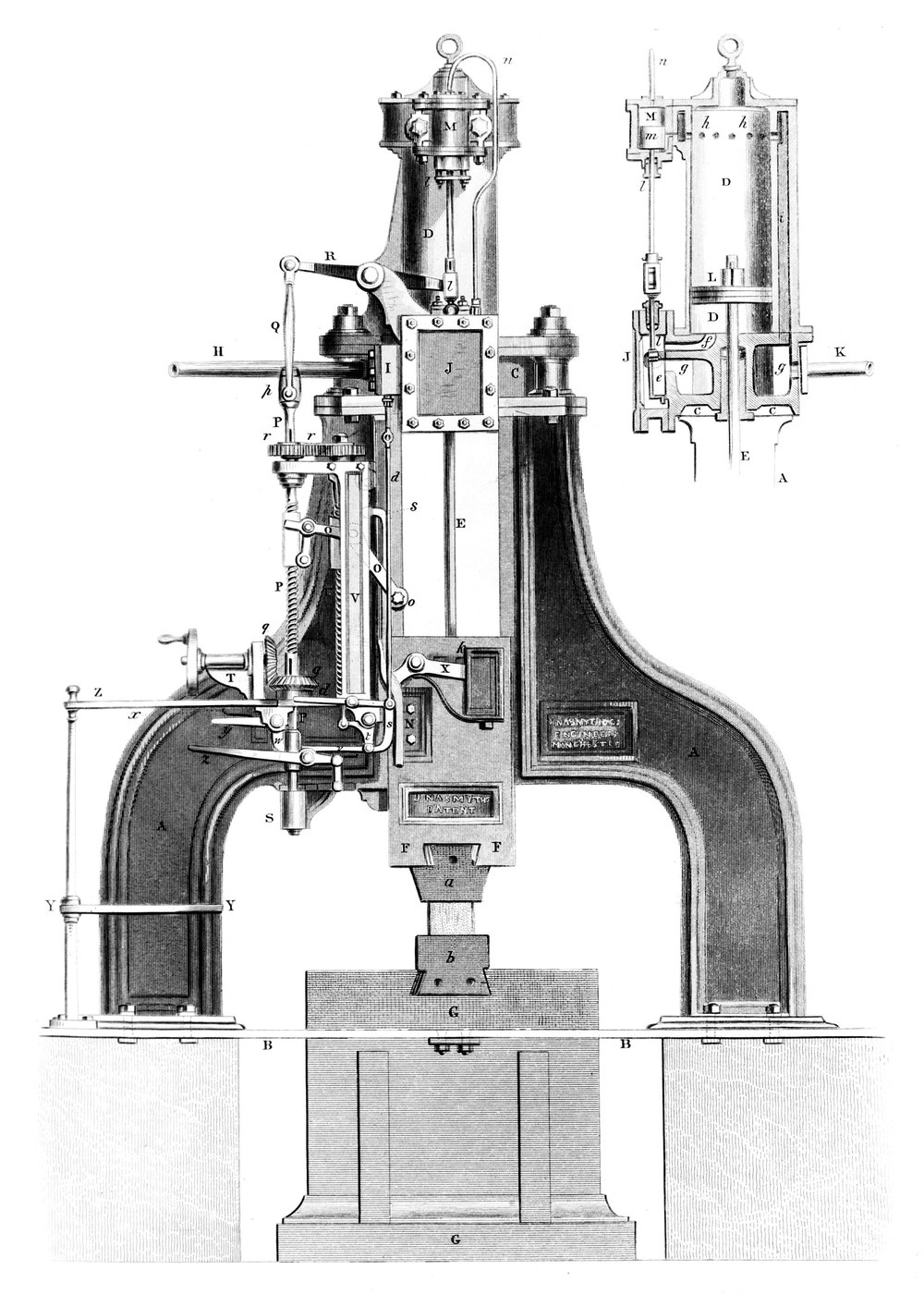


Nasmyth Steam Hammer
안내
Find the limit of a swinging hammer
Find the limit of a swinging hammer
Model the machine being replaced and find where it stops working.
- Pivot a weighted arm so it falls onto an anvil — a tilt hammer.
- Put a thin workpiece under it: the blow lands well.
- Put a tall workpiece under it and try again.
이 단계의 재료:
 소나무 다월 세트1 세트
Stand it upright
Stand it upright
A vertical drop has no arc and no clearance problem.
- Build a frame with a vertical guide.
- Fit a heavy block — the tup — that slides freely on the guide.
- Raise it and let it fall onto an anvil below.
Vary the drop and measure the energy
Vary the drop and measure the energy
Control is the selling point, so quantify it.
- Weigh the tup.
- Drop it from several measured heights onto a lump of modelling clay.
- Measure the depth of each impression.
- Energy in joules ≈ mass (kg) × 9.81 × height (m).
이 단계의 재료:
 디지털 주방 저울1 개
 자1 개
자1 개Understand double action
Understand double action
Nasmyth's first hammer only lifted with steam. The improvement was to push as well.
- Single acting — steam raises the tup, gravity delivers the blow. Maximum energy is fixed by weight and height.
- Double acting — steam also drives the tup down, adding force beyond gravity.
History and context
History and context
James Nasmyth (1808-1890) was a Scottish engineer with a works at Patricroft near Manchester. The commission behind the design was the paddle shaft for Brunel's SS Great Britain — a forging larger than any existing hammer could reach over. He recorded the design in his scheme book in 1839 and patented it in 1842. In the event the Great Britain was redesigned for a screw propeller and never needed the shaft.
The priority dispute is real. While Nasmyth's patent was pending, François Bourdon at Schneider's works at Le Creusot in France built a working steam hammer, reportedly from a drawing he had made independently. Nasmyth visited Le Creusot in 1842 and saw it. His autobiography presents the design as entirely his own; French accounts credit Bourdon with the first machine actually built. Both men may well have arrived at it separately — the need was obvious to anyone forging large work — and the honest position is that Nasmyth patented and popularised it, while who built the first one is contested.
The egg demonstration — lowering the tup to crack an eggshell in a wine glass without breaking the glass — was a real party trick performed for visitors, and it made a serious point about controllability that a specification sheet could not.
What it enabled and what displaced it: steam hammers made large marine shafts, gun barrels, armour plate and locomotive parts practical, and they got enormous — Krupp's Fritz weighed 50 tonnes. Very large forgings later moved to hydraulic presses, which squeeze rather than strike; a press works metal all the way through the section, while a hammer blow tends to deform the surface layers first. Hammers remain in use for smaller work where speed matters.
관련 블루프린트
이 블루프린트들은 지식을 공유합니다 — 기술, 재료 또는 원리



CC0 퍼블릭 도메인
이 블루프린트는 CC0로 공개되었습니다. 어떤 목적으로든 자유롭게 복사, 수정, 배포 및 사용할 수 있습니다.
제품 구매를 통해 메이커를 지원하세요. 판매자가 설정한 메이커 커미션 을 받거나, 이 블루프린트의 새로운 반복을 만들어 연결로 포함시킬 수 있습니다.