예술
뷰티 및 웰니스
공예
문화 및 역사
엔터테인먼트
환경
음식 및 음료
역공학
과학
스포츠
기술
웨어러블
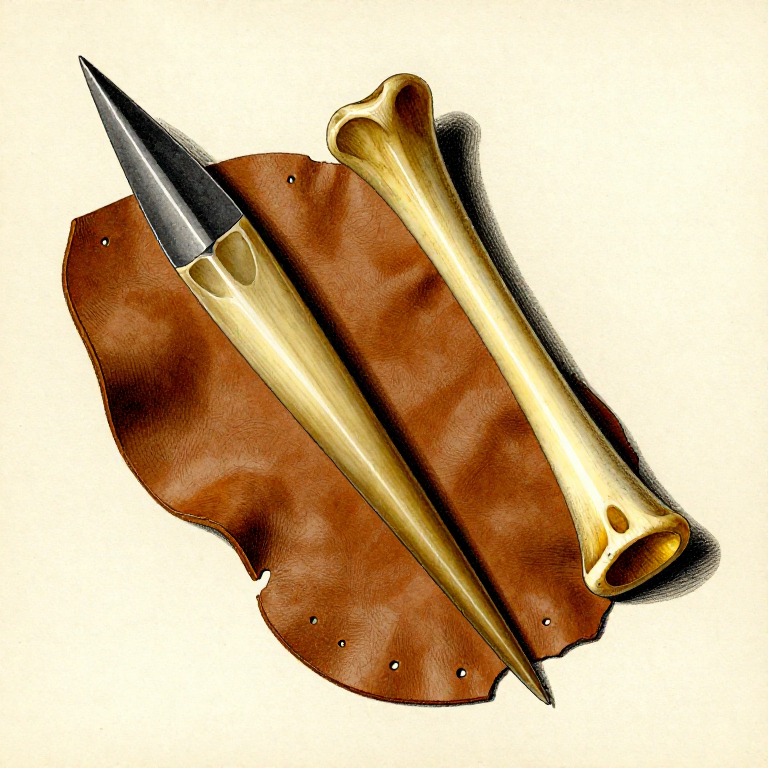

Making a Bone Awl — Piercing Tool for Sewing and Basketry
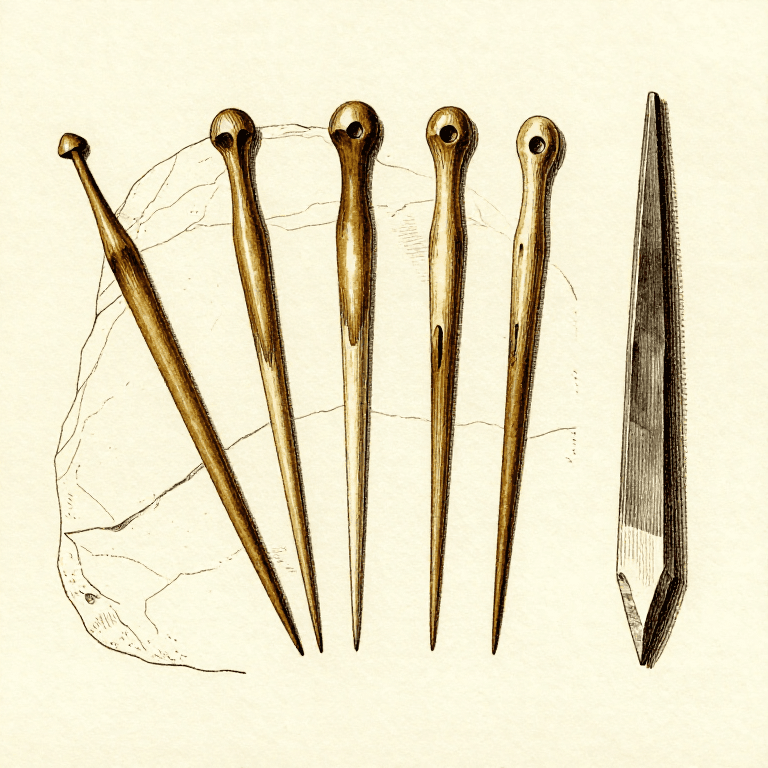
The bone awl is one of the oldest compound tools in the archaeological record, appearing alongside the earliest evidence of sewn clothing and woven containers roughly 60,000 years ago. An awl is a pointed tool used to pierce holes in leather, bark, plant fibers, and other materials before threading cordage or sinew through them. Bone is ideal for awls because it is hard enough to punch through tough materials, can be ground to a very fine point, is slightly flexible (preventing snap breakage under lateral stress), and is self-lubricating from the natural oils in its microstructure. This blueprint teaches how to select suitable bones, split them into blanks, grind the working point, and finish the handle — producing a tool that is essential for sewing hides into clothing, lacing snowshoes, stitching bark containers, and weaving baskets.
초급
45 minutes
안내
1
1
Select a Suitable Bone
Select a Suitable Bone
Choose a long bone from a medium to large mammal — deer metatarsals, elk cannon bones, or cattle shin bones are ideal. The bone must be fresh or recently cleaned (not weathered and brittle). Long bones have thick cortical walls and a natural hollow centre, making them easy to split into elongated blanks with strong cross-sections.
이 단계의 재료:
 동물 뼈(세척·탈지)1 개
2
2
Remove Remaining Tissue and Grease
Remove Remaining Tissue and Grease
Scrape off any remaining periosteum (the thin membrane covering the bone surface) using a stone scraper or the edge of a flint flake. If the bone still feels greasy, soak it in warm water for several hours to leach out fats. Degreased bone grinds more cleanly and accepts abrasion without clogging the grinding stone.
3
3
Score a Splitting Line Along the Bone
Score a Splitting Line Along the Bone
Using a sharp flint flake, score a deep groove along the length of the bone shaft where you want it to split. Apply firm, repeated strokes in the same channel until the groove cuts through at least half the cortical wall thickness. Score both sides of the bone along parallel lines to define the blank width — typically 8 to 12 mm wide.
필요한 도구:
 부싯돌 결핵체
4
4
Split the Bone Along the Score Lines
Split the Bone Along the Score Lines
Place the scored bone on a flat stone anvil with the groove facing up. Position a pointed stone or antler wedge in the groove and strike it firmly with a hammerstone. The bone should split cleanly along the scored line. If it resists, deepen the score groove and try again. You need one splinter approximately 8 to 15 cm long and 8 to 12 mm wide.
필요한 도구:
 망치돌
망치돌 평평한 돌판
5
5
Rough-Shape the Blank
Rough-Shape the Blank
Examine the bone splinter and decide which end will become the point. Choose the end with the straightest grain and thickest cross-section. Using a flint flake, scrape away any jagged edges or protrusions along the sides of the blank. The blank should be roughly rectangular in cross-section at this stage, tapering slightly toward the point end.
6
6
Grind the Point on a Coarse Sandstone Slab
Grind the Point on a Coarse Sandstone Slab
Wet a flat sandstone slab with water to create an abrasive slurry. Hold the point end of the bone blank at a 15 to 20 degree angle against the stone and push forward with firm, even pressure. Rotate the blank slightly between strokes to grind all faces evenly, creating a symmetrical conical point. The coarse stone removes material quickly — switch to finer stone once the basic taper is established.
필요한 도구:
 사암(연마재)
7
7
Refine the Point on a Fine-Grained Stone
Refine the Point on a Fine-Grained Stone
Switch to a finer abrasive stone (fine sandstone or a smooth river pebble) to polish the last 2 cm of the point. The tip should be needle-sharp — it must pierce leather without tearing. Rotate the awl continuously while grinding to maintain a perfectly symmetrical point. Test sharpness by pressing the tip lightly against your thumbnail — it should catch immediately without sliding.
필요한 도구:
 숫돌
숫돌8
8
Shape the Handle End for Grip
Shape the Handle End for Grip
The handle end (the blunt end opposite the point) should be wide enough to push against your palm without pain. Round off any sharp corners by light abrasion on the sandstone slab. Some prehistoric awls show deliberate widening of the handle end — you can leave the natural bone flare or epiphysis as a palm rest if your blank includes it.
9
9
Smooth the Entire Shaft
Smooth the Entire Shaft
Run the full length of the awl shaft over the fine abrasive stone, removing any remaining ridges, score marks, or rough patches from the splitting process. A smooth shaft slides through pierced holes without snagging the material. The bone surface should feel uniformly smooth to the touch, with no catches when you run a fingernail along it.
10
10
Polish with Animal Fat or Beeswax
Polish with Animal Fat or Beeswax
Rub a small amount of rendered animal fat or beeswax into the entire bone surface. This seals the porous bone structure, reduces friction when the awl passes through leather, and prevents the bone from drying out and becoming brittle over time. Buff with a scrap of soft leather until the surface develops a slight sheen.
11
11
Test the Awl on Scrap Leather
Test the Awl on Scrap Leather
Place a piece of scrap leather on a wooden surface. Push the awl point through the leather with steady pressure while twisting slightly. The point should pierce cleanly, creating a round hole without tearing the surrounding material. If the hole tears, the point is too blunt — return to the fine grinding stone. If the awl bends, the blank is too thin — start with a thicker bone.
12
12
Maintain the Point Between Uses
Maintain the Point Between Uses
After each use session, wipe the awl clean of debris and rub a thin film of fat over the point. Store the awl point-down in a sand-filled container or wrapped in soft leather to protect the tip. When the point dulls after extended use, resharpen it on a fine-grained stone — bone resharpens quickly. A well-maintained bone awl lasts for years of regular use.
관련 블루프린트
이 블루프린트들은 지식을 공유합니다 — 기술, 재료 또는 원리
Carving a Bone Fishhook — Grinding & Scoring Technique
Mary 작성
석재 가공
96
0
0
0
0
0
Brain Tanning a Hide — Primitive Leather from Scratch
Mary 작성
황야
104
0
0
0
8
0
Sewing Leather Moccasins from Brain-Tanned Hide — One-Piece Wraparound Pattern
Tex 작성
재봉
63
0
0
0
3
0
Making a Hammerstone — The First Tool in Human History
Mary 작성
석재 가공
57
0
0
0
4
0
CC0 퍼블릭 도메인
이 블루프린트는 CC0로 공개되었습니다. 어떤 목적으로든 자유롭게 복사, 수정, 배포 및 사용할 수 있습니다.
제품 구매를 통해 메이커를 지원하세요. 판매자가 설정한 메이커 커미션 을 받거나, 이 블루프린트의 새로운 반복을 만들어 연결로 포함시킬 수 있습니다.