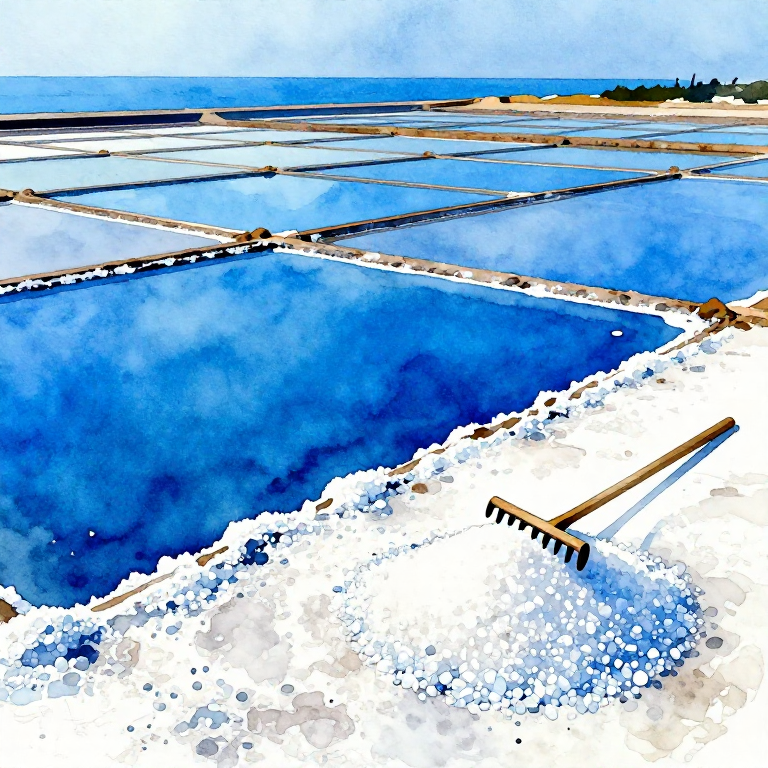

Producing Salt by Solar Evaporation of Seawater — Humanity's Oldest Chemical Process
안내
Understand seawater composition
Understand seawater composition
Seawater contains approximately 35 grams of dissolved salts per liter (3.5% salinity). The dissolved salts are roughly: 78% sodium chloride (NaCl), 11% magnesium chloride (MgCl2), 5% magnesium sulfate (MgSO4), 4% calcium sulfate (CaSO4), and 2% other salts including potassium chloride. To produce 1 kg of salt, you need approximately 28-30 liters of seawater. Solar evaporation works best in warm, dry climates with consistent sunshine and low rainfall. Traditional salt-making regions include the Mediterranean, India (Gujarat), Southeast Asia, and West Africa.
Select a site for evaporation pans
Select a site for evaporation pans
Choose a flat, sun-exposed area near the coast. The site should be above the high-tide line to avoid flooding. Ideal characteristics: maximum sun exposure (south-facing in the Northern Hemisphere), minimal shade from trees or structures, and protection from rain (or a plan to cover pans during rain). Clay or compacted earth makes the best natural pan floor — sandy soil lets brine drain away. Wind is beneficial as it accelerates evaporation. Avoid sites near river mouths where freshwater dilutes salinity.
Construct the first pan (concentrating pan)
Construct the first pan (concentrating pan)
Dig a shallow rectangular basin approximately 2 m x 3 m and 15-20 cm deep. Line the bottom with compacted clay or, if available, a pond liner to prevent seepage. Build low earthen dikes around the edges. The floor must be as level as possible — uneven floors lead to uneven evaporation and premature crystallization in shallow spots. This first pan is the concentrating pan where seawater begins its evaporation journey.
이 단계의 재료:
 다진 점토100 kilogram
 흙 재료200 kilogram
필요한 도구:
 삽
삽 브레이크 패드
 수평계
수평계Construct the second and third pans
Construct the second and third pans
Build two additional pans of similar dimensions but progressively shallower: the second pan 10-15 cm deep, and the third (crystallizing) pan only 5-10 cm deep. Connect the pans with small gated channels or sluices so brine can flow from one to the next by gravity. Position the pans in sequence — each slightly lower than the previous. The multi-pan system allows progressive concentration: calcium sulfate (gypsum) precipitates first at 3-4x concentration in pan two, while NaCl crystallizes in the final pan at 9-10x concentration.
이 단계의 재료:
다진 점토150 kilogram필요한 도구:
삽브레이크 패드Collect seawater
Collect seawater
Collect clean seawater at high tide or from offshore, avoiding river-diluted or harbor-contaminated water. Use buckets, jugs, or a siphon/pump system to fill the first concentrating pan to a depth of 10-15 cm. For a 6 m2 pan at 15 cm depth, you need approximately 900 liters. Collect on calm, clear days when the water is not stirred up with sediment. Let the water settle in the first pan for 24 hours — suspended silt and organic matter will settle to the bottom.
이 단계의 재료:
 바닷물900 리터
필요한 도구:
 양동이
양동이 물 운반 용기
Begin solar evaporation in the first pan
Begin solar evaporation in the first pan
Leave the seawater to evaporate in the first pan under the sun. Evaporation rate depends on temperature, humidity, wind speed, and pan surface area. In warm, dry climates (Mediterranean, tropical dry season), expect 5-10 mm of evaporation per day. A 15 cm deep pan will reduce by half in about 10-15 days. The brine gradually turns from clear to slightly pink or amber as concentration increases. Skim off any floating debris or algae that develops.
필요한 도구:
 고운 그물 뜰채
Transfer concentrated brine to the second pan
Transfer concentrated brine to the second pan
When the brine in the first pan has reduced to about one-third of its original volume (salinity approximately 10-12%), transfer it to the second pan through the connecting channel. At this concentration, calcium sulfate (CaSO4, gypsum) begins to precipitate as fine white crystals on the pan floor. This is desirable — removing gypsum before the NaCl crystallization stage produces cleaner table salt. Refill the first pan with fresh seawater to continue the cycle.
Monitor for NaCl saturation point
Monitor for NaCl saturation point
Continue evaporation in the second pan. When salinity reaches approximately 25-26% (about 9-10 times the original seawater concentration), sodium chloride begins to crystallize. You can test for this point using a hydrometer (read 1.20-1.21 specific gravity) or by observing the first small cubic crystals forming on the surface and edges. The brine at this stage is called bittern. Transfer this near-saturated brine to the third (crystallizing) pan, leaving the gypsum deposits behind in pan two.
필요한 도구:
 비중계
비중계Crystallize salt in the final pan
Crystallize salt in the final pan
In the shallow crystallizing pan (5-10 cm deep), NaCl crystals form as the brine continues to evaporate. Crystals appear first as a thin floating crust on the surface, then grow as hollow pyramidal hoppers (inverted stepped pyramids characteristic of NaCl). As they grow heavier, they sink and accumulate on the pan floor as a thick salt bed 2-5 cm deep. The process takes 5-10 days in warm, dry conditions. Do NOT let the pan evaporate completely — stop when about 2 cm of liquid (bittern) remains above the salt.
Harvest the salt crystals
Harvest the salt crystals
Drain or scoop off the remaining bittern (bitter liquid rich in magnesium chloride and potassium salts — this is the traditional source of nigari/magnesium chloride used in tofu making). Use a wooden rake or flat shovel to scrape the salt crystals from the pan floor. Pile the wet salt on a raised platform or in baskets to drain. The harvested raw salt is a mixture of NaCl crystals, some trapped bittern, and minor impurities. Total yield from 900 liters of seawater: approximately 25-30 kg of raw salt.
필요한 도구:
 나무 갈퀴
나무 갈퀴 각삽
각삽 물기 빼는 바구니
Wash the salt with saturated brine
Wash the salt with saturated brine
To remove bitter magnesium and potassium salts trapped between crystals, wash the harvested salt with a small amount of saturated sodium chloride solution (brine). Make the wash brine by dissolving salt in water until no more dissolves (approximately 360 g NaCl per liter at 20 degrees C). Pour this saturated brine over the salt pile — it dissolves the more soluble MgCl2 and KCl impurities without dissolving significant NaCl (because the brine is already saturated with NaCl). Drain and repeat once more if the salt tastes bitter.
이 단계의 재료:
 깨끗한 물 (헹굼용)5 리터
 가지고 있는 소금2 kilogram
필요한 도구:
 혼합 용기
혼합 용기Dry the washed salt
Dry the washed salt
Spread the washed salt in a thin layer (2-3 cm) on a clean, raised surface — a wooden table, clean tarp, or woven mat works well. Cover with a fine mesh or cheesecloth to keep insects and debris out while allowing air circulation. In direct sun with good airflow, the salt dries in 1-2 days. Turn it occasionally with a wooden paddle to expose all surfaces. Properly dried salt should feel completely dry and free-flowing, with no clumping.
필요한 도구:
 건조면
건조면 고운 치즈클로스
 나무 주걱노
Grade and store the finished salt
Grade and store the finished salt
Sieve the dried salt to separate crystal sizes: coarse crystals (above 2 mm) for cooking and curing, fine crystals for table use. Well-made solar salt is white to slightly gray, tastes clean and salty with no bitterness (bitterness indicates remaining magnesium salts — wash again). Store in dry, airtight containers — ceramic jars, glass jars, or food-grade plastic. Salt is hygroscopic (absorbs moisture from air), so keep containers sealed. Properly stored, salt keeps indefinitely — it is itself a preservative. Label with production date and source.
필요한 도구:
 체
체 밀폐 보관 용기
Maintain the evaporation pans for next cycle
Maintain the evaporation pans for next cycle
After harvesting, clean the crystallizing pan by scraping off any remaining salt crust and gypsum deposits. Repair any cracks in the clay lining. Re-level the pan floor if it has become uneven. In commercial salt pans (salinas), the cycle is continuous — fresh seawater enters the first pan while salt is harvested from the third. A well-maintained three-pan system can produce multiple harvests per season. In tropical climates with year-round sunshine, production can be nearly continuous during dry months.
필요한 도구:
삽브레이크 패드재료
6- 250 kilogram플레이스홀더
- 200 kilogram플레이스홀더
- 900 리터플레이스홀더
- 5 리터플레이스홀더
- 2 kilogram플레이스홀더
- 5 리터플레이스홀더
연결된 블루프린트 재료
CC0 퍼블릭 도메인
이 블루프린트는 CC0로 공개되었습니다. 어떤 목적으로든 자유롭게 복사, 수정, 배포 및 사용할 수 있습니다.
제품 구매를 통해 메이커를 지원하세요. 판매자가 설정한 메이커 커미션 을 받거나, 이 블루프린트의 새로운 반복을 만들어 연결로 포함시킬 수 있습니다.