예술
뷰티 및 웰니스
공예
문화 및 역사
엔터테인먼트
환경
음식 및 음료
역공학
과학
스포츠
기술
웨어러블
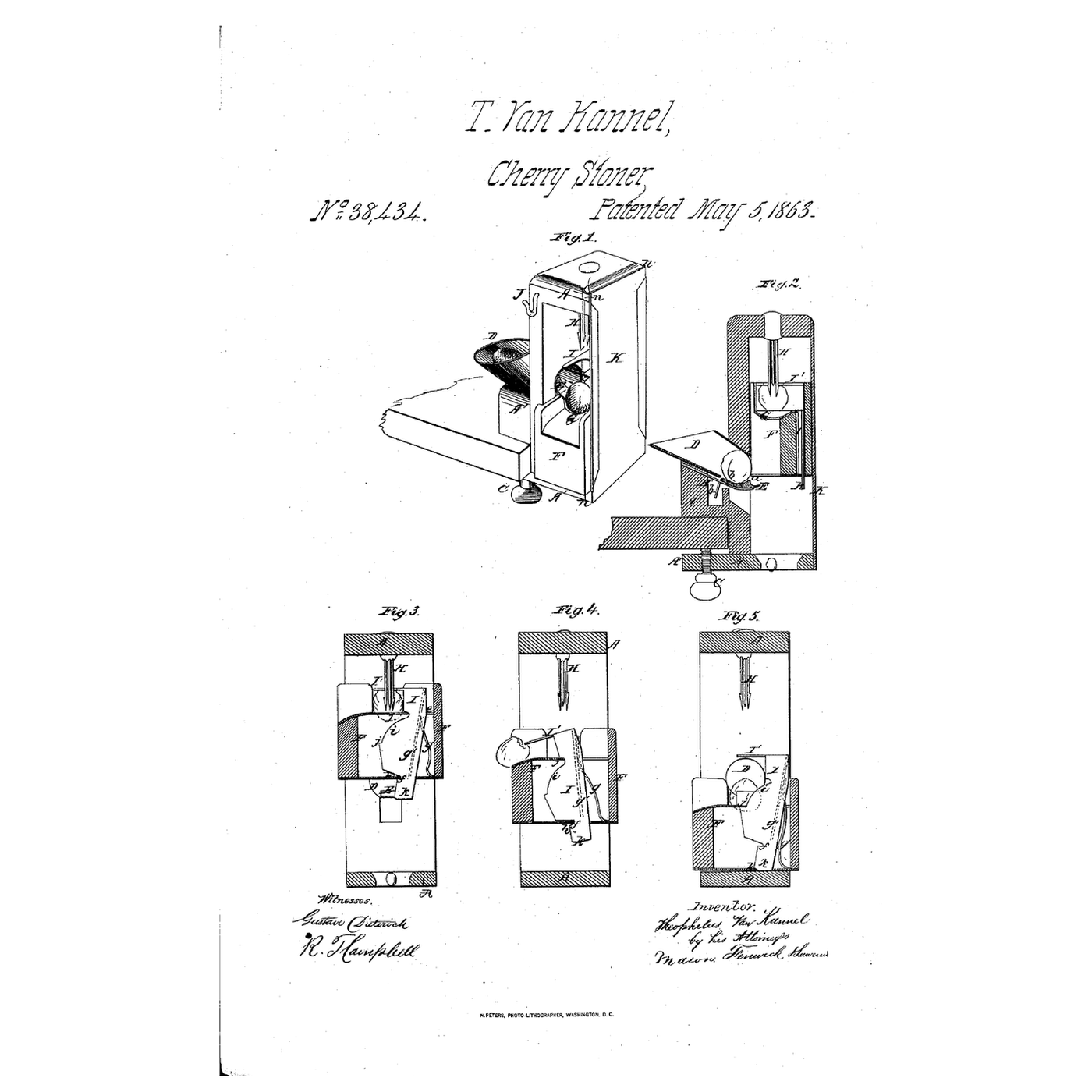


The Cherry Stoner: A Hopper, a Basin and a Fork of Needles
Cherries for pies, jam and bottling have to be stoned, one at a time, and a season's fruit is thousands of them.
Theophilus Van Kannel of Chester, Illinois, received US 38,434, dated 5 May 1863, for an "Automatic Cherry-Stoner" that improved on his own patent of 14 October 1862. Clamped to a table, it has a hopper that a rocking feeder lets out one cherry at a time into a basin on a sliding box. On the up-stroke a fork of barbed needles pushes the stone through the cherry and out through a hole in the basin; on the down-stroke a spring claw strips the stoned cherry off the fork and throws it out of the machine.
This rung works out the throughput and times stoning by machine and by hand.
초급
About 2 hours
안내
1
1
Strokes, cherries and minutes
Strokes, cherries and minutes
Jupyter 노트북 불러오는 중…
2
2
Why so many cherries needed stoning
Why so many cherries needed stoning
Bottling fruit made a season's harvest worth preparing in bulk. The embedded blueprint shows the method.
3
3
Read US 38,434
Read US 38,434
Van Kannel's object is "to stone cherries by machinery adapted to this purpose, which is automatic in its operation, requiring no further manipulation than to put the cherries into a hopper and to keep the machine in motion". His earlier machine (patent of 14 October 1862) removed the cherries from the "barbed needles" with a spring finger-piece worked by the hand; now that piece, "which I now term a 'claw,' operates automatically".
A box A with jaws and a clamping screw holds the machine upright on a table edge. A conical-mouthed hopper D feeds a sliding box F; a curved rocking feeder E with a ridge and tongue lets out "only one cherry to be discharged at a time." Box F has a basin G with a hole in its bottom. The fork H "is made of five (or more or less) needles", fixed above in line with the hole, so as the basin rises "the fork H will thrust the stone through the cherry and through the basin, leaving the stoned cherry above or on the basin". The fork is barbed to hold the cherry, and the spring-claw I "separates the stoned cherry from the barbed fork H, and thrusts this cherry out of the machine in the downward stroke".
4
4
One stroke of the stoner
One stroke of the stoner
Blockly 작업 공간
Loading Blockly workspace...
5
5
Stone a kilo two ways
Stone a kilo two ways
Weigh out two 500 g lots of cherries. Stone one lot by hand with a paper-clip loop or the tip of a knife, timing it with the stopwatch; stone the other with a cherry pitter, timing it too. Weigh the stones and the stoned fruit from each lot to see how much flesh each method loses, and count any cherries where the stone was missed.
이 단계의 재료:
 체리1 개
체리1 개필요한 도구:
 체리 씨 제거기
 디지털 주방 저울
 스톱워치
스톱워치 양동이
양동이6
6
A cherry pitter that misses
A cherry pitter that misses
Cherry pitter troubleshooting.
Flow
Loading...
7
7
History and honest limits
History and honest limits
**Theophilus Van Kannel** of Chester, Illinois, received US 38,434, dated 5 May 1863. His claims cover the curved spring-rocker feeding cherries one at a time, the automatic claw that discharges the stoned cherries, and the claw's sliding and vibrating action.
**Honest limits.** Cherry weight and stoning rates in the notebook are examples.
관련 블루프린트
이 블루프린트들은 지식을 공유합니다 — 기술, 재료 또는 원리





CC0 퍼블릭 도메인
이 블루프린트는 CC0로 공개되었습니다. 어떤 목적으로든 자유롭게 복사, 수정, 배포 및 사용할 수 있습니다.
제품 구매를 통해 메이커를 지원하세요. 판매자가 설정한 메이커 커미션 을 받거나, 이 블루프린트의 새로운 반복을 만들어 연결로 포함시킬 수 있습니다.