예술
뷰티 및 웰니스
공예
문화 및 역사
엔터테인먼트
환경
음식 및 음료
역공학
과학
스포츠
기술
웨어러블


The Floppy Disk
IBM's System/370 had a problem that had nothing to do with storing customer data: it needed its own microcode loaded at power-up, and punched cards were slow and enormous. In 1971 a team under Alan Shugart shipped the 23FD, codenamed Minnow — an eight-inch flexible disc in a sleeve, read-only, holding about eighty kilobytes. Its whole job was to boot the machine.
The 33FD of 1973 made it read-write, and at that point somebody noticed what had actually been invented. Here was storage you could take OUT and hand to somebody. The hard disks of the day were sealed, or the size of a washing machine, or both. Within a decade the floppy was how software was sold, how documents moved between offices, and how an entire generation of personal computers booted.
The engineering choice underneath it is contact. The head rests ON the medium instead of flying above it, which by blueprint 1's arithmetic should be a triumph — zero spacing means zero spacing loss. It is not a triumph, because contact means friction, so the disc must turn slowly, the medium must be soft enough not to grind the head away, and the head must be wide enough not to plough. Every one of those costs density, and together they cost more than the spacing loss they saved.
MEASURED, NOT FABRICATED. Nobody coats their own medium. What you can do is develop a real floppy's magnetic tracks with ferrofluid and look at them — the recorded data becomes visible under a loupe, and the track pitch is measurable to a few percent.
초급
3 hours
안내
1
1
Open a disc and find the parts
Open a disc and find the parts
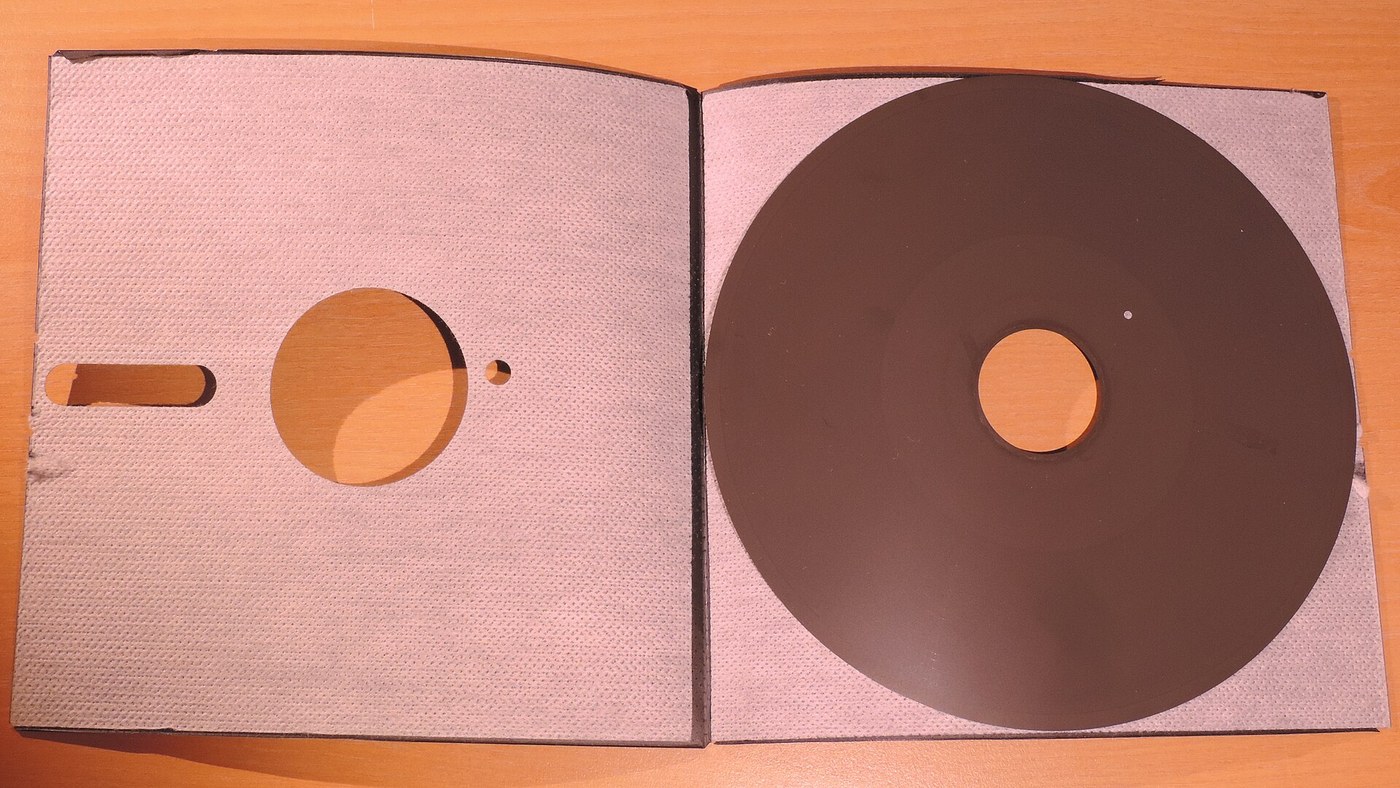
Prise the shutter off a 3.5-inch floppy and cut the plastic shell open. Inside: a circular sheet of PET about 80 micrometres thick, coated on both sides with magnetic oxide, and two sheets of soft non-woven fabric that wipe it as it turns.
That fabric is not padding. It is a self-cleaning system, because in contact recording every particle that gets between head and medium is a scratch, and the drive has no way to keep dust out of a removable disc.
Note the metal hub with its drive pin hole, and on a 5.25-inch disc the index hole in the jacket. That hole gives the drive its rotational origin — the one moment per revolution when it knows where it is. Measure the disc with the caliper and record the coating colour.
이 단계의 재료:
 플로피 디스크2 개
필요한 도구:
 디지털 캘리퍼스 6인치
 여분 날이 딸린 공예용 칼
 휴대용 확대경 10배
2
2
Develop the tracks with ferrofluid
Develop the tracks with ferrofluid
Wear the gloves and work over a tray; ferrofluid stains everything it touches and does not come out.
Dilute one drop of ferrofluid in about 5 ml of isopropyl alcohol. Lay the disc flat and let a thin film of the mixture flow across it, then tilt to drain and let the alcohol evaporate.
The particles collect where the field gradients are strongest — which is exactly at every recorded transition. Concentric rings appear. They are the tracks, and each one carries a visible fine structure that is the data itself.
Look under the loupe against a scale. Count the rings across a measured 5 mm and divide. You should land near 135 tracks per inch on a 3.5-inch disc, which is 188 micrometres apart. Compare an unused disc against a written one: the unused one shows only the factory-written index and nothing else.
이 단계의 재료:
 자성 유체5 ml
 이소프로필 알코올 99 %50 ml
 니트릴 장갑1 개플로피 디스크1 개
필요한 도구:
휴대용 확대경 10배 자디지털 캘리퍼스 6인치
3
3
Formats, pitch and the cost of contact
Formats, pitch and the cost of contact
Jupyter 노트북 불러오는 중…
필요한 도구:
 데스크톱 컴퓨터
4
4
Compendium: what removability cost
Compendium: what removability cost
OPEN LOOP, AND WHY IT WORKED. A floppy has no servo: a stepper counts steps out from a track-zero switch. At 188 micrometres of pitch that is good enough, just — which is why discs written in one drive sometimes would not read in another, why 40-track discs in an 80-track drive were unreliable, and why alignment was a service procedure with its own test disc.
THE SIBLING, MEASURED. Floppy: contact, removable, 300 rpm, soft medium, open-loop stepper, a head that wears. Winchester: flying at 0.46 um, sealed, 3000 rpm, hard medium, closed-loop servo, and in 1973 already 70 MB against the floppy's 250 KB. Removability is the only row the floppy wins, and it won it so decisively the format outlived drives fifty times denser.
WHY IT ENDED. Not density — it was beaten on density by 1975 and survived twenty-five more years. It ended when something ELSE became removable: the CD-ROM held 450 floppies, and flash made even that look slow.
관련 블루프린트
이 블루프린트들은 지식을 공유합니다 — 기술, 재료 또는 원리

CC0 퍼블릭 도메인
이 블루프린트는 CC0로 공개되었습니다. 어떤 목적으로든 자유롭게 복사, 수정, 배포 및 사용할 수 있습니다.
제품 구매를 통해 메이커를 지원하세요. 판매자가 설정한 메이커 커미션 을 받거나, 이 블루프린트의 새로운 반복을 만들어 연결로 포함시킬 수 있습니다.