예술
뷰티 및 웰니스
공예
문화 및 역사
엔터테인먼트
환경
음식 및 음료
역공학
과학
스포츠
기술
웨어러블
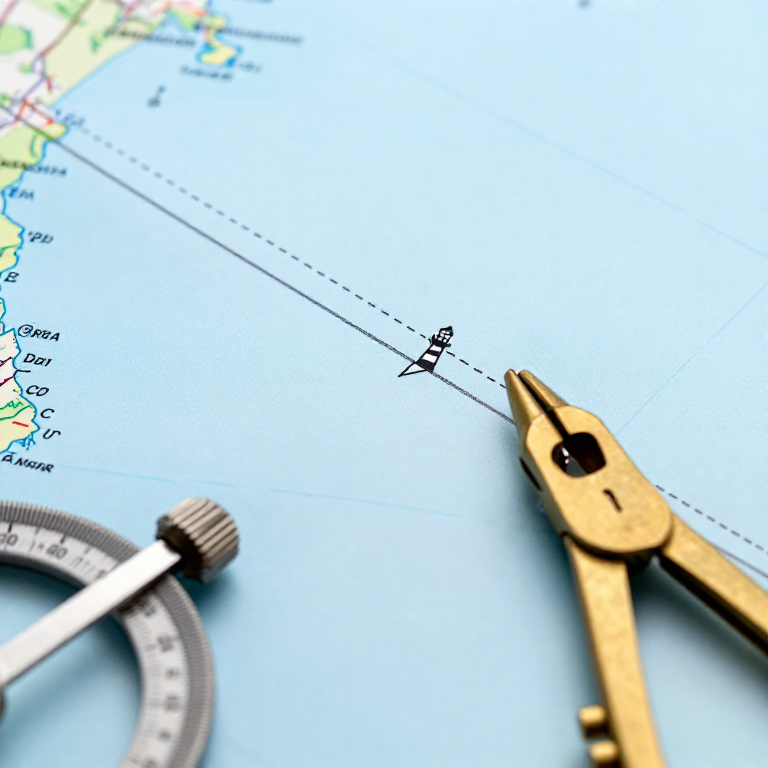


The Running Fix: A Position from One Object
Two landmarks give you a position immediately: take a bearing on each, draw both lines, and you are where they cross. Along most coasts, most of the time, you can only see one.
The running fix solves it with time. Take a bearing on the single object, run on for a known course and distance, and take a second bearing on the SAME object. Then transfer the first bearing line forward by exactly the distance and direction you ran, and where the transferred line crosses the second bearing is your position.
It is dead reckoning and observation working together, and it inherits the weaknesses of both — the transfer is only as good as your run, so a running fix is never quite as trustworthy as a proper fix. Knowing by how much, and in which direction, is what makes it safe to use.
중급
1 day
안내
1
1
Choose an object you can identify beyond doubt
Choose an object you can identify beyond doubt
A lighthouse, a church spire, a distinctive headland — something charted, unmistakable, and still visible after the run.
The commonest catastrophic error in coastal navigation is a confidently taken bearing on the wrong object: two similar headlands, two chimneys, a light misidentified at night. Check the characteristic of a light before trusting it, and if there is any doubt at all, say so in the log and treat the fix as an estimate.
필요한 도구:
 쌍안경
쌍안경2
2
Take the first bearing and note the time and log
Take the first bearing and note the time and log
Sight the object, read the bearing, and write it down with the exact time and the log reading in the same breath.
The three belong together, because the transfer depends on knowing precisely how far you ran between the two bearings. A bearing without its time is not usable in a running fix at all. Take three readings and average them if the boat is moving about — a bearing taken from a lurching deck can easily be five degrees out.
필요한 도구:
 나침반
나침반 스톱워치
스톱워치3
3
Run on, and change the geometry
Run on, and change the geometry
Hold a steady course and speed, and wait until the bearing has changed by at least thirty degrees — sixty is better.
The two lines must cross at a decent angle or the fix is worthless: at a shallow crossing, a small bearing error slides the intersection a long way along the lines. This is the same angle-of-cut problem as the plane table rung, and it has the same answer — be patient, and let the geometry improve before taking the second sight.
필요한 도구:
나침반스톱워치4
4
Transfer the first line by the run made good
Transfer the first line by the run made good
Draw the first bearing. Then from any point on it, lay off the course and distance actually run — including the tidal stream — and draw a new line parallel to the first through that point. Label it as transferred, with both times.
The transfer must use the ground track, not the water track. Ignoring the stream here is the commonest way a running fix comes out wrong, and it fails in the direction of the stream, which near a headland is exactly where you least want to be pushed.
이 단계의 재료:
 모눈종이10 개
필요한 도구:
 각도기
각도기 자
자5
5
How good is the fix, and the special cases worth knowing
How good is the fix, and the special cases worth knowing
Jupyter 노트북 불러오는 중…
필요한 도구:
각도기6
6
Label it as a running fix, and treat it as one
Label it as a running fix, and treat it as one
Mark the position 'R Fix' with the time, not 'Fix'. On a chart they look identical and they are not equally trustworthy.
The convention exists so that whoever reads the chart — including you, later — knows how much weight to give it. When a running fix disagrees with the depth sounder, believe the sounder. When it disagrees with a two-object fix, believe the fix.
관련 블루프린트
이 블루프린트들은 지식을 공유합니다 — 기술, 재료 또는 원리




CC0 퍼블릭 도메인
이 블루프린트는 CC0로 공개되었습니다. 어떤 목적으로든 자유롭게 복사, 수정, 배포 및 사용할 수 있습니다.
제품 구매를 통해 메이커를 지원하세요. 판매자가 설정한 메이커 커미션 을 받거나, 이 블루프린트의 새로운 반복을 만들어 연결로 포함시킬 수 있습니다.