예술
뷰티 및 웰니스
공예
문화 및 역사
엔터테인먼트
환경
음식 및 음료
역공학
과학
스포츠
기술
웨어러블
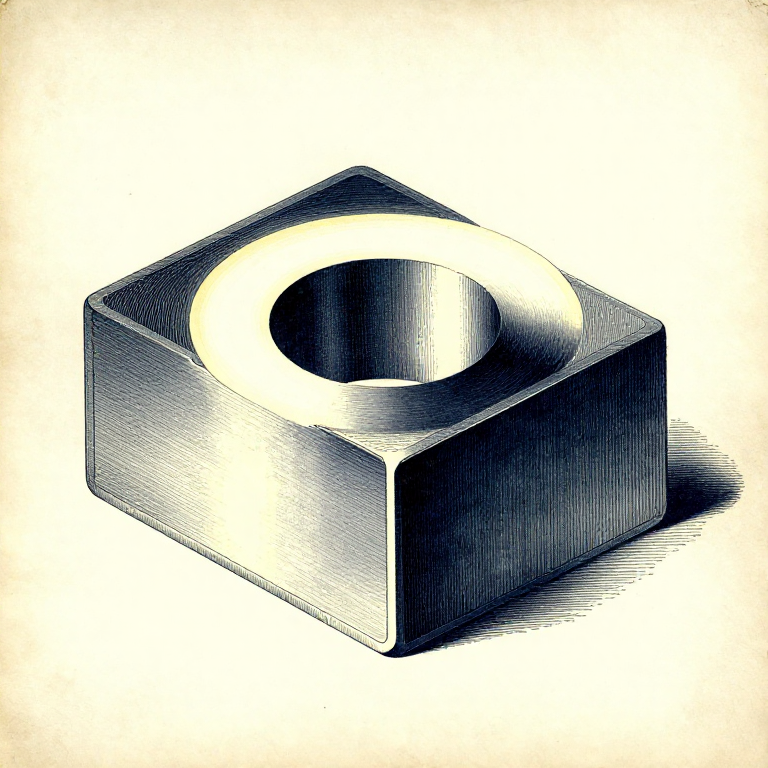


The Surface Is Not the Centre: Thermal Mass and Soak Time
A piece of steel that looks orange all over is orange on the OUTSIDE. The centre is cooler, and how much cooler depends on how thick it is and how long it has been in the fire.
That gap is the cause of a whole family of failures that look like something else: a blade that hardens at the edge and not the spine, a billet that cracks when forged, a pot that survives the kiln and shatters a week later. In each case the colour was right and the inside was not.
The fix is SOAK TIME — holding at temperature after it looks right — and how much you need is calculable rather than a matter of opinion.
중급
3 hours
안내
1
1
Heat travels at a finite speed, and it is slower than you think
Heat travels at a finite speed, and it is slower than you think
Heat spreads by conduction, and the rate depends on the material's thermal diffusivity. Copper and aluminium are fast; steel is several times slower; ceramic, glass and stone are slower again by a large factor.
The consequence is that time-to-centre grows with the SQUARE of the thickness. Double the bar and it takes four times as long, not twice. That single relationship explains most of what goes wrong here and it is worth internalising before any of the arithmetic.
It is also why thin sections in the same piece reach temperature long before thick ones — the subject of a later rung, because it is the reason points and edges burn off while the body is still coming up.
이 단계의 재료:
 연강 봉2 개
필요한 도구:
 대장간 화덕
 대장간 집게
2
2
How long to the centre
How long to the centre
Jupyter 노트북 불러오는 중…
필요한 도구:
 계산기
계산기 표시기 달린 열전대
3
3
Soak at temperature, do not just reach it
Soak at temperature, do not just reach it
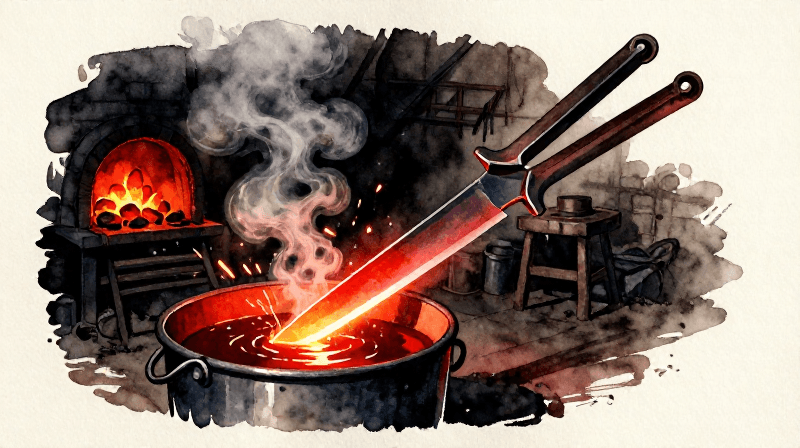
Once the surface is at the colour you want, HOLD it there. The fire should be maintaining the temperature rather than still driving it up, and the work should sit in it without being pushed hotter.
For hardening this matters most: the steel has to be fully austenitic through its section before quenching, and a piece quenched as soon as the surface reaches colour hardens only in a shell. The published heat-treatment blueprint depends on this being done properly.
Turn the work and move it in the fire during the soak. A piece lying still has a hot side and a cold side, so it is soaking unevenly even while the total time looks right.
이 단계의 재료:
연강 봉1 개 숯1 개
숯1 개필요한 도구:
대장간 화덕대장간 집게표시기 달린 열전대 긴 소매 가죽 장갑
4
4
The same arithmetic runs kiln schedules
The same arithmetic runs kiln schedules
A kiln is fired slowly for exactly this reason. Clay and glass have diffusivities twenty to forty times lower than steel, so a pot wall that looks trivially thin takes minutes rather than seconds to equalise — and a thick foot or a heavy handle takes far longer than the wall beside it.
Heat it faster than the inside can follow and the temperature difference across the wall creates stress. That is why ware cracks on the way UP as often as on the way down, and why a firing schedule has soak periods at particular temperatures rather than simply climbing.
The same reasoning covers glass annealing, tempering a large casting, and warming a cold anvil before heavy work. Whenever a thing is thick and the material is slow, the schedule matters more than the peak.
필요한 도구:
 가마(킬른)
 고온 가마표시기 달린 열전대
관련 블루프린트
이 블루프린트들은 지식을 공유합니다 — 기술, 재료 또는 원리


CC0 퍼블릭 도메인
이 블루프린트는 CC0로 공개되었습니다. 어떤 목적으로든 자유롭게 복사, 수정, 배포 및 사용할 수 있습니다.
제품 구매를 통해 메이커를 지원하세요. 판매자가 설정한 메이커 커미션 을 받거나, 이 블루프린트의 새로운 반복을 만들어 연결로 포함시킬 수 있습니다.