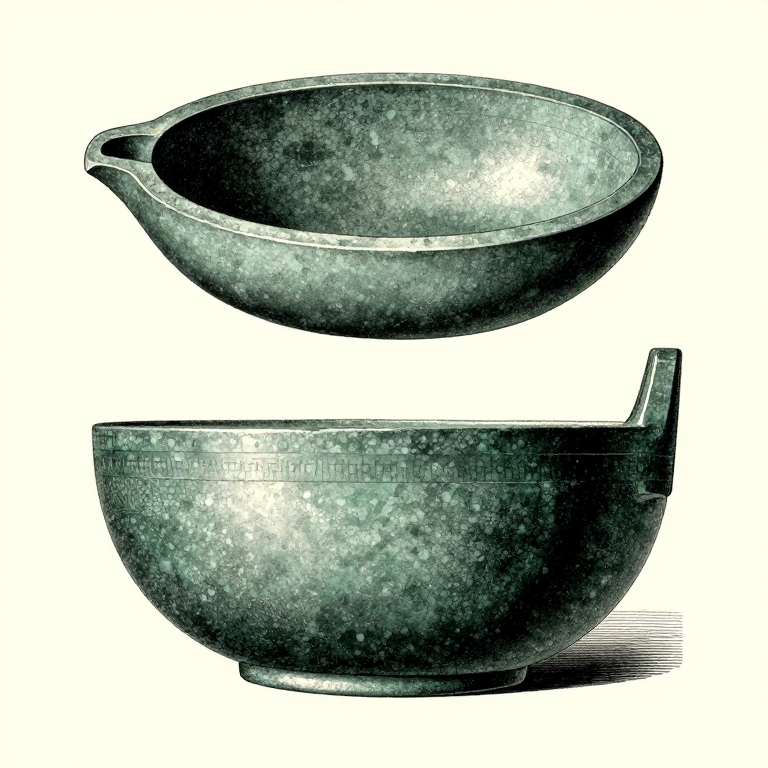


Carving a Soapstone Cooking Vessel — Steatite Cookware
안내
Select the Soapstone
Select the Soapstone
Choose a block of soapstone (steatite) free of cracks, fractures, and hard mineral inclusions. Soapstone is very soft — you can scratch it with a fingernail — and has a soapy, greasy feel. It ranges in color from gray to green to brown. Select a piece at least 25cm × 20cm × 15cm for a cooking vessel of useful size.
Test for soundness by tapping with a hammer — a clear ring indicates solid stone; a dull thud may indicate internal cracks. Soapstone with visible veins of harder minerals (like quartz) should be avoided as they resist carving and can cause the vessel to crack unevenly during heating.
이 단계의 재료:
 동석 블록1 block (25×20×15cm minimum) cm
필요한 도구:
 도끼
도끼 쇠끌
쇠끌 둥근끌(구우지)
 사암(연마재)
Mark the Vessel Outline
Mark the Vessel Outline
Plan the vessel shape on the stone surface using a sharp point or charcoal. An oval or rectangular plan is easier to carve than circular. Mark the wall thickness — aim for approximately 1.5-2cm walls with a slightly thicker bottom (2-3cm) for durability. Mark a pouring spout location if desired.
Consider the grain direction of the stone. Soapstone has a layered structure — carving with the grain is easier and produces cleaner surfaces than carving against it.
Rough-Carve the Exterior
Rough-Carve the Exterior
Using an axe, chisel, or heavy knife, remove excess stone from the outside to shape the exterior contour. Work carefully — soapstone is soft but can chip or fracture if struck too aggressively at an angle. Use controlled, direct blows.
Shape the exterior to the planned vessel form. Leave the walls slightly thicker than final dimensions to allow for smoothing and finishing later. The bottom should be flat or gently rounded for stability when placed on coals or a hearth stone.
Hollow the Interior
Hollow the Interior
Using a gouge, chisel, and scraping tools, hollow out the interior of the vessel. Begin by chiseling a series of channels across the interior, then remove the ridges between them. Work from the center outward and downward, checking wall thickness frequently by pressing a finger on the outside while feeling the inside.
Maintain even thickness throughout — thin spots are weak points that may crack under thermal stress. The interior surface does not need to be perfectly smooth at this stage but should be free of deep gouges and ridges. Remove material gradually — it is easy to carve too deep in soapstone.
Smooth and Finish
Smooth and Finish
Smooth the interior and exterior surfaces using progressively finer abrasives. Start with a piece of coarse sandstone, rubbing in circular motions to remove tool marks. Follow with a finer-grained stone or a flat piece of slate for a smoother finish.
Carve a pouring spout at one edge if desired — cut a V-shaped channel in the rim using a knife or chisel. Smooth all edges and the rim to prevent chipping. The finished surface should feel smooth and have a subtle sheen from the natural talc content of the stone.
First Firing (Heat Seasoning)
First Firing (Heat Seasoning)
Soapstone can crack if heated too quickly (thermal shock). Season the vessel by warming it gradually — place it near (not directly on) a fire for the first session. Over several uses, gradually increase the heat exposure until it can sit directly on coals or a hearth fire.
Once heat-seasoned, soapstone cookware is remarkably durable and retains heat exceptionally well — food continues cooking after being removed from the fire. Soapstone also imparts no flavor to food and does not react with acidic liquids. Clean by scrubbing with water; avoid dropping it, as the main risk to soapstone cookware is impact fracture.
이 블루프린트로 만드는 것

CC0 퍼블릭 도메인
이 블루프린트는 CC0로 공개되었습니다. 어떤 목적으로든 자유롭게 복사, 수정, 배포 및 사용할 수 있습니다.
제품 구매를 통해 메이커를 지원하세요. 판매자가 설정한 메이커 커미션 을 받거나, 이 블루프린트의 새로운 반복을 만들어 연결로 포함시킬 수 있습니다.