ศิลปะ
ความงามและสุขภาพ
งานฝีมือ
วัฒนธรรมและประวัติศาสตร์
ความบันเทิง
สิ่งแวดล้อม
อาหารและเครื่องดื่ม
วิศวกรรมย้อนรอย
วิทยาศาสตร์
กีฬา
เทคโนโลยี
อุปกรณ์สวมใส่
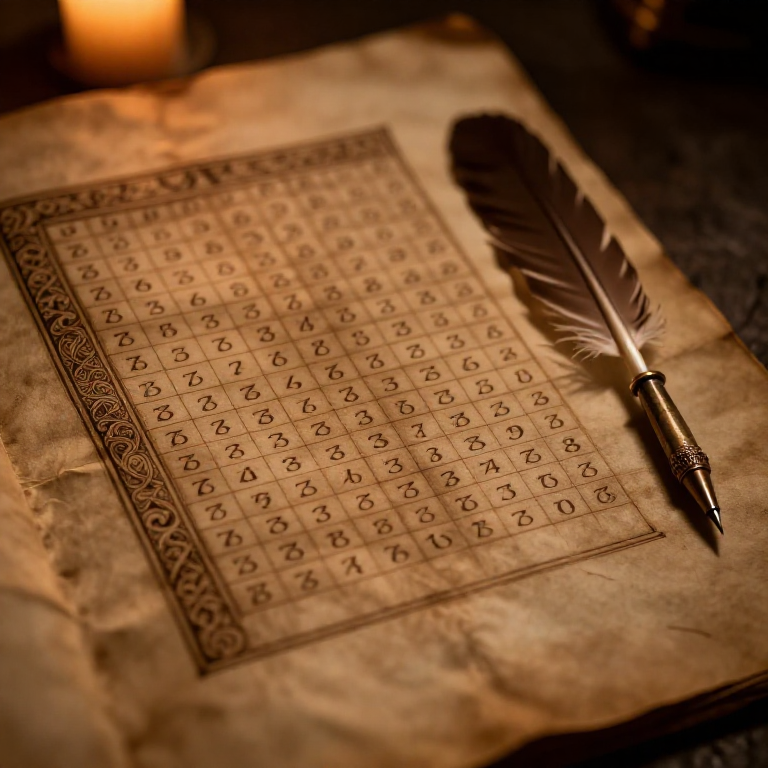


Magic Squares — Arrange Numbers So Every Line Adds the Same
A hands-on maths puzzle: cut number tiles 1 to 9 and arrange them in a 3 by 3 square so every row, column and diagonal adds to 15. A Python cell checks any square you make, and a compendium reveals the maths (and the artist Durer) hidden inside these ancient number patterns.
เริ่มต้น
30 minutes
คำแนะนำ
1
1
Numbers that balance
Numbers that balance
A magic square is a grid where every row, every column and both diagonals add up to the same total. The oldest, the Chinese Lo Shu, is thousands of years old. You will build one with your hands.
2
2
Make your number tiles
Make your number tiles
Cut nine small squares of card and write the numbers 1 to 9, one on each tile. Draw an empty 3 by 3 grid to place them in.
วัสดุสำหรับขั้นตอนนี้:
 กระดาษการ์ด1 ชิ้น
เครื่องมือที่ต้องใช้:
 กรรไกร
 ชุดดินสอกราไฟต์
3
3
Solve the puzzle
Solve the puzzle
Arrange the nine tiles in the grid so that every row, every column and both diagonals add up to 15. Hint: the numbers 1 to 9 add to 45, and 45 divided by 3 rows is 15, so 15 is the target. Another hint: 5 belongs in the middle. Keep swapping tiles until every line makes 15.
4
4
Check your square
Check your square
กำลังโหลดสมุด Jupyter…
เครื่องมือที่ต้องใช้:
 คอมพิวเตอร์ตั้งโต๊ะ
5
5
Compendium: the maths inside
Compendium: the maths inside
What you discovered. (1) For a square of side n using 1 to n-squared, the magic total is always n times (n-squared plus 1) over 2 -- 15 for a 3x3, 34 for a 4x4. (2) There is really only ONE 3x3 magic square; every solution you find is just that one rotated or flipped. (3) Bigger squares have their own tricks -- odd sizes can be filled by the 'always step up and to the right' Siamese method. (4) In 1514 the artist Albrecht Durer hid a 4x4 magic square in his engraving Melencolia I, with the year 1514 tucked into its bottom row -- proof that mathematicians and artists have loved these balanced numbers for centuries.
วัสดุ
2- 1 ชิ้นตัวยึดตำแหน่ง
- 1 แผ่นตัวยึดตำแหน่ง
เครื่องมือที่จำเป็น
3- ตัวยึดตำแหน่ง
- ตัวยึดตำแหน่ง
- ตัวยึดตำแหน่ง
บลูพริ้นท์ที่เกี่ยวข้อง
บลูพริ้นท์เหล่านี้แบ่งปันความรู้ — เทคนิค วัสดุ หรือหลักการ
CC0 สาธารณสมบัติ
พิมพ์เขียวนี้เผยแพร่ภายใต้ CC0 คุณสามารถคัดลอก แก้ไข แจกจ่าย และใช้งานผลงานนี้เพื่อวัตถุประสงค์ใดก็ได้ โดยไม่ต้องขออนุญาต
สนับสนุนเมกเกอร์โดยซื้อสินค้าผ่านพิมพ์เขียวของพวกเขา ซึ่งพวกเขาจะได้รับ ค่าคอมมิชชันเมกเกอร์ ที่ผู้ขายกำหนด หรือสร้างเวอร์ชันใหม่ของพิมพ์เขียวนี้และรวมเป็นการเชื่อมต่อในพิมพ์เขียวของคุณเพื่อแบ่งรายได้