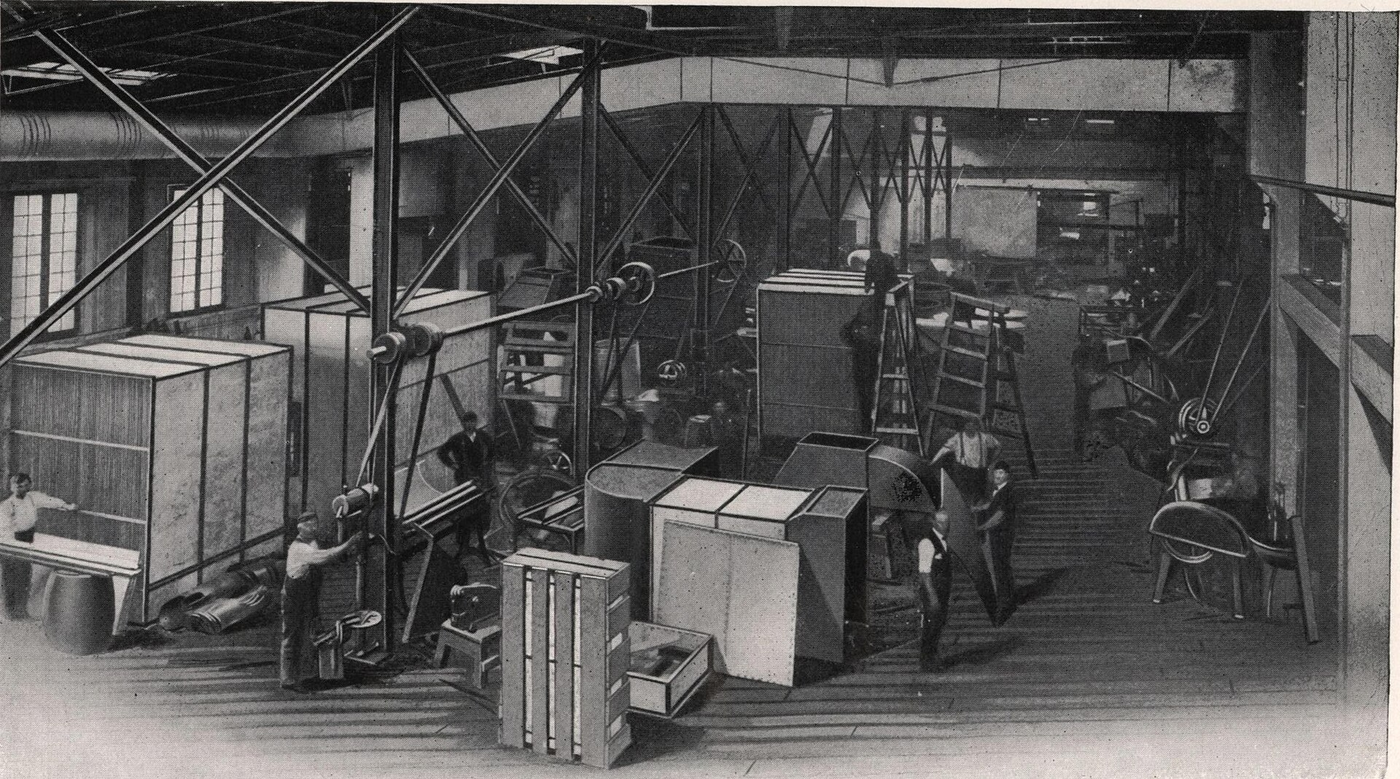


Apparatus for Treating Air
Willis Carrier was not asked to make anyone comfortable. He was asked to stop a Brooklyn printing works ruining colour jobs, because paper swells and shrinks with humidity and each colour pass landed in a slightly different place.
His answer controls humidity by controlling temperature. Air can only hold so much water at a given temperature. Chill it below its dew point and the surplus condenses out; reheat it and you have air at a known, chosen humidity. The cooling is a means, not the goal — comfort cooling was a by-product that took over the invention's name.
US Patent 808,897, "Apparatus for Treating Air", granted 2 January 1906. This blueprint builds a bench-scale version and measures the dew point directly, which is the only way the idea stops being abstract.
คำแนะนำ
Read US 808,897 and note what is being controlled
Read US 808,897 and note what is being controlled
The patent is titled for treating AIR, not for cooling it. Humidity is the controlled variable; temperature is the lever.
Demonstrate the problem with a strip of paper
Demonstrate the problem with a strip of paper
Measure a long paper strip, leave it over a steaming kettle for an hour, and measure again. It grows. That growth is the printing fault Carrier was hired to fix.
เครื่องมือที่ต้องใช้:
 ไม้บรรทัด
Build a wet-and-dry-bulb hygrometer
Build a wet-and-dry-bulb hygrometer
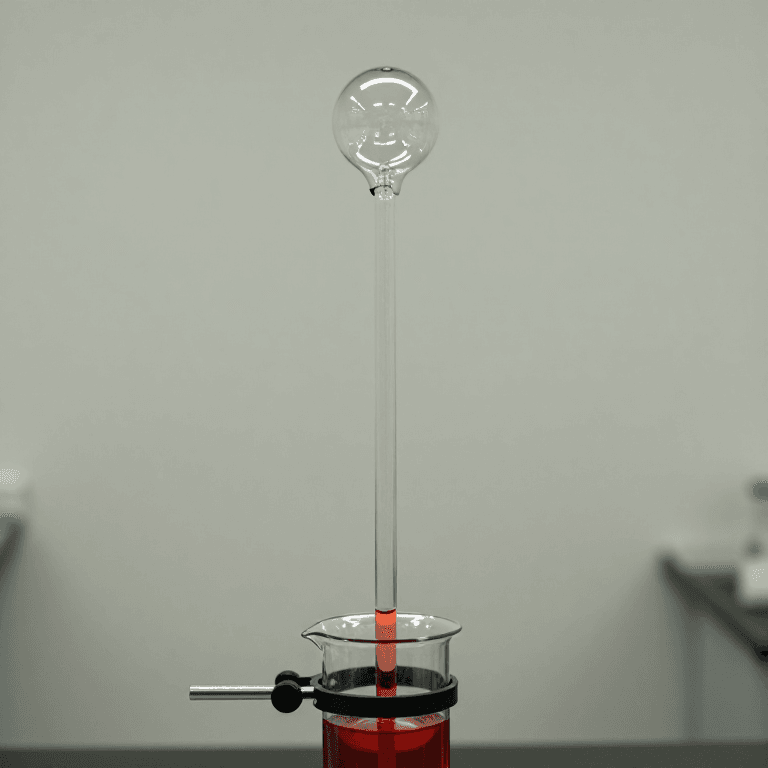
Mount two thermometers side by side and wrap one bulb in wet muslin. The difference between them is your humidity measurement.
วัสดุสำหรับขั้นตอนนี้:
 ผ้ามัสลินฝ้าย1 ชิ้น
เครื่องมือที่ต้องใช้:
 เทอร์มอมิเตอร์วัดอุณหภูมิห้อง
Understand why the wet bulb reads lower
Understand why the wet bulb reads lower
Evaporation removes latent heat. Dry air evaporates faster and cools the wet bulb more, so a big gap means dry air and no gap means saturated air.
Find the dew point by chilling a polished can
Find the dew point by chilling a polished can
Add ice to a shiny metal can while stirring and watch for the instant mist appears on the outside. Record that temperature — it is the dew point of the room.
Note that dew point IS an absolute humidity reading
Note that dew point IS an absolute humidity reading
The dew point tells you how much water the air actually holds, regardless of its current temperature. Carrier's whole method is choosing a dew point.
Build a duct with a fan at one end
Build a duct with a fan at one end
Make a simple rectangular duct and mount a fan to draw air through steadily. Everything else sits inside this airflow.
วัสดุสำหรับขั้นตอนนี้:
 แผ่นไม้เนื้อแข็ง1 ชิ้น
เครื่องมือที่ต้องใช้:
 เลื่อยมือ
Fit a chilled coil in the airstream
Fit a chilled coil in the airstream
Run copper tube through the duct and pass ice water through it. This is the cooling coil, and its surface must be BELOW the dew point to do anything.
วัสดุสำหรับขั้นตอนนี้:
 ท่อทองแดง3 เมตร
Put a drip tray under the coil
Put a drip tray under the coil
Condensate must be collected and drained. The water in that tray is the humidity you removed — it is the product, not a nuisance.
Measure humidity before and after the coil
Measure humidity before and after the coil
Take wet and dry bulb readings at both ends of the duct. Downstream air should be colder and, crucially, holding less water.
Add a reheater after the coil
Add a reheater after the coil
Warm the chilled air back up with a small heater. Its water content is unchanged, so RELATIVE humidity falls — you now have warm dry air on demand.
Realise you are controlling two variables with two devices
Realise you are controlling two variables with two devices
The coil sets the moisture; the reheater sets the temperature. Independent control of both is exactly what a printing works needs and what a single cooler cannot give.
Repeat the paper test in your conditioned air
Repeat the paper test in your conditioned air
Leave the measured paper strip in the treated stream. Its length should now hold steady — the actual result Carrier was paid for.
Plot your readings on a psychrometric chart
Plot your readings on a psychrometric chart
Mark before, after-coil and after-reheat. The path drops to saturation, runs along it, then moves right — Carrier drew this chart himself in 1911.
Compendium — humidity was the target, cold was the method
Compendium — humidity was the target, cold was the method
The patent. US 808,897, "Apparatus for Treating Air", granted 2 January 1906 to Willis H. Carrier. He designed the first system in 1902 for the Sackett-Wilhelms Lithographing and Publishing Company in Brooklyn, whose multi-colour printing was misregistering because paper changed dimension with humidity between passes. The brief was dimensional stability of paper. Human comfort was not mentioned.
The dew-point control principle. Air holds a maximum amount of water vapour that depends strongly on temperature. Cool air below its dew point and the excess condenses on the cold surface, leaving the remaining air saturated at that lower temperature — which means it now carries a known, fixed amount of water. Reheat it and the absolute moisture content stays put while relative humidity falls. By choosing the coil temperature you choose the moisture; by choosing the reheat you choose the temperature. Carrier called it "dew-point control", and it is why every air conditioner produces a stream of condensate.
The chart is arguably the bigger contribution. In 1911 Carrier published the psychrometric chart, which plots dry-bulb temperature, humidity ratio, wet-bulb temperature, relative humidity and enthalpy on a single diagram. It turned air conditioning from craft into engineering: any process can be drawn as a path on the chart and its energy cost read off. Engineers still use it, and the version on the wall of a modern plant room is recognisably his.
How the name drifted. Early installations went to industry — printing, textiles, tobacco, pharmaceuticals, munitions — wherever material properties depend on moisture. Comfort cooling arrived through cinemas in the 1920s, which used it as a summer attraction, and public expectation reversed the emphasis entirely. The term "air conditioning" was in fact coined by Stuart Cramer in 1906, for a textile-mill process of adding moisture to yarn, the opposite of what most people now assume it means. The device you know as a cooler is a humidity controller whose side effect became its purpose.
วัสดุ
3- 1 ชิ้นตัวยึดตำแหน่ง
- 1 ชิ้นตัวยึดตำแหน่ง
- 3 เมตรตัวยึดตำแหน่ง
บลูพริ้นท์ที่เกี่ยวข้อง
บลูพริ้นท์เหล่านี้แบ่งปันความรู้ — เทคนิค วัสดุ หรือหลักการ

CC0 สาธารณสมบัติ
พิมพ์เขียวนี้เผยแพร่ภายใต้ CC0 คุณสามารถคัดลอก แก้ไข แจกจ่าย และใช้งานผลงานนี้เพื่อวัตถุประสงค์ใดก็ได้ โดยไม่ต้องขออนุญาต
สนับสนุนเมกเกอร์โดยซื้อสินค้าผ่านพิมพ์เขียวของพวกเขา ซึ่งพวกเขาจะได้รับ ค่าคอมมิชชันเมกเกอร์ ที่ผู้ขายกำหนด หรือสร้างเวอร์ชันใหม่ของพิมพ์เขียวนี้และรวมเป็นการเชื่อมต่อในพิมพ์เขียวของคุณเพื่อแบ่งรายได้