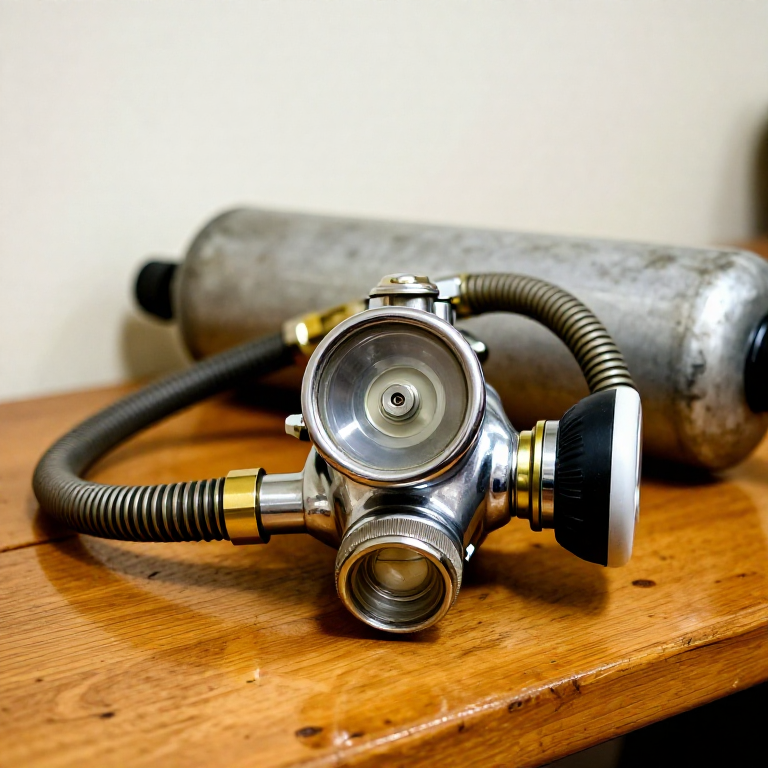


Aqualung
A diver ten metres down is under two atmospheres. Air delivered at surface pressure simply will not enter the lungs against that — the chest cannot expand. Deliver it at a fixed higher pressure instead and the diver is force-fed, and the pressure is wrong the moment they change depth.
The demand valve solves it by having no setting at all. A diaphragm has water on one side and breathing gas on the other. Whatever the surrounding pressure, the diaphragm balances it, and the diver's inhalation deflects it just enough to open a valve. Gas is therefore always delivered at exactly ambient pressure, automatically, at any depth.
The patent is titled plainly "Diving unit" — US Patent 2,485,039, granted to Jacques-Yves Cousteau and Émile Gagnan on 18 October 1949. Gagnan was an engineer who had been building gas regulators for wartime cars.
คำแนะนำ
Build the mechanism, do not dive it
Build the mechanism, do not dive it
This is a bench demonstration of a demand valve. Never breathe from home-made diving equipment. Diving requires certified gear and training; the physics here is the object of study.
Read US 2,485,039 and find the diaphragm
Read US 2,485,039 and find the diaphragm
Cousteau and Gagnan claim a pressure-reducing valve with a diaphragm that adjusts gas flow according to water pressure and the diver's breathing. Both inputs act on one part.
Prove the problem with a snorkel
Prove the problem with a snorkel
Try to breathe through a tube with your chest a metre underwater. You cannot — the water column presses on your chest and surface-pressure air will not go in. This is why snorkels are short.
Work out the pressure at depth
Work out the pressure at depth
Every 10 m of sea water adds about one atmosphere. At 30 m a diver is at 4 bar, and their gas must arrive at 4 bar to be breathable.
Build a chamber split by a flexible diaphragm
Build a chamber split by a flexible diaphragm
Make a housing with a thin rubber sheet dividing it. One side vents to the surrounding water, the other holds breathing gas.
วัสดุสำหรับขั้นตอนนี้:
 แผ่นยาง1 แผ่น
 ข้อต่อทองเหลือง3 ชิ้น
Make sure the wet side is genuinely open to ambient
Make sure the wet side is genuinely open to ambient
Leave a clear port to the water. The diaphragm must feel ambient pressure directly — that is what makes the regulator self-adjusting instead of preset.
Link the diaphragm to a lever operating a valve
Link the diaphragm to a lever operating a valve
Connect the diaphragm's centre to a lever that cracks a valve seat open. A small deflection must produce a usable gas flow.
Understand the balance at rest
Understand the balance at rest
With no breathing, gas pressure on one side equals water pressure on the other and the valve sits closed. The regulator does nothing until asked.
Inhale and watch the valve open
Inhale and watch the valve open
Draw gently on the mouthpiece. Pressure on the dry side drops, the diaphragm flexes inward, the lever opens the valve — gas flows at exactly ambient pressure.
Stop inhaling and confirm it shuts
Stop inhaling and confirm it shuts
Release. Pressure equalises, the diaphragm returns, the valve closes. On demand, and only on demand — hence the name.
Fit a one-way exhaust valve
Fit a one-way exhaust valve
Add a mushroom valve venting exhaled gas to the water. Open circuit: nothing is rebreathed, which is why the bubbles are the system working correctly.
Put a first stage ahead of it
Put a first stage ahead of it
Reduce cylinder pressure — 200 bar or more — to an intermediate pressure first. A single stage cannot span that range smoothly, so real regulators use two.
เครื่องมือที่ต้องใช้:
 ถังเก็บพลังงานอากาศอัด 10 ลิตร 300 บาร์
Test at two simulated depths
Test at two simulated depths
Pressurise the wet side to two different values and check delivery pressure follows. It should track ambient with no adjustment — that is the whole claim, demonstrated.
เครื่องมือที่ต้องใช้:
 มัลติมิเตอร์
Note where the exhaust sits relative to the diaphragm
Note where the exhaust sits relative to the diaphragm
Cousteau's early testing found the regulator breathed differently head-up and head-down, because exhaust and diaphragm were at slightly different depths. Position matters by centimetres.
Compendium — a valve that asks the water what to do
Compendium — a valve that asks the water what to do
The patent. US 2,485,039, "Diving unit", granted 18 October 1949 to Jacques-Yves Cousteau and Émile Gagnan, following their French work of 1943. Gagnan was an engineer at Air Liquide who had been designing regulators to let cars run on cooking gas under wartime petrol rationing; Cousteau brought the diving problem. The device was marketed as the Aqua-Lung, and the acronym SCUBA — self-contained underwater breathing apparatus — came later, from US Navy usage.
Why ambient-pressure delivery is the whole thing. Lungs cannot inflate against a pressure difference of more than a fraction of a bar, so gas must arrive at very nearly the pressure surrounding the chest. A diver changes that pressure continuously by swimming up and down. A regulator with a fixed setting would be correct at exactly one depth. Referencing the diaphragm to the water makes ambient pressure an INPUT rather than a parameter, so the device is right at every depth without being told the depth. It is a beautifully direct piece of feedback design — the disturbance is fed straight into the controller.
Open circuit, and what it costs. Exhaled gas is dumped to the water rather than scrubbed and reused. That makes the equipment simple, robust and safe from carbon dioxide build-up, at the price of consuming gas fast — and consumption rises with depth, because each breath contains more gas at higher pressure. A rebreather recycles the gas and is far more efficient and silent, but it must manage CO₂ removal and oxygen partial pressure actively, and its failure modes are much less forgiving.
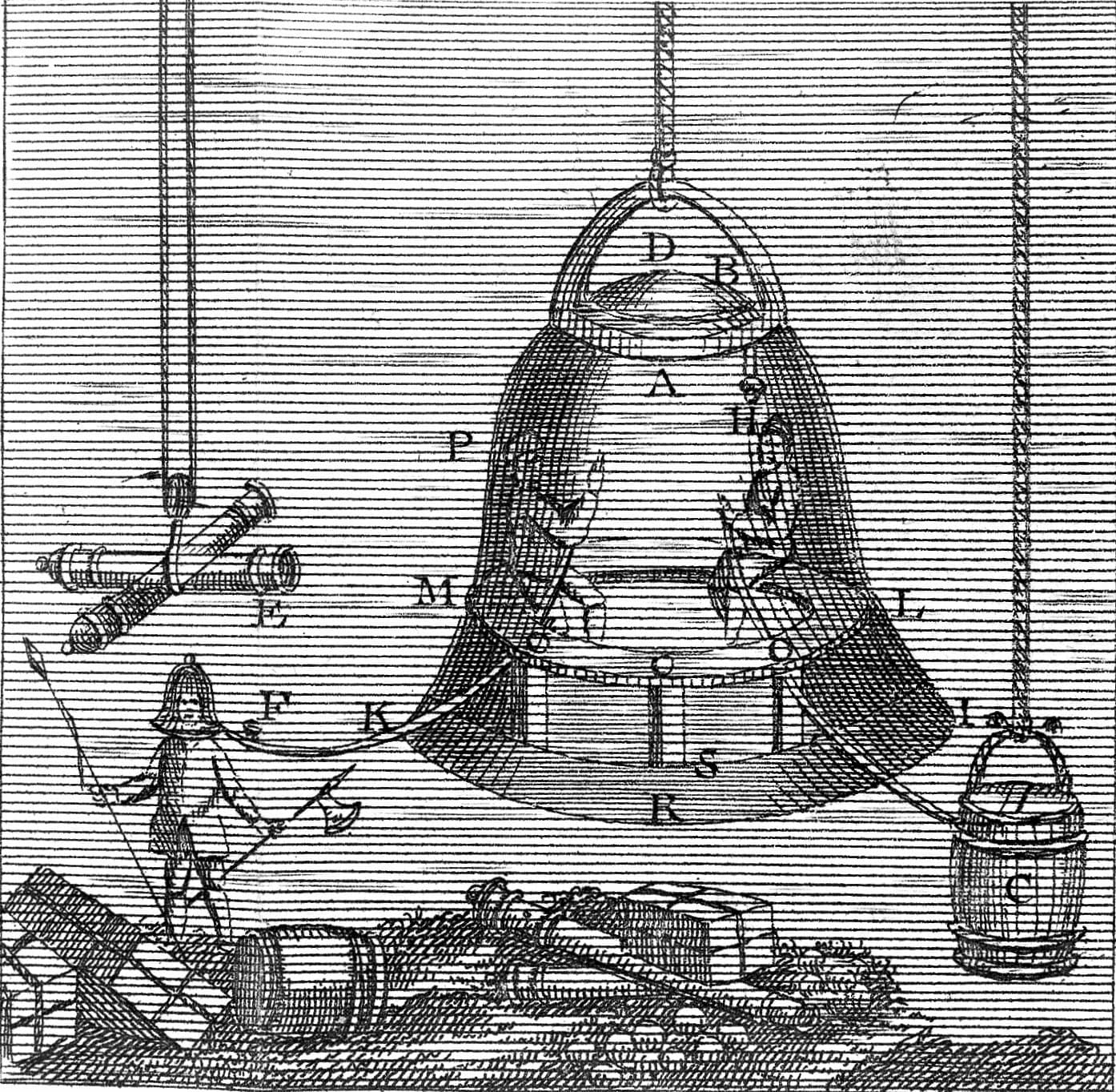
What it changed, and the hazard it created. Before 1943, working underwater meant a surface-supplied helmet with an air hose and a tender — the diver was tethered and slow. The Aqua-Lung made a diver autonomous, which opened marine biology, archaeology, film-making and sport to anyone who could carry a cylinder. It also made decompression sickness a civilian problem: breathing gas at pressure dissolves nitrogen into the tissues, and ascending too quickly lets it come out of solution as bubbles. The mechanism in this patent is entirely safe; the freedom it granted is what needed dive tables, training and a certification industry to make survivable.
เครื่องมือที่จำเป็น
2- ตัวยึดตำแหน่ง
- ตัวยึดตำแหน่ง
บลูพริ้นท์ที่เกี่ยวข้อง
บลูพริ้นท์เหล่านี้แบ่งปันความรู้ — เทคนิค วัสดุ หรือหลักการ



CC0 สาธารณสมบัติ
พิมพ์เขียวนี้เผยแพร่ภายใต้ CC0 คุณสามารถคัดลอก แก้ไข แจกจ่าย และใช้งานผลงานนี้เพื่อวัตถุประสงค์ใดก็ได้ โดยไม่ต้องขออนุญาต
สนับสนุนเมกเกอร์โดยซื้อสินค้าผ่านพิมพ์เขียวของพวกเขา ซึ่งพวกเขาจะได้รับ ค่าคอมมิชชันเมกเกอร์ ที่ผู้ขายกำหนด หรือสร้างเวอร์ชันใหม่ของพิมพ์เขียวนี้และรวมเป็นการเชื่อมต่อในพิมพ์เขียวของคุณเพื่อแบ่งรายได้