
Gilbert's Terrella
Why does a compass needle point north? For most of history the answer was that it was drawn to the pole star, or to a magnetic mountain somewhere in the far north. In 1600 William Gilbert proposed something far stranger and entirely correct: the Earth is itself a magnet.
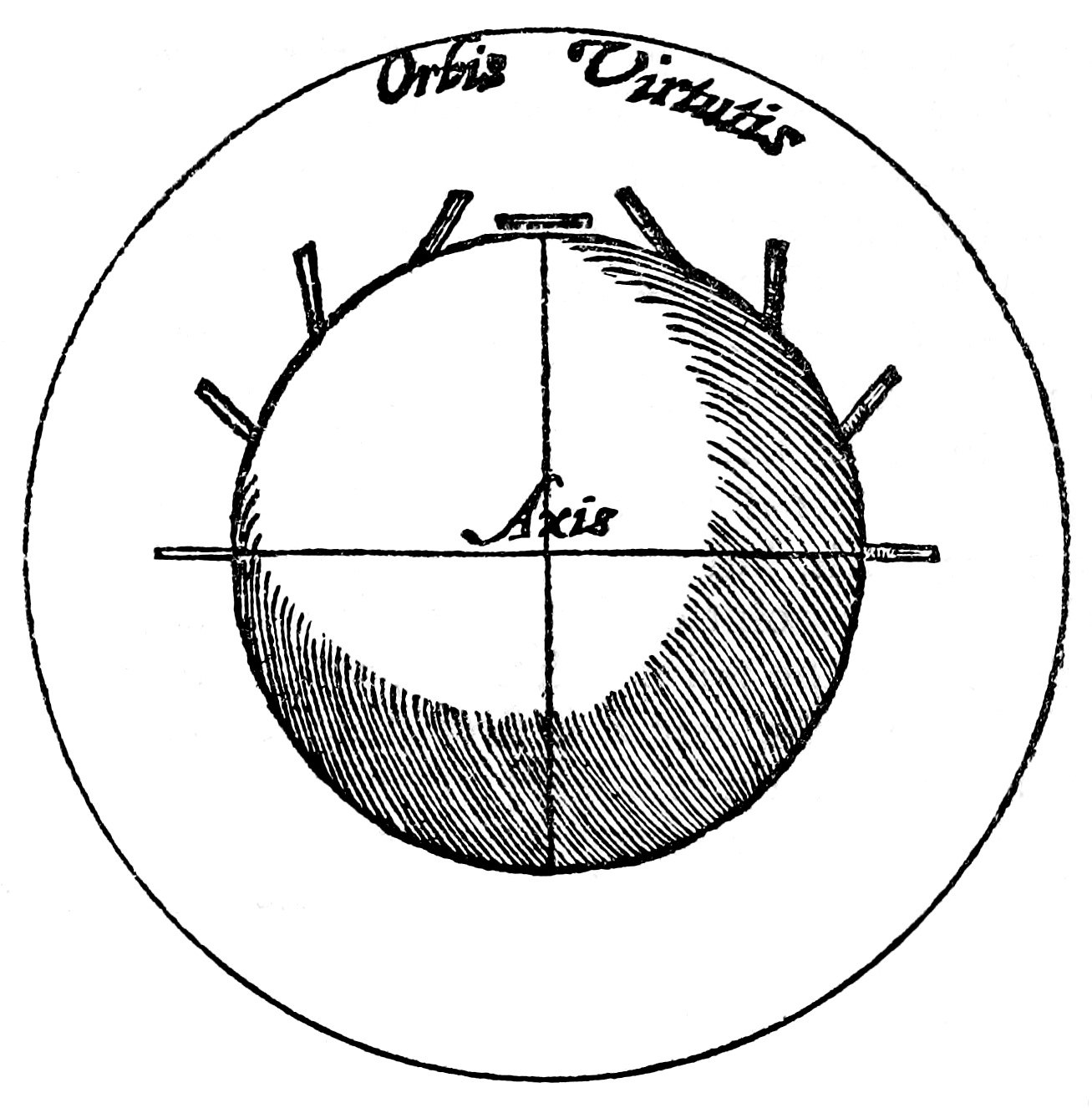
He did not argue it. He built it. A sphere of lodestone — a terrella, a little Earth — and a small compass carried over its surface. The needle swings north-south wherever you put it, and a needle free to tip vertically dips further and further as you move it toward the pole, exactly as compasses do on the real Earth.
This is one of the earliest experiments where a scale model is used as an argument about the world. Build it and the reasoning is yours in ten minutes.
คำแนะนำ
Get a spherical magnet
Get a spherical magnet
Use a spherical magnet 40-60 mm across, or fix two strong magnets inside a wooden ball with their axis through the centre. Gilbert used a turned sphere of natural lodestone; the geometry is what matters, not the material.
วัสดุสำหรับขั้นตอนนี้:
 ชุดแม่เหล็กนีโอดิเมียม2 ชิ้น
Keep magnets away from anything electronic
Keep magnets away from anything electronic
Strong magnets damage cards, drives and hearing aids, and they pinch hard when they snap together. Work well away from screens and phones, and never let two large magnets close under their own attraction.
Find the poles
Find the poles
Bring a small compass near the sphere and find the two opposite points where the needle points straight in or straight out. Mark them. Those are the magnetic poles of your little Earth.
เครื่องมือที่ต้องใช้:
 เข็มทิศพร้อมมาตรวัดมุมเอียง (แบบ Brunton)
Draw an equator and meridians
Draw an equator and meridians
Draw the equator halfway between the poles and a few meridians running pole to pole. Now the sphere is a globe and you can say where on it you are measuring.
Mount it so you can reach everywhere
Mount it so you can reach everywhere
Sit the sphere in a non-magnetic ring — wood, cork or plastic — so it stays put and every part of its surface is reachable. Steel anywhere near it corrupts every reading.
วัสดุสำหรับขั้นตอนนี้:
 เดือยไม้1 ชิ้น
Make a small floating compass
Make a small floating compass
Magnetise a needle by stroking it 30 times in one direction with a magnet, push it through a slice of cork and float it in a shallow non-metal dish of water. This is the horizontal compass — the versorium of Gilbert's experiments.
เครื่องมือที่ต้องใช้:
 ชุดเข็มเย็บผ้า
Make a dip needle
Make a dip needle
Balance a second magnetised needle on a horizontal pivot — pushed through a cork sitting on two pin supports — so it can tip up and down in a vertical plane. This is the instrument that carries the real argument.
Balance it before magnetising
Balance it before magnetising
Get the dip needle balanced level while it is still unmagnetised. Any tilt left over is gravity, not magnetism, and it will masquerade as a reading later.
Walk the horizontal compass over the surface
Walk the horizontal compass over the surface
Carry the floating compass slowly across the terrella. Wherever it goes it lines up along a meridian, pointing toward the same pole. This is the behaviour of a ship's compass, reproduced on a sphere in your hand.
Measure dip at the equator
Measure dip at the equator
Hold the dip needle just above the equator and record its angle. It should sit close to horizontal — the field runs parallel to the surface there.
เครื่องมือที่ต้องใช้:
 ไม้บรรทัด
Measure dip at five latitudes
Measure dip at five latitudes
Take the dip at the equator, a quarter of the way up, halfway, three quarters and at the pole, writing each angle down. Five numbers are a result; one is an anecdote.
Plot dip against latitude
Plot dip against latitude
Plot your angles against position. Dip rises from about horizontal at the equator to vertical at the pole. That curve is the whole of Gilbert's case, drawn from your own measurements.
Compare with the real Earth
Compare with the real Earth
Look up the magnetic dip where you live and compare it with the reading at the matching latitude on your sphere. The agreement is the argument: the Earth behaves like this sphere, so the Earth is a magnet like this sphere.
Test the magnetic mountain idea
Test the magnetic mountain idea
Now put a single small magnet at the north pole of a non-magnetic ball and repeat the dip measurements. The pattern is wrong — dip changes far too abruptly near the magnet and stays near zero elsewhere. You have just falsified the rival hypothesis with an experiment rather than an argument.
History & Context
History & Context
De Magnete, 1600. William Gilbert, an English physician, published De Magnete in 1600 — a treatise on magnets, magnetic bodies, and "that great magnet the Earth". It contains some fifty distinct experiments and it argues from them rather than from authority, which is why it is so often named as one of the first genuinely experimental works of science.
The terrella. Gilbert turned lodestone into spheres he called terrellae, little Earths. Carrying a compass across one, he showed the needle aligns north-south everywhere on the surface; carrying a dip needle — balanced on a horizontal axis so it can tip — he showed the inclination varies with position on the sphere exactly as magnetic inclination varies with latitude on Earth. From that correspondence he concluded that the Earth is itself a great magnet.
What it replaced. The prevailing explanations were that the compass was drawn to the pole star or to a magnetic island or mountain in the north. Gilbert's model does something those cannot: it reproduces the whole pattern of compass behaviour — direction and dip together, at every latitude — rather than just the fact that needles point north. That is the strength of a model argument, and it is why the dip needle is the crucial instrument rather than the ordinary compass.
What he got wrong. Gilbert believed the Earth's magnetism was a permanent property of its solid substance. It is not: it is generated by convecting molten iron in the outer core, and it reverses at irregular intervals of hundreds of thousands of years. Being wrong about the mechanism does not damage the finding — that the Earth is a magnet is correct, and it was established by building a model and measuring it.
The word persists. Physicists still call a magnetised sphere used to model planetary magnetism a terrella, and such devices are still used to study aurorae. It is a rare case of a four-hundred-year-old piece of apparatus keeping both its name and its job.
เครื่องมือที่จำเป็น
3- ตัวยึดตำแหน่ง
- ตัวยึดตำแหน่ง
- ตัวยึดตำแหน่ง
บลูพริ้นท์ที่เกี่ยวข้อง
บลูพริ้นท์เหล่านี้แบ่งปันความรู้ — เทคนิค วัสดุ หรือหลักการ

CC0 สาธารณสมบัติ
พิมพ์เขียวนี้เผยแพร่ภายใต้ CC0 คุณสามารถคัดลอก แก้ไข แจกจ่าย และใช้งานผลงานนี้เพื่อวัตถุประสงค์ใดก็ได้ โดยไม่ต้องขออนุญาต
สนับสนุนเมกเกอร์โดยซื้อสินค้าผ่านพิมพ์เขียวของพวกเขา ซึ่งพวกเขาจะได้รับ ค่าคอมมิชชันเมกเกอร์ ที่ผู้ขายกำหนด หรือสร้างเวอร์ชันใหม่ของพิมพ์เขียวนี้และรวมเป็นการเชื่อมต่อในพิมพ์เขียวของคุณเพื่อแบ่งรายได้