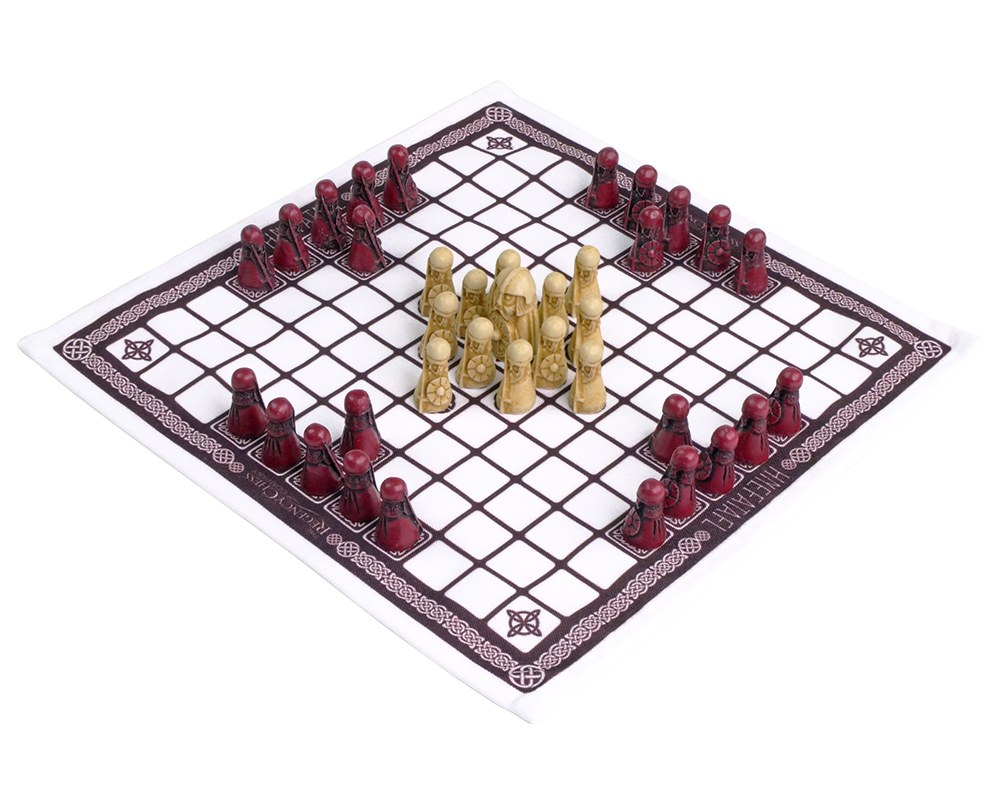


Hnefatafl
A board game where the two sides are not playing the same game. One player has a king at the centre with twelve defenders and must get him out to the edge. The other has twenty-four attackers ringed around the outside and must trap him. Half the pieces, opposite goals, and a board that pulls in two directions at once.
Tafl games were the board games of the Norse world before chess arrived and displaced them. Boards and pieces come out of graves and settlements across Scandinavia, Britain and Ireland.
The rules are reconstructed, and the reconstruction has a known error in its history. That story is in the last step, and it is worth reading before anyone tells you they are playing the authentic Viking game.
คำแนะนำ
Choose the board size
Choose the board size
Build 11x11 for the common modern game, or 9x9 to follow the one historically recorded ruleset. Surviving boards range from 7x7 up to 19x19 — the family is regional, not standard.
Prepare a board blank
Prepare a board blank
Plane a hardwood board to 330 x 330 x 20 mm. At 11x11 that gives 30 mm squares, which suits pieces you can pick up without fumbling.
วัสดุสำหรับขั้นตอนนี้:
 แผ่นไม้เนื้อแข็ง1 ชิ้น
เครื่องมือที่ต้องใช้:
 กบไสไม้
Lay out an odd-numbered grid
Lay out an odd-numbered grid
Mark 11 squares each way from the centre outward, not from one edge. The centre square must be the exact middle — the whole game is built around a central throne, so an even grid cannot work.
เครื่องมือที่ต้องใช้:
 ไม้บรรทัด
Mark the throne and the corners
Mark the throne and the corners
Carve or burn a distinct mark on the centre square — the throne, konakis in the recorded Sami game — and on the four corner squares. These five squares behave differently from all the others.
Score and darken the grid lines
Score and darken the grid lines
Cut the lines with a knife against a straightedge and rub dark pigment into them. Scored lines survive centuries of use; pencil does not.
เครื่องมือที่ต้องใช้:
 มีดคัตเตอร์งานประดิษฐ์
Turn 24 attackers
Turn 24 attackers
Turn or cut 24 identical pieces in a dark wood, about 20 mm across. This is the larger army and it starts on the outside.
วัสดุสำหรับขั้นตอนนี้:
 เดือยไม้2 ชิ้น
เครื่องมือที่ต้องใช้:
 เลื่อยมือ
Turn 12 defenders and one king
Turn 12 defenders and one king
Make 12 pieces in a light wood plus one distinctly taller or crowned piece for the king. The king has to be identifiable across the room — it is the only piece that matters.
Finish board and pieces
Finish board and pieces
Sand everything and oil it. Round the piece edges so they sit into the hand.
วัสดุสำหรับขั้นตอนนี้:
 น้ำมันลินสีดต้ม50 มล.
Set up the cross and the throne
Set up the cross and the throne
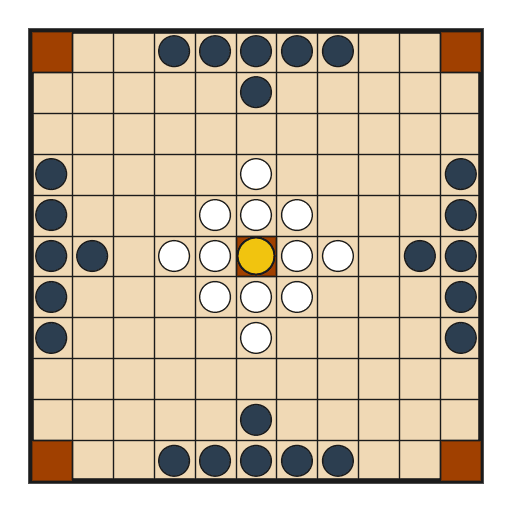
Place the king on the throne with the 12 defenders in a diamond around him, and the 24 attackers in four groups of six at the middle of each edge. The starting position is a cross inside a cross.
Move like a rook
Move like a rook
Every piece moves any number of empty squares in a straight line, orthogonally — never diagonally, never jumping. One movement rule for both sides.
Capture by sandwiching
Capture by sandwiching
A piece is captured when the opponent moves so that it stands between two enemy pieces on a straight line. Moving into the gap yourself is safe — capture only happens on the capturing player's move.
Agree the king's capture rule
Agree the king's capture rule
Decide before play whether the king is captured by two attackers like any piece, or must be surrounded on all four sides. This single choice swings the balance of the whole game and is the most-varied rule in the family.
Agree the winning condition
Agree the winning condition
The king wins by reaching a corner square in the common modern game, or any board edge in some versions. Attackers win by capturing him. Edge-escape makes the king far stronger; agree it up front.
Play both sides and count the wins
Play both sides and count the wins
Play ten games alternating sides and tally who wins. An asymmetric game is only worth playing if both roles can win — if one side takes nine out of ten, adjust the king's capture or escape rule and test again. You are doing exactly what the modern reconstructors did.
History & Context
History & Context
The board game of the Norse world. Tafl games were played across Scandinavia and the Norse-settled parts of Britain and Ireland, and were displaced by chess during the Middle Ages. Boards and playing pieces survive from graves and settlements, and the family has clear regional variants: Brandubh at 7x7 in Ireland, Tablut at 9x9 among the Sami, Tawlbwrdd at 11x11 in Wales, and the enormous 19x19 Alea Evangelii from Anglo-Saxon England.
No medieval ruleset survives. Not one. Everything played today is reconstructed from archaeology, scattered mentions in the sagas, and a single ethnographic account.
That account, and the mistake in it. On 20 July 1732 Carl Linnaeus — the botanist — watched Sami people in Lapland playing a 9x9 game called Tablut, sketched the board and wrote the rules in Latin in his travel diary. In 1811 E. L. Smith translated that Latin into English and rendered a phrase meaning "likewise the king" as "except the king". H. J. R. Murray used Smith's translation as the basis for his 1913 reconstruction, and that reconstruction became the standard rules for most of the twentieth century — with a mistranslation inside it that heavily favoured the king's side. Players and researchers later found the error and corrected it, which is where the many modern variants come from.
Why that story matters more than the game. One word, mistranslated once in 1811, shaped how thousands of people played a thousand-year-old game for a century. It is a clean illustration of how a reconstruction hardens into a "fact" through repetition. When someone offers you the authentic Viking rules, the honest answer is that nobody has them.
What we do know. The asymmetry is real and archaeologically supported: the piece counts, the central throne and the king are consistent across finds. The uncertainty is in the details of capture and escape — which is precisely where the balance of the game lives.
วัสดุ
3- 1 ชิ้นตัวยึดตำแหน่ง
- 2 ชิ้นตัวยึดตำแหน่ง
- 50 มล.ตัวยึดตำแหน่ง
พิมพ์เขียวนี้สร้าง
บลูพริ้นท์ที่เกี่ยวข้อง
บลูพริ้นท์เหล่านี้แบ่งปันความรู้ — เทคนิค วัสดุ หรือหลักการ
CC0 สาธารณสมบัติ
พิมพ์เขียวนี้เผยแพร่ภายใต้ CC0 คุณสามารถคัดลอก แก้ไข แจกจ่าย และใช้งานผลงานนี้เพื่อวัตถุประสงค์ใดก็ได้ โดยไม่ต้องขออนุญาต
สนับสนุนเมกเกอร์โดยซื้อสินค้าผ่านพิมพ์เขียวของพวกเขา ซึ่งพวกเขาจะได้รับ ค่าคอมมิชชันเมกเกอร์ ที่ผู้ขายกำหนด หรือสร้างเวอร์ชันใหม่ของพิมพ์เขียวนี้และรวมเป็นการเชื่อมต่อในพิมพ์เขียวของคุณเพื่อแบ่งรายได้