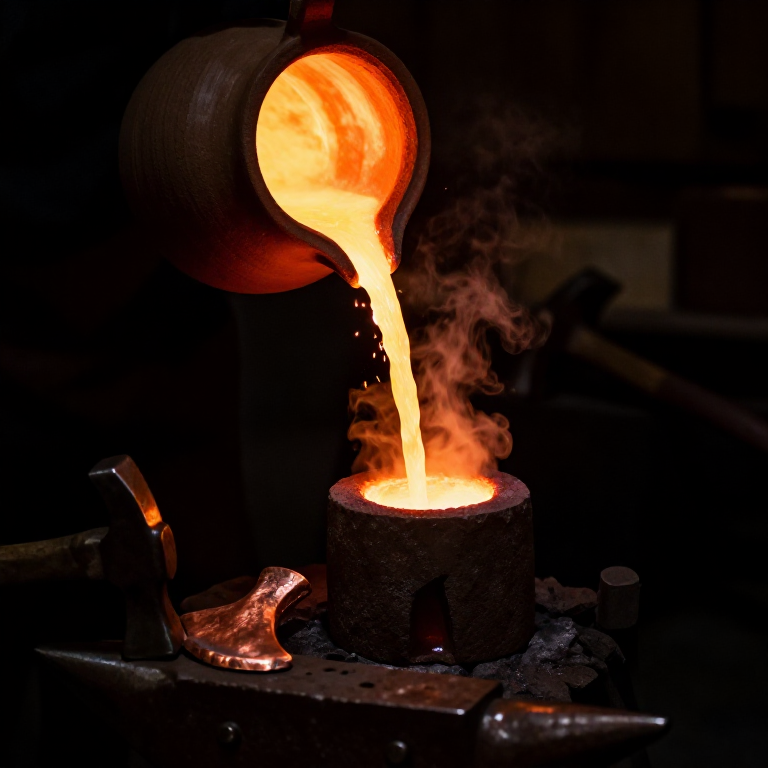


Casting Copper Tools — Shaping the First Metal
คำแนะนำ
Prerequisite: Smelting Copper
Prerequisite: Smelting Copper
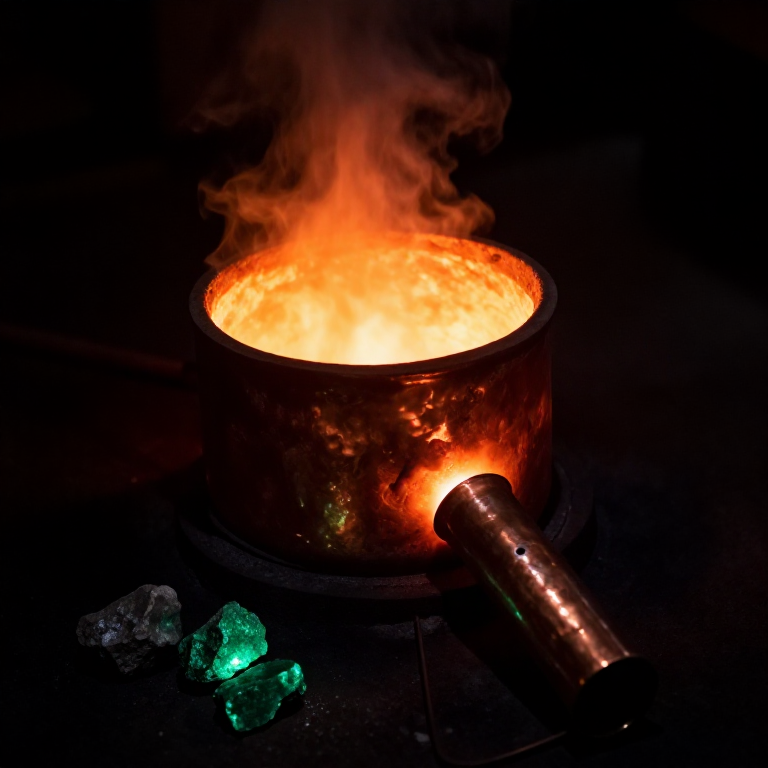
You need copper ingots from smelting. Complete this blueprint first:
พิมพ์เขียวเบื้องต้น
Smelting Copper from Malachite — The Birth of Metallurgy
วัสดุสำหรับขั้นตอนนี้:
เครื่องมือที่ต้องใช้:
 เตาเผา
 คีมคีบเบ้าหลอม
 ค้อนหัวกลม
 ทั่ง
 กระดาษทราย
 กล่องทำแม่พิมพ์ปรับขนาดได้
Making the Mold
Making the Mold
Open Mold Casting (Simplest Method)
The earliest casting method: carve the shape of your tool into a flat stone or packed sand, pour molten copper in, let it solidify.
Stone Mold
- Find a piece of soapstone or sandstone — soft enough to carve, heat-resistant.
- Carve the profile of your tool into the flat face, 1-2cm deep. For a simple axe head, carve a trapezoidal shape.
- Carve a pouring channel from the edge to the mold cavity.
- Smooth the cavity — rough surfaces create rough castings.
- Pre-heat the mold near the kiln before pouring. Cold mold = premature freezing = incomplete fill.
Two-Part Mold (Advanced)
For thicker tools (axe heads, chisels), you need a two-part mold:
- Carve half the tool shape into each of two stones
- Align them with registration marks (notches that interlock)
- Bind together with wet clay or cord
- Pour through a hole in the top
This was the technique used for Ötzi's copper axe — a flat axe cast in a two-part stone mold, then cold-hammered to final edge.
วัสดุสำหรับขั้นตอนนี้:
 ดินเหนียว5 กก.
เครื่องมือที่ต้องใช้:
กล่องทำแม่พิมพ์ปรับขนาดได้Melting and Pouring
Melting and Pouring
Melting the Copper
- Place copper pieces in the crucible. Fill loosely — copper expands when heated.
- Place crucible in the kiln, surrounded by charcoal.
- Bring to full temperature with bellows. Copper melts at 1085°C.
- Signs of melting: copper surface becomes mirror-bright, then liquid. Do not overheat — excessive temperature causes porosity from dissolved gases.
- Skim slag (dark crust) from the surface with a stick before pouring.
The Pour
- Lift the crucible with tongs. Move smoothly — sloshing = spills.
- Pour in one continuous, steady stream into the mold's pouring channel.
- Fill the mold completely — stopping mid-pour creates cold-shut defects.
- Let solidify naturally. Copper solidifies in 30-60 seconds for small castings.
- Wait at least 5 minutes before removing from mold.
วัสดุสำหรับขั้นตอนนี้:
 เบ้าหลอม1 pc
 ผงถ่านกัมมันต์10 กก.
เครื่องมือที่ต้องใช้:
กล่องทำแม่พิมพ์ปรับขนาดได้Cold Working and Finishing
Cold Working and Finishing
Work Hardening
Cast copper is relatively soft. Ancient smiths discovered that hammering (cold working) makes it significantly harder — this is work hardening, where deformation compresses the crystal structure.
- Remove the casting from the mold. Break off the pouring sprue.
- Hammer the tool on an anvil/flat stone. Focus on the working edge (blade, cutting surface).
- Hammer in overlapping strokes from center outward. Rotate the piece regularly.
- When the copper becomes hard and brittle (resists further hammering, starts cracking at edges), it's fully work-hardened.
Annealing (If Needed)
If you need to reshape a work-hardened piece:
- Heat it to cherry red (~600°C) in the kiln
- Quench in water
- The copper is now soft again — you can continue hammering
This heat-hammer cycle (anneal → cold work → anneal) was the core metallurgical technique for 3,000 years.
Finishing
- Grind the working edge on sandstone to create a sharp blade.
- Polish with progressively finer abrasive (coarse sand → fine sand → leather).
What You've Made
A functional copper tool — but it's soft compared to stone. Copper axes lose their edge quickly. To make a truly superior metal, you need tin — see Blueprint 06: Extracting Tin and Blueprint 07: Alloying Bronze.
วัสดุสำหรับขั้นตอนนี้:
ดินเหนียว5 กก.เครื่องมือที่ต้องใช้:
กล่องทำแม่พิมพ์ปรับขนาดได้วัสดุ
5- 1 ชิ้นตัวยึดตำแหน่ง
- 5 กก.ตัวยึดตำแหน่ง
- 10 กก.ตัวยึดตำแหน่ง
- 10 กก.ตัวยึดตำแหน่ง
เครื่องมือที่จำเป็น
7- ตัวยึดตำแหน่ง
- ตัวยึดตำแหน่ง
- ตัวยึดตำแหน่ง
- ตัวยึดตำแหน่ง
- ตัวยึดตำแหน่ง
- ตัวยึดตำแหน่ง
- ตัวยึดตำแหน่ง
วัสดุจากพิมพ์เขียวที่เชื่อมต่อ

CC0 สาธารณสมบัติ
พิมพ์เขียวนี้เผยแพร่ภายใต้ CC0 คุณสามารถคัดลอก แก้ไข แจกจ่าย และใช้งานผลงานนี้เพื่อวัตถุประสงค์ใดก็ได้ โดยไม่ต้องขออนุญาต
สนับสนุนเมกเกอร์โดยซื้อสินค้าผ่านพิมพ์เขียวของพวกเขา ซึ่งพวกเขาจะได้รับ ค่าคอมมิชชันเมกเกอร์ ที่ผู้ขายกำหนด หรือสร้างเวอร์ชันใหม่ของพิมพ์เขียวนี้และรวมเป็นการเชื่อมต่อในพิมพ์เขียวของคุณเพื่อแบ่งรายได้