ศิลปะ
ความงามและสุขภาพ
งานฝีมือ
วัฒนธรรมและประวัติศาสตร์
ความบันเทิง
สิ่งแวดล้อม
อาหารและเครื่องดื่ม
วิศวกรรมย้อนรอย
วิทยาศาสตร์
กีฬา
เทคโนโลยี
อุปกรณ์สวมใส่

The Microprocessor
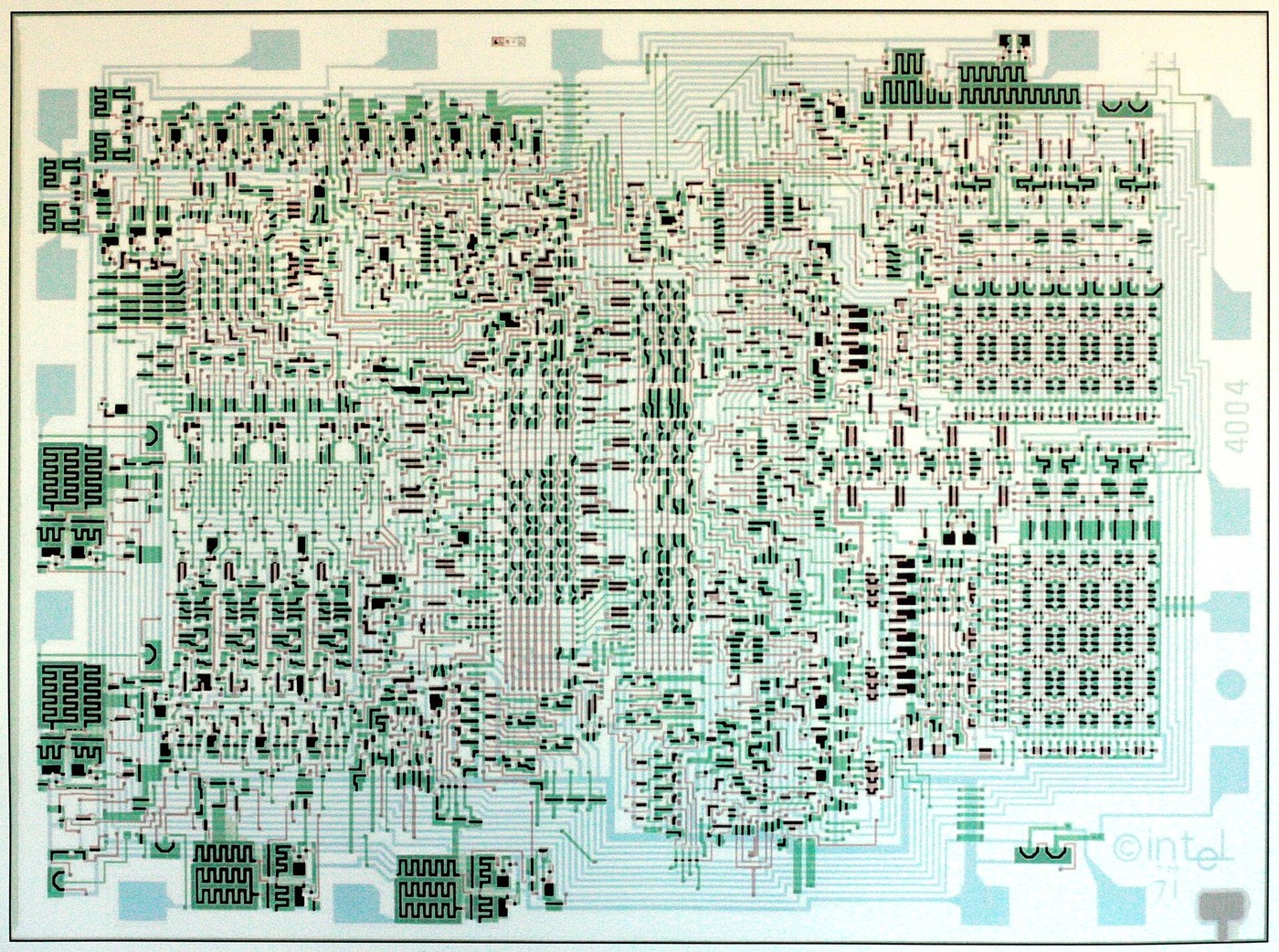
In 1969 a Japanese calculator company called Busicom asked Intel for a set of twelve custom chips for a printing calculator. Ted Hoff looked at the specification and proposed something else: instead of twelve chips each wired to do one fixed job, build ONE chip that does general operations, and put the specific behaviour in a memory as a list of instructions.
That substitution — replace fixed wiring with a stored list of steps — is the whole idea, and it was not new. Batch 82 followed it from Babbage through Turing to the stored-program computer. What was new in 1971 was fitting the processing part onto a single piece of silicon.
It fitted because of the previous blueprint. Federico Faggin, who joined Intel to do the design, had developed the silicon-gate MOS process at Fairchild — polysilicon gates that act as their own diffusion mask, so source and drain self-align to the gate with no overlap and no alignment error. That removed the parasitic capacitance that had made MOS too slow, and shrank the cells enough that a whole processor fitted in 12 square millimetres. Faggin did the logic and circuit design, Masatoshi Shima came from Busicom to verify it, Stan Mazor helped with the architecture.
The Intel 4004 shipped in March 1971: 2,300 transistors, 10 micrometre silicon-gate PMOS, 16 pins, 4-bit words, 108 kilohertz. It was slower than the minicomputers of the day and it was on one chip.
Intel nearly did not sell it. The contract gave Busicom exclusivity, and Intel had to buy the rights back for 60,000 dollars to offer it generally — a decision internally regarded as a gamble on a product with no obvious market.
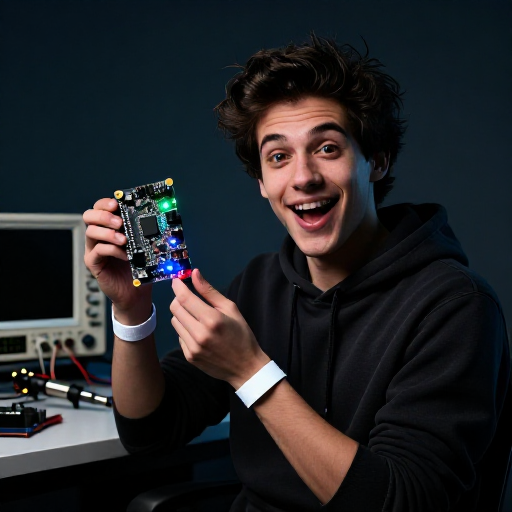
You will not fabricate a processor. You will build a 4-bit datapath from discrete logic on breadboard, single-step it by hand, and watch a stored instruction become a physical operation — which is the part that is genuinely hard to believe until you have seen the wires do it.
ขั้นสูง
10 hours
คำแนะนำ
1
1
Build the datapath — accumulator, ALU, bus
Build the datapath — accumulator, ALU, bus
A processor is four things connected by a bus: a place to hold a number, something to do arithmetic, a place to hold the next instruction, and a counter saying where to read from. Build the first two, because those are the ones you can watch.
THE PARTS. A 74HC283 4-bit binary adder. A 74HC173 4-bit D register with tri-state outputs, as the accumulator. A 74HC157 quad 2-input multiplexer to choose what goes into the adder's B input. Four toggle switches for a hand-entered operand, four LEDs with 470 ohm resistors on the accumulator output, and a debounced push-button for the clock.
DEBOUNCE THE CLOCK PROPERLY — this is where most first builds fail. A mechanical switch bounces for milliseconds, and a register clocked from a bouncing switch advances an unpredictable number of times per press, so your machine appears to skip instructions at random. Use a 74HC14 Schmitt inverter with a 10 kilohm resistor and 100 nanofarad capacitor on the input, or a dedicated debounce IC. Verify it on the scope before you trust anything downstream: one press must give exactly one clean edge.
WIRE IT UP. The accumulator outputs feed the adder's A inputs. The switches feed the multiplexer, whose output feeds the adder's B inputs. The adder's sum outputs feed back to the accumulator's data inputs. The accumulator's clock comes from your debounced button.
That loop — accumulator to ALU to accumulator — is the heart of every processor ever built. The 4004 has exactly this, four bits wide, with more ways to steer what goes into the B input.
NOW USE IT. Set the switches to 0001 and press the button repeatedly. The LEDs count up in binary: 0001, 0010, 0011. You have built a counter. Set the switches to 0011 and each press adds three.
Watch what happens at 1111 plus 1. The display rolls to 0000 and the carry-out lights. That is not a fault — four bits cannot hold sixteen, so the arithmetic wraps, and every processor since has had a carry flag for exactly this reason. The 4004 was 4-bit, so it hit this constantly, and its instruction set has add-with-carry precisely so that multi-digit arithmetic can be chained across several 4-bit operations.
OBSERVE THE ONE THING PEOPLE FIND SURPRISING. Put the scope on an adder output and press the button. The sum appears at the adder output the instant the inputs change — before any clock edge. The ALU is COMBINATIONAL: it is a lump of gates that continuously computes a function of whatever is on its inputs. The clock does not make it calculate. The clock decides when the answer is KEPT. That distinction between computing and remembering is the entire architecture of a synchronous machine.
วัสดุสำหรับขั้นตอนนี้:
 ชุดไอซีลอจิกคละแบบ2 ชิ้น
 ชุดหลอด LED คละสี1 ชุด
 สวิตช์ DIP2 ชิ้น
 ชุดตัวต้านทาน1 ชุด
 เบรดบอร์ด2 ชิ้น
 สายจัมเปอร์1 ชุด
เครื่องมือที่ต้องใช้:
 ออสซิลโลสโคป
 มัลติมิเตอร์ดิจิทัลเกรดห้องปฏิบัติการ
 แหล่งจ่ายไฟตั้งโต๊ะ
2
2
The instruction cycle — eight steps, repeated forever
The instruction cycle — eight steps, repeated forever
พื้นที่ทำงาน Blockly
Loading Blockly workspace...
เครื่องมือที่ต้องใช้:
 คอมพิวเตอร์ตั้งโต๊ะ
3
3
Why it fitted in 1971 and not 1968 — the transistor budget
Why it fitted in 1971 and not 1968 — the transistor budget
กำลังโหลดสมุด Jupyter…
เครื่องมือที่ต้องใช้:
คอมพิวเตอร์ตั้งโต๊ะ4
4
Compendium — and what this batch was actually about
Compendium — and what this batch was actually about
WHY 4 BITS? Because Busicom wanted a calculator, and decimal digits fit in 4 bits. The width was chosen for one customer's application and it constrained everything: 4-bit arithmetic means multi-digit numbers must be handled in chained operations with carry, which is why the instruction set has the carry handling it does. The 8008 followed within a year at 8 bits, from a different customer's terminal requirement, and 8 bits happened to suit characters. Two accidents of customer specification set the shape of computing for a decade.
WAS IT REALLY THE FIRST? It depends on the definition, which is why this is argued about. The Four-Phase Systems AL1 (1969) and the Garrett AiResearch MP944 for the F-14 (1970) both predate it and both are single-chip processing elements — the MP944 was classified until 1998, which is why it is absent from most accounts. The 4004 has the strong claim to being the first commercially available general-purpose microprocessor sold as a product to anyone who wanted one. That is a narrower claim than 'first microprocessor' and it is the defensible one.
WHY DID INTEL ALMOST NOT SELL IT? Busicom held exclusive rights under the development contract. Intel bought them back for 60,000 dollars, having concluded there might be a market for general-purpose processors. Internally this was contested — the company's business was memory, and a processor with no identified customers looked like a distraction. Busicom, which needed cash, took the deal.
WHAT DOES THE WHOLE BATCH ADD UP TO? Ten blueprints and a single continuous argument. Silicon does nothing useful until you control where the impurities are, to a part in a billion, at a scale you cannot see. Zone refining got the purity. Czochralski got the order. Thermal oxide got a mask that says not here. Diffusion put the dopant where the mask allowed. Photolithography made the mask pattern arbitrarily complex at no extra cost. The planar process sealed the junctions and left a flat surface. Kilby and Noyce each found a way to put many devices on that surface, by different means with different economics. The MOSFET provided a device whose control input draws no current, so billions could share a chip. And the silicon gate shrank it enough that a processor fitted on one.
Remove any one and the chain stops. That is the reason for publishing them as a chain rather than as ten interesting objects, and it is what the connections between them are for.
WHAT WOULD YOU BUILD NEXT? The two obvious continuations are memory — DRAM arrived in 1970 from the same industry and the same processes, and is a genuinely different problem — and packaging, which this batch skipped: dicing the wafer, bonding the wires and sealing the die is a whole discipline that decides how much of your yield survives to a customer. Both are gaps in the catalogue as it stands.
วัสดุ
6- 2 ชิ้นตัวยึดตำแหน่ง
- 1 ชุดตัวยึดตำแหน่ง
- ตัวยึดตำแหน่ง
- ตัวยึดตำแหน่ง
- ตัวยึดตำแหน่ง
- ตัวยึดตำแหน่ง
เครื่องมือที่จำเป็น
4- ตัวยึดตำแหน่ง
- ตัวยึดตำแหน่ง
- ตัวยึดตำแหน่ง
- ตัวยึดตำแหน่ง
บลูพริ้นท์ที่เกี่ยวข้อง
บลูพริ้นท์เหล่านี้แบ่งปันความรู้ — เทคนิค วัสดุ หรือหลักการ


CC0 สาธารณสมบัติ
พิมพ์เขียวนี้เผยแพร่ภายใต้ CC0 คุณสามารถคัดลอก แก้ไข แจกจ่าย และใช้งานผลงานนี้เพื่อวัตถุประสงค์ใดก็ได้ โดยไม่ต้องขออนุญาต
สนับสนุนเมกเกอร์โดยซื้อสินค้าผ่านพิมพ์เขียวของพวกเขา ซึ่งพวกเขาจะได้รับ ค่าคอมมิชชันเมกเกอร์ ที่ผู้ขายกำหนด หรือสร้างเวอร์ชันใหม่ของพิมพ์เขียวนี้และรวมเป็นการเชื่อมต่อในพิมพ์เขียวของคุณเพื่อแบ่งรายได้