ศิลปะ
ความงามและสุขภาพ
งานฝีมือ
วัฒนธรรมและประวัติศาสตร์
ความบันเทิง
สิ่งแวดล้อม
อาหารและเครื่องดื่ม
วิศวกรรมย้อนรอย
วิทยาศาสตร์
กีฬา
เทคโนโลยี
อุปกรณ์สวมใส่
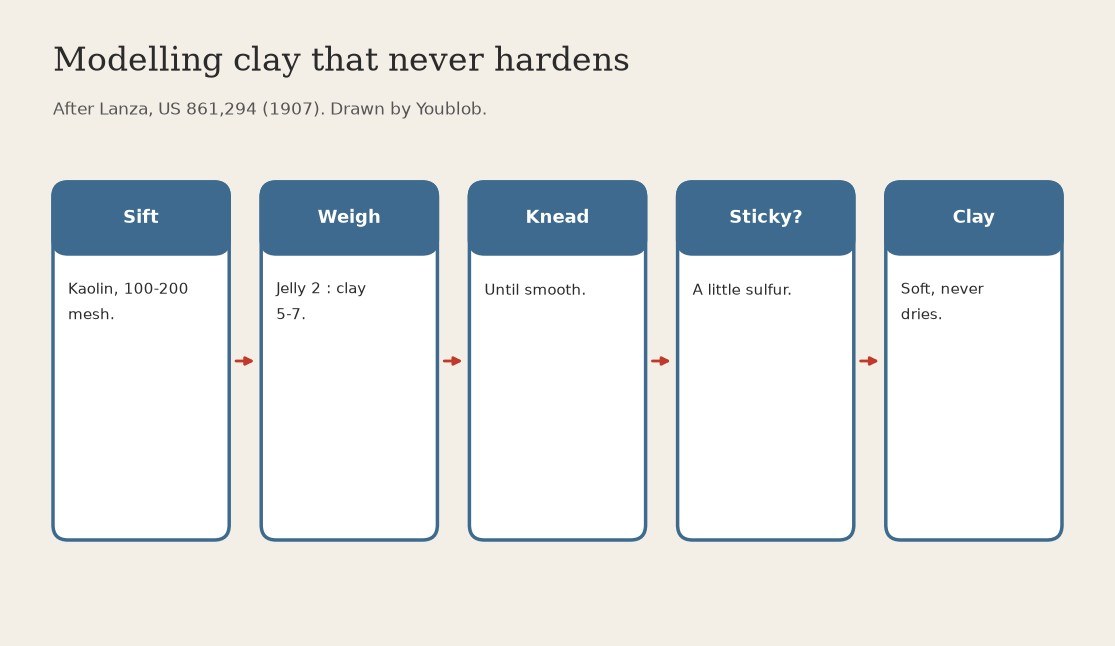


Modelling Clay That Never Hardens: Kaolin Kneaded with Petroleum Jelly (Lanza, US 861,294, 1907)
Clay mixed with water dries, cracks and needs wetting all the time. Lanza bound fine clay with petroleum jelly instead, so it stays soft and workable for good.
Result: a clean, non-hardening modelling clay; the more petroleum jelly, the softer it is.
Source: Lanza, US 861,294 (1907). Not given: batch size, kneading time. Picture drawn by Youblob.
เริ่มต้น
1 hour
คำแนะนำ
1
1
Sift the clay fine
Sift the clay fine
Use clay ground fine enough to pass a 100-mesh screen, better 200 mesh. Lanza used kaolin with good results.
วัสดุสำหรับขั้นตอนนี้:
 ผงดินขาวเคโอลิน5 parts
เครื่องมือที่ต้องใช้:
 ตะแกรงตาถี่
2
2
Weigh 2 parts jelly to 5-7 parts clay
Weigh 2 parts jelly to 5-7 parts clay
By weight: 2 parts petroleum jelly to 5-7 parts clay. Ratio: more jelly (2:5) gives a softer clay, less (2:7) a firmer one.
วัสดุสำหรับขั้นตอนนี้:
 วาสลีน2 parts
เครื่องมือที่ต้องใช้:
 ตราชั่งสองแขน
3
3
Knead them together
Knead them together
Mix the clay and jelly intimately until smooth. If the clay sticks to the fingers, work in a little sulfur as a filler.
วัสดุสำหรับขั้นตอนนี้:
 ผงกำมะถัน1 a little, if sticky
เครื่องมือที่ต้องใช้:
 ครกและสาก
วัสดุ
3- 5 partsตัวยึดตำแหน่ง
- 2 partsตัวยึดตำแหน่ง
- 1 a little, if stickyตัวยึดตำแหน่ง
เครื่องมือที่จำเป็น
3- ตัวยึดตำแหน่ง
- ตัวยึดตำแหน่ง
- ตัวยึดตำแหน่ง
พิมพ์เขียวนี้สร้าง

CC0 สาธารณสมบัติ
พิมพ์เขียวนี้เผยแพร่ภายใต้ CC0 คุณสามารถคัดลอก แก้ไข แจกจ่าย และใช้งานผลงานนี้เพื่อวัตถุประสงค์ใดก็ได้ โดยไม่ต้องขออนุญาต
สนับสนุนเมกเกอร์โดยซื้อสินค้าผ่านพิมพ์เขียวของพวกเขา ซึ่งพวกเขาจะได้รับ ค่าคอมมิชชันเมกเกอร์ ที่ผู้ขายกำหนด หรือสร้างเวอร์ชันใหม่ของพิมพ์เขียวนี้และรวมเป็นการเชื่อมต่อในพิมพ์เขียวของคุณเพื่อแบ่งรายได้