ศิลปะ
ความงามและสุขภาพ
งานฝีมือ
วัฒนธรรมและประวัติศาสตร์
ความบันเทิง
สิ่งแวดล้อม
อาหารและเครื่องดื่ม
วิศวกรรมย้อนรอย
วิทยาศาสตร์
กีฬา
เทคโนโลยี
อุปกรณ์สวมใส่
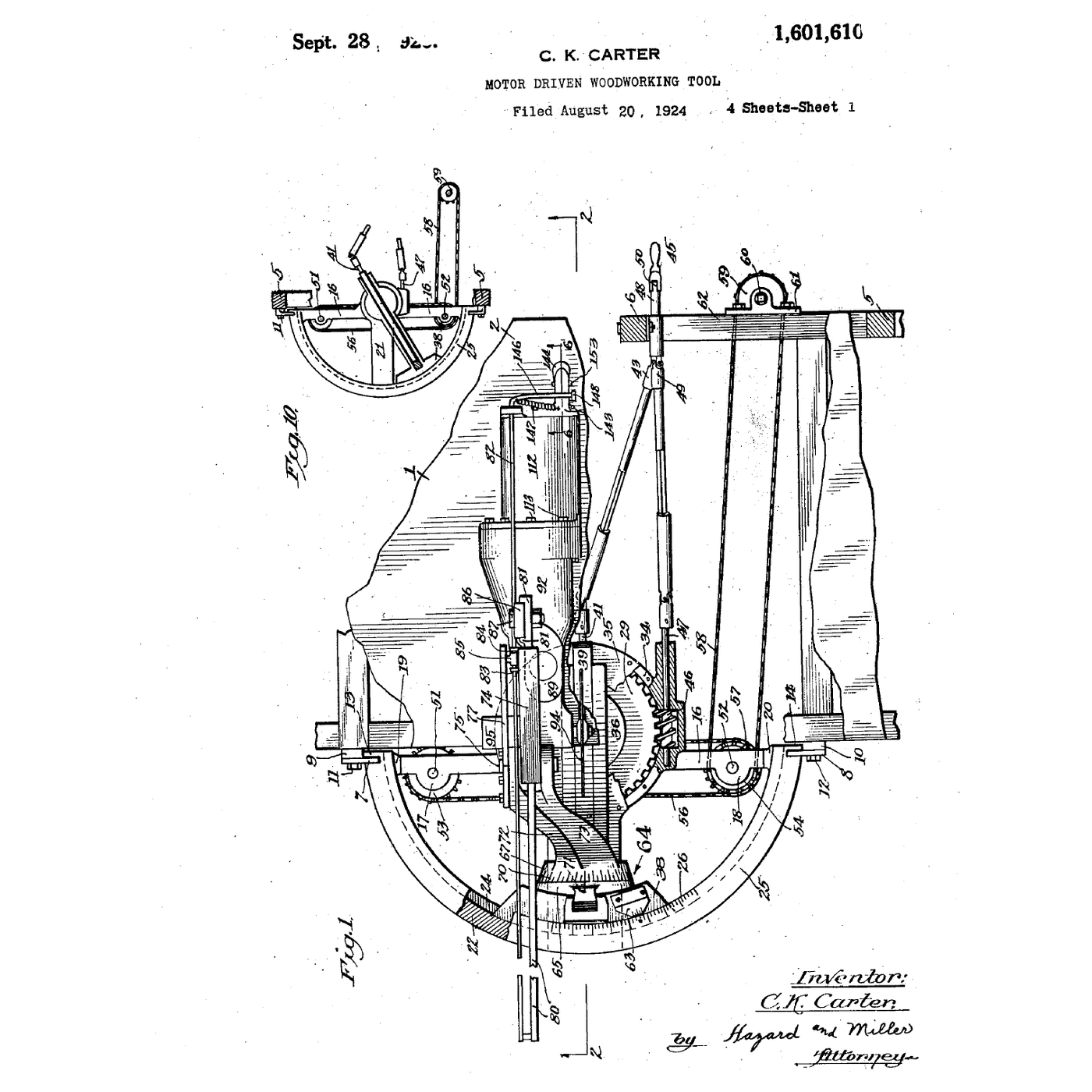


The Saw That Moves Over the Work: One Pivot, Every Angle
Every saw before this one asked you to move the WORK past a fixed blade, or to move a hand-held blade through stationary work. Carter's machine does neither: the motor and blade hang from an arm above a table, and the whole assembly is pulled across the wood.
The payoff is that one pivot gives you every angle. Swing the arm for a mitre, tilt the motor for a bevel, and the cut line stays where you put it because the pivot never moves.
The price is that the blade turns into the cut and tries to pull itself along the arm. This rung takes both seriously: how the geometry gives you the angles, and why the same geometry makes this the machine that demands the most respect in the shop.
ระดับกลาง
About 3 hours, most of it squaring up
คำแนะนำ
1
1
Square the arm to the fence before anything else
Square the arm to the fence before anything else
Isolate the machine. Everything in this step is done with the power off and the plug out.
The fence is the reference and the arm must be square to it. Clamp a wide, known-straight board against the fence. Pull the carriage out, rest the combination square against the fence, and bring its blade up to the saw blade body — not the teeth, which are set to either side and will lie to you by the amount of the set.
Check at the near end of travel and again at the far end. If the reading changes, the arm is not square and step 4 shows what that costs across a wide board.
Adjust at the arm's index, not by shimming the fence. The fence is a consumable — it gets cut into every time you change the blade angle — and a machine squared to a sacrificial part goes out of square the first time you replace it.
Write the date of the check in your notebook. A radial arm that has been knocked, moved or lent out is out of square until proven otherwise.
เครื่องมือที่ต้องใช้:
 ฉากรวมอเนกประสงค์
 ไม้บรรทัด
 แคลมป์ตัวซี
2
2
One pivot, and what Carter actually claimed
One pivot, and what Carter actually claimed
The patent is titled 'Motor-driven woodworking tool' and its argument is about motion, not about cutting.
A motor carrying a circular saw hangs from a frame above a work table. The frame pivots at a SINGLE mounting point, so the saw can be swung to cut at any horizontal angle while the pivot — and therefore the point the cut line passes through — stays put. The same assembly tilts so the saw axis inclines to the table, which gives a bevel. Combine the two and you have a compound cut from one setup.
Carter also put the electric controls in a **pistol-grip handle** on the carriage, two years after Black and Decker patented that grip on a drill. The shape had already escaped the tool it was invented for — which is the quiet story of this whole batch.
The claim that matters for a maker is the single pivot. On a mitre box you re-register the work for every angle and accumulate error each time. Here the work stays clamped against the fence and only the arm moves, so the reference surface is never disturbed. That is the same discipline as measuring every fret from the nut rather than from the fret before it.
เครื่องมือที่ต้องใช้:
ฉากรวมอเนกประสงค์3
3
Cut a test frame and measure the error you actually have
Cut a test frame and measure the error you actually have
Set the arm to 45 degrees and cut four mitres from the same board, without changing the setting between cuts. Assemble them dry into a frame and clamp it.
Four 45-degree cuts make 360 degrees only if every cut is truly 45. Hold the frame up to the light at each corner. A gap at the outside means the angle is under 45; a gap at the inside means it is over. Because the error appears four times, the frame shows you a fault a single cut would hide — the same reason a machinist checks a square by flipping it rather than by trusting the scale.
Measure the gap with a feeler gauge and write it down. Then halve the correction at the arm index and cut four more. Two iterations usually gets it closed.
Safety, and it is not optional on this machine: keep the blade guard down, keep your hands outside the blade's path along the whole travel, and **hold the carriage back** rather than letting it come to you. Step 4 shows why it wants to come.
วัสดุสำหรับขั้นตอนนี้:
 แผ่นไม้สน1 ชิ้น
เครื่องมือที่ต้องใช้:
ฉากรวมอเนกประสงค์ ชุดฟีลเลอร์เกจแคลมป์ตัวซี
 แว่นนิรภัย
 ที่ป้องกันการได้ยิน (ครอบหู SNR 30 เดซิเบล)
4
4
What the arm error costs, and why the saw climbs
What the arm error costs, and why the saw climbs
กำลังโหลดสมุด Jupyter…
เครื่องมือที่ต้องใช้:
ชุดฟีลเลอร์เกจ5
5
History and context
History and context
**US 1,601,610**, Charles K. Carter of Los Angeles, California. Filed 20 August 1924, granted 28 September 1926, on four sheets of drawings. Long expired.
The radial arm saw is usually credited to Raymond DeWalt, whose 1922 machine and the company built around it made the type famous. Carter's patent is a separate, contemporary answer to the same question — sources differ on precedence, and this corpus states both rather than picking a winner. What is not in dispute is the idea they share: bring the tool to the work on an arm, and let one pivot serve every angle.
For fifty years this was the machine at the centre of the small shop, because it crosscuts, mitres, bevels, dadoes and — badly — rips. Then the sliding compound mitre saw took the crosscutting and the table saw took the ripping, and the radial arm saw was left holding neither job outright.
**Honest limits.** It self-feeds, as step 4 measures, which makes ripping on it genuinely dangerous and crosscutting a matter of restraint. It needs a large fixed footprint and a table that stays flat. It goes out of square if anything nudges the column. And the adjustments that make it versatile are the same adjustments that let it drift — every degree of freedom is also a way to be wrong.
บลูพริ้นท์ที่เกี่ยวข้อง
บลูพริ้นท์เหล่านี้แบ่งปันความรู้ — เทคนิค วัสดุ หรือหลักการ

CC0 สาธารณสมบัติ
พิมพ์เขียวนี้เผยแพร่ภายใต้ CC0 คุณสามารถคัดลอก แก้ไข แจกจ่าย และใช้งานผลงานนี้เพื่อวัตถุประสงค์ใดก็ได้ โดยไม่ต้องขออนุญาต
สนับสนุนเมกเกอร์โดยซื้อสินค้าผ่านพิมพ์เขียวของพวกเขา ซึ่งพวกเขาจะได้รับ ค่าคอมมิชชันเมกเกอร์ ที่ผู้ขายกำหนด หรือสร้างเวอร์ชันใหม่ของพิมพ์เขียวนี้และรวมเป็นการเชื่อมต่อในพิมพ์เขียวของคุณเพื่อแบ่งรายได้