

Reading Stratigraphy
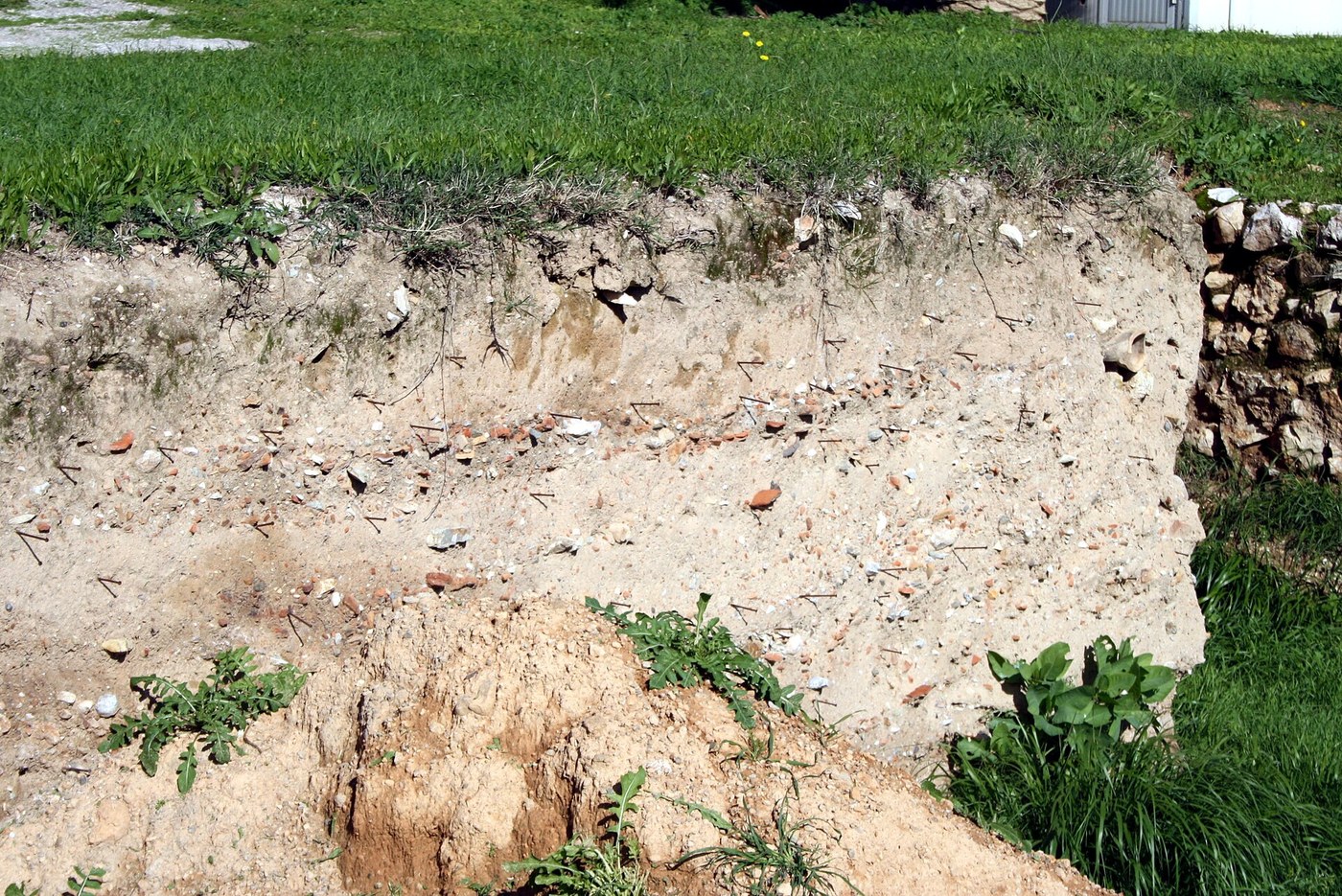
Archaeology has no clock. What it has is order: in an undisturbed sequence, the layer underneath was put there before the layer on top. That single idea — the Law of Superposition — turns a muddy section of ground into a timeline you can read from the bottom up.
The complication is that ground is rarely undisturbed. People dig pits, cut ditches, build walls, and every one of those actions slices through what was already there. So a real site is not a neat stack of pancakes; it is a stack with holes punched through it, and the holes are themselves datable events.
This is a build-and-measure project. You will make a layered box with a deliberate intrusion in it, excavate it blind, record what you find, and draw a Harris matrix — the diagram archaeologists use to turn a three-dimensional mess into an ordered sequence. Then you open the record of what you actually built and see how much of it you got right.
คำแนะนำ
Get a clear-sided box
Get a clear-sided box
Take a clear plastic box about 300 x 200 x 200 mm. Clear sides let you check your reading against the truth afterwards.
เครื่องมือที่ต้องใช้:
 กล่องเก็บของใส
Have someone else build the sequence
Have someone else build the sequence
Get a partner to build the layers while you are out of the room, writing down each step. If you build it yourself you cannot excavate it honestly.
Lay four contrasting layers
Lay four contrasting layers
Lay four 30 mm layers of visibly different material — sand, dark soil, gravel, pale sand. Each layer is a context: one event of deposition.
วัสดุสำหรับขั้นตอนนี้:
 ทรายละเอียด2 กก.
 ดินสวน2 กก.
 กรวด2 กก.
Put a dated object in each layer
Put a dated object in each layer
Bury one small distinctive object in each layer — a different coloured bead or button. These are the finds that will let you argue for a date later.
วัสดุสำหรับขั้นตอนนี้:
 ลูกปัดคละแบบ6 ชิ้น
Cut a pit through the upper layers
Cut a pit through the upper layers
Have your partner dig a narrow pit down through the top two or three layers and refill it with a fifth, different material, dropping one object in. This is the crucial step — the pit is younger than everything it cuts.
Cap it and hide the sides
Cap it and hide the sides
Add a final capping layer and tape paper over the clear sides. Now you can only see the top surface, which is the archaeologist's actual situation.
Excavate in plan, one context at a time
Excavate in plan, one context at a time
Remove material one context at a time from the top, following the edges of each layer rather than digging to a fixed depth. Digging in flat spits mixes contexts together and destroys the sequence.
เครื่องมือที่ต้องใช้:
 เกรียงแต่งร่องปูน
Fill in a context sheet for each layer
Fill in a context sheet for each layer
For every context record: a number, its colour and texture, what it contained, and which contexts it lies above, below or cuts. The relationships matter more than the description.
Bag finds by context, not by type
Bag finds by context, not by type
Bag each object labelled with its context number. A find with no context is almost worthless — it is the association with a layer, not the object, that carries the date.
Spot the cut
Spot the cut
When you reach the pit fill, note that it interrupts the layers around it. A cut is a context too — it is a recorded event with no material of its own, only an edge.
Draw the Harris matrix
Draw the Harris matrix
Draw a box per context and connect them vertically: earlier below, later above, with the pit cut placed above every layer it passes through. Contexts with no direct relationship sit side by side, unconnected.
Uncover the sides and check
Uncover the sides and check
Peel the paper off and compare your matrix with your partner's written build order. Most people get the layers right and misplace the pit — the cut is the hard part, and it is the hard part on real sites too.
History & Context
History & Context
The Law of Superposition. In an undisturbed sequence, the oldest layer is at the bottom and each layer above it is younger. Borrowed from geology and applied to human deposits, this is the foundation the whole discipline rests on. Note the qualifier: undisturbed. Almost the entire skill of excavation lies in spotting where that condition fails.
Why cuts change everything. A pit, ditch, grave or posthole is not a layer — it is a removal. It is necessarily younger than every deposit it passes through, and its fill is younger still. Get a cut wrong and you can date a site by an object that arrived a thousand years after the layer it appears to sit in. Intrusive finds are one of the commonest sources of bad archaeological dates.
The Harris matrix. Developed in 1973 in Winchester, England, by Edward C. Harris, it depicts the temporal succession of archaeological contexts as a diagram. It was devised to overcome the limits of conventional section drawings: a section shows only what a single vertical slice happens to intersect, while the matrix translates the three-dimensional arrangement of deposits into a two-dimensional graph carrying a fourth dimension — time. It became standard practice remarkably fast, because it forces the excavator to state relationships explicitly rather than leaving them implied in a drawing.
Context is the unit. Modern excavation records the context — one depositional or destructive event — as its basic unit, not arbitrary depths. This was a real methodological shift: digging in fixed spits produces tidy sections and scrambled evidence. Recording by context is slower and it is the only method that preserves the sequence.
Relative, not absolute. Stratigraphy tells you order, never calendar dates. "Layer 4 is older than layer 3" is all it gives you. Absolute dates come from elsewhere — radiocarbon, dendrochronology, coins, datable pottery — and are then hung on the stratigraphic framework. The sequence is the skeleton; the dating methods are the flesh. Getting the skeleton wrong makes every date attached to it wrong too.
Excavation destroys its own evidence. Unlike almost any other science, the experiment cannot be repeated: digging a site removes it permanently. The record — context sheets, drawings, photographs, the matrix — becomes the site. That is why the paperwork in step 8 is not bureaucracy. It is the only thing that will survive.
วัสดุ
4- 2 กก.ตัวยึดตำแหน่ง
- 2 กก.ตัวยึดตำแหน่ง
- 2 กก.ตัวยึดตำแหน่ง
- 6 ชิ้นตัวยึดตำแหน่ง
เครื่องมือที่จำเป็น
2- ตัวยึดตำแหน่ง
- ตัวยึดตำแหน่ง
CC0 สาธารณสมบัติ
พิมพ์เขียวนี้เผยแพร่ภายใต้ CC0 คุณสามารถคัดลอก แก้ไข แจกจ่าย และใช้งานผลงานนี้เพื่อวัตถุประสงค์ใดก็ได้ โดยไม่ต้องขออนุญาต
สนับสนุนเมกเกอร์โดยซื้อสินค้าผ่านพิมพ์เขียวของพวกเขา ซึ่งพวกเขาจะได้รับ ค่าคอมมิชชันเมกเกอร์ ที่ผู้ขายกำหนด หรือสร้างเวอร์ชันใหม่ของพิมพ์เขียวนี้และรวมเป็นการเชื่อมต่อในพิมพ์เขียวของคุณเพื่อแบ่งรายได้