ศิลปะ
ความงามและสุขภาพ
งานฝีมือ
วัฒนธรรมและประวัติศาสตร์
ความบันเทิง
สิ่งแวดล้อม
อาหารและเครื่องดื่ม
วิศวกรรมย้อนรอย
วิทยาศาสตร์
กีฬา
เทคโนโลยี
อุปกรณ์สวมใส่
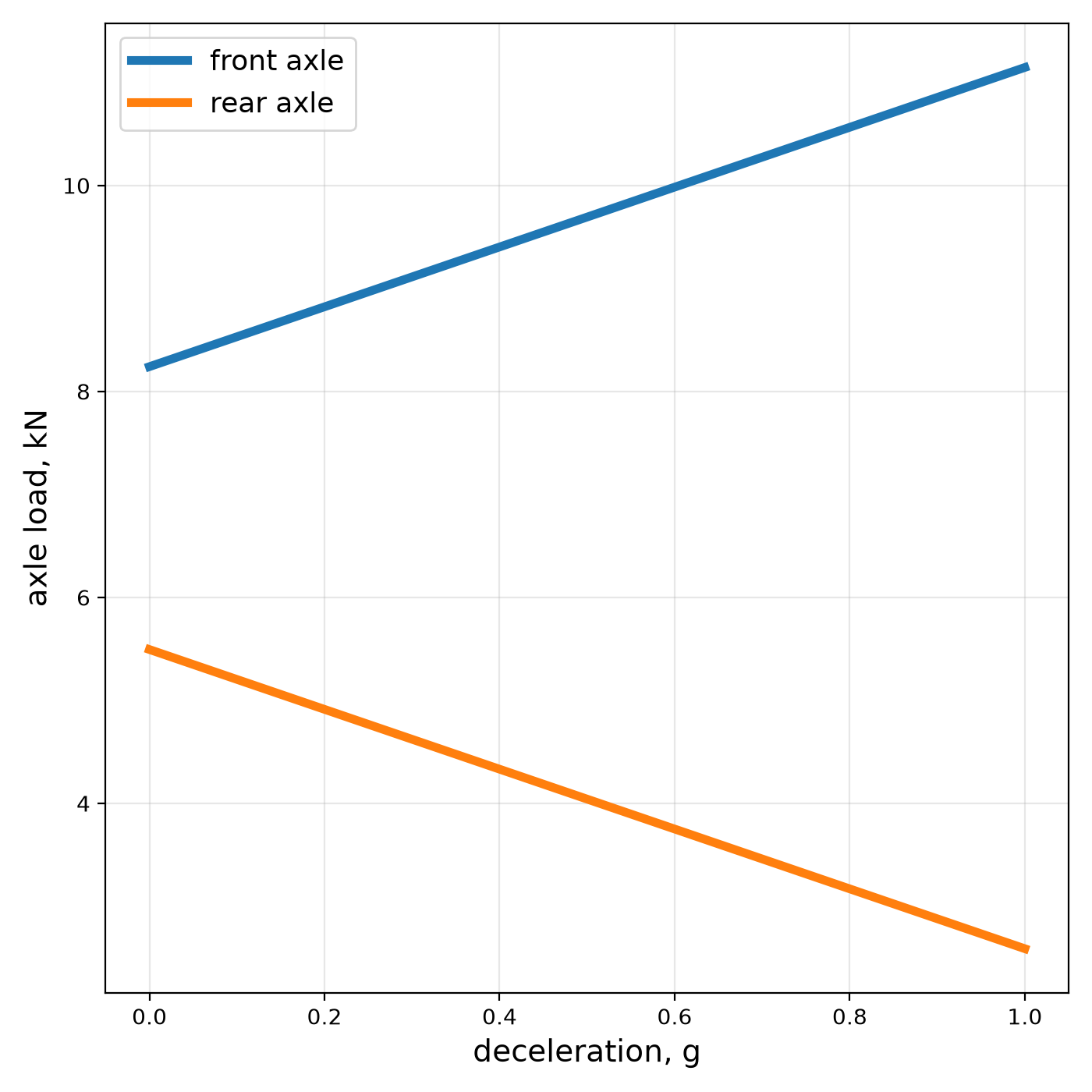
Youblob (generated from this blueprint's notebook) · CC0

Weight Transfer Under Braking: Why the Front Brakes Are Bigger
Brake hard and the nose dips: load moves from the rear wheels to the front. A tyre can only grip in proportion to the load on it, so in a hard stop the front tyres can do far more of the braking than the rear. Ask the rear brakes to do their static share and the rear wheels lock, and a car with locked rear wheels turns round.
This practice rung works out the load on each axle at several decelerations, and shows how to find a vehicle's centre-of-gravity height — the number the whole calculation turns on — with two scales and a block.
เริ่มต้น
About 2 hours
คำแนะนำ
1
1
Axle loads and centre-of-gravity height
Axle loads and centre-of-gravity height
กำลังโหลดสมุด Jupyter…
2
2
Measure a cart's centre of gravity
Measure a cart's centre of gravity
Build or take a wheeled cart — the dynamics cart set, or a board on the axle-and-wheel kit — and load it with weights. Stand its front wheels on the kitchen scale and its rear wheels on a block of the same height; read the front load. Weigh the whole cart too.
Raise the rear wheels by 100 mm on a stack of books and read the front load again. Put your numbers into the notebook in place of the example inputs.
Now move the weights higher on the cart and repeat: the front load changes MORE when the cart is tilted, and the notebook gives a greater height. A high centre of gravity means more weight transfer — the reason a tall van pitches so much more than a low car.
วัสดุสำหรับขั้นตอนนี้:
 ตุ้มถ่วง1 ชุด
เครื่องมือที่ต้องใช้:
 เครื่องชั่งดิจิทัลสำหรับครัว
 ชุดรถทดลองพลศาสตร์ (แรงเสียดทานต่ำ)
 ไม้บรรทัด
3
3
Context
Context
A practice rung: the statics of a braking vehicle, which set the proportions of every brake system — bigger front brakes, pressure-limiting valves to the rear, and today anti-lock systems that keep each wheel just short of locking.
**Honest limits of the model.** Rigid body, no suspension movement, level road, and constant deceleration. Suspension geometry can resist the pitch (anti-dive); a slope changes the static loads; and a tyre's grip is not exactly proportional to its load.
เครื่องมือที่จำเป็น
3- ตัวยึดตำแหน่ง
- ตัวยึดตำแหน่ง
- ตัวยึดตำแหน่ง
บลูพริ้นท์ที่เกี่ยวข้อง
บลูพริ้นท์เหล่านี้แบ่งปันความรู้ — เทคนิค วัสดุ หรือหลักการ
The Drum Brake: Shoes That Push Themselves Harder
โดย Martin
กลศาสตร์
39
0
0
0
0
0
The Disc Brake: A Stop Is Heat, and the Disc Can Get Rid of It
โดย Emma
กลศาสตร์
28
0
0
0
0
0

The Hydraulic Shock Absorber: Liquid Forced Through a Small Passage
โดย Emma
กลศาสตร์
32
0
0
0
0
0
Hydraulic Brake
โดย Emma
เทคโนโลยี
43
0
0
0
0
0
Pneumatic Tyre
โดย Spartan
การแข่งรถ
39
0
0
0
0
0
CC0 สาธารณสมบัติ
พิมพ์เขียวนี้เผยแพร่ภายใต้ CC0 คุณสามารถคัดลอก แก้ไข แจกจ่าย และใช้งานผลงานนี้เพื่อวัตถุประสงค์ใดก็ได้ โดยไม่ต้องขออนุญาต
สนับสนุนเมกเกอร์โดยซื้อสินค้าผ่านพิมพ์เขียวของพวกเขา ซึ่งพวกเขาจะได้รับ ค่าคอมมิชชันเมกเกอร์ ที่ผู้ขายกำหนด หรือสร้างเวอร์ชันใหม่ของพิมพ์เขียวนี้และรวมเป็นการเชื่อมต่อในพิมพ์เขียวของคุณเพื่อแบ่งรายได้