

Addressing Machine
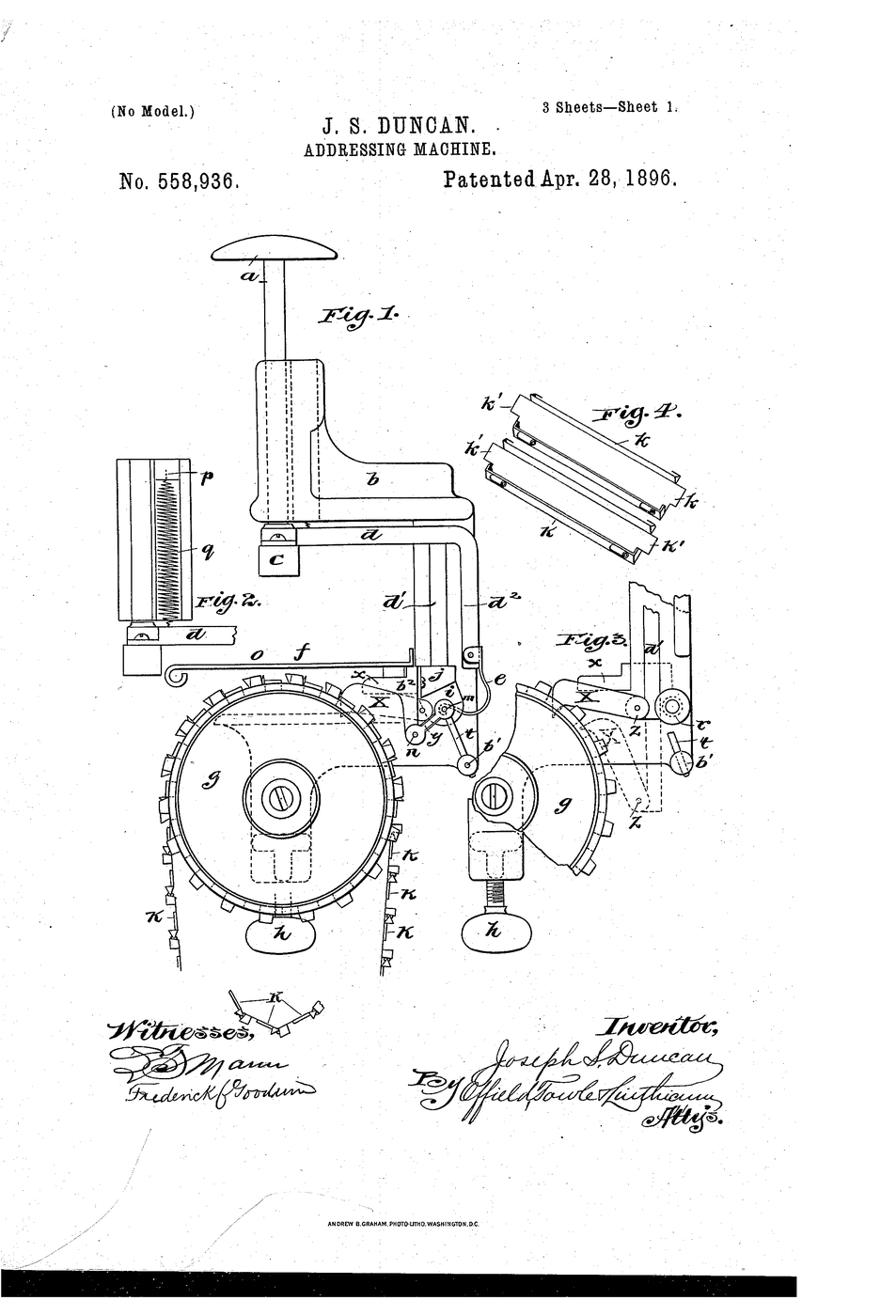
A business sending ten thousand identical circulars had to write ten thousand addresses. Joseph Smith Duncan of Sioux City, Iowa, built a machine that stored each address once and printed it on demand.
US 558,936, “Addressing-Machine”, granted 28 April 1896 (filed 2 August 1893) is the first US patent for an addressing machine. And it does not work the way almost every account says it does.
The patent claims rubber type pressed into recesses in the links of an endless chain, the chain suspended over a drum: “I prefer to make the type of rubber and to press them in with sufficient force to cause them to retain their position by compression.” Not embossed metal plates. Each link carries one address; advance the chain, print the next. This blueprint builds that chain.
Зааварчилгаа
Write the same address ten times
Write the same address ten times
By hand, write one address ten times. Time it. This is the cost Duncan attacked.
Энэ алхмын материал:
 Цаас1 хуудас
Шаардлагатай багаж:
 Секунд хэмжигч
Read the claim carefully
Read the claim carefully
The patent specifies rubber type set into the links of an endless chain, not embossed metal plates. Note the difference now — you will meet the myth in step 14.
Cut the chain links
Cut the chain links
Cut eight cardboard rectangles 60 × 30 mm. Each is one link and will carry one address.
Энэ алхмын материал:
 Хөндлөвчтэй картон хавтан1 хуудас
Шаардлагатай багаж:
 Гар урлалын хутга
 Шугам
ШугамRecess each link
Recess each link
Cut a shallow window in each link to hold type by compression. The recess must grip without glue — that is Duncan's claim.
Шаардлагатай багаж:
Гар урлалын хутгаSet type into three links
Set type into three links
Press rubber letters into the recesses of three links to spell three short, different addresses. They should hold by friction alone.
Энэ алхмын материал:
 Резинэн тамганы багц (цагаан толгой ба тоо)1 багц
Test the compression grip
Test the compression grip
Turn each link upside down and shake. If type falls out, the recess is too loose. Adjust until it holds.
Join the links into an endless chain
Join the links into an endless chain
Punch and wire the links together into a closed loop. It must flex at every joint.
Энэ алхмын материал:
 Цайрдсан ган утас1 метр
Шаардлагатай багаж:
 Хайч
ХайчBuild the drum
Build the drum
Mount a dowel horizontally on the board so the chain hangs over it and can be advanced link by link.
Энэ алхмын материал:
 Модны цавуу5 мл
Шаардлагатай багаж:
 Хавтгай модон банз
 Модон шон
Ink the type at the printing station
Ink the type at the printing station
Roll ink onto whichever link sits at the bottom of the drum.
Энэ алхмын материал:
 Модон хэвлэлийн бэх2 мл
Шаардлагатай багаж:
 Резинэн бэхний өнхрүүл
Print the first address
Print the first address
Press paper against the inked link. Lift straight up — no sliding.
Энэ алхмын материал:
Цаас1 хуудасAdvance and print the next
Advance and print the next
Move the chain one link and print again. Two different addresses, one machine, no rewriting.
Энэ алхмын материал:
Цаас1 хуудасRun the whole loop and time it
Run the whole loop and time it
Print all three addresses in rotation, ten sheets total. Time it and compare with step 1.
Энэ алхмын материал:
Цаас10 хуудасШаардлагатай багаж:
Секунд хэмжигчTest selective skipping
Test selective skipping
Advance two links without printing. Duncan's machine let an operator select which addresses to print — the beginning of the mailing list as a data structure.
History & Context
History & Context
US 558,936, “Addressing-Machine”, Joseph S. Duncan, granted 28 April 1896, filed 2 August 1893.
🔴 The embossed-plate story is wrong for this patent. Reference works routinely describe US 558,936 as a mechanical imprinter using embossed metal plates with a reciprocating platen. The document says otherwise: rubber type, compressed into recesses in metal link-plates forming an endless chain over a drum, in the inventor's own words. Embossed metal plates belong to the later Addressograph and to the Graphotype machine that embossed them. The description has been back-projected from the famous later product onto the founding patent.
Duncan developed the idea from 1892 work; the “Baby O” model went into production on 26 July 1893 in a back room of the old Caxton Building in Chicago, and he formed the Addressograph International Company in 1896.
Why it belongs beside the tabulator and the cash register. All three are machines that hold business information in physical form and act on it selectively — Hollerith's punched strips, Ritty's registered transactions, Duncan's addressed links. The mailing list, the audit trail and the census are the same idea in three costumes, and they are the direct ancestors of the database.
Addressograph plates outlived the machines: the same principle survived into the metal credit-card imprinters that were still clattering on shop counters in the 1980s.
Материал
6- 13 хуудасТүр орлуулагч
- 1 хуудасТүр орлуулагч
- Түр орлуулагч
- 1 метрТүр орлуулагч
- 5 млТүр орлуулагч
- Түр орлуулагч
Холбогдсон загварын материал

Холбоотой загварууд
Эдгээр загварууд мэдлэг хуваалцдаг — арга техник, материал эсвэл зарчим
CC0 Нийтийн домэйн
Энэ загвар CC0 дор гаргагдсан. Та зөвшөөрөл авахгүйгээр хуулах, өөрчлөх, түгээх, ашиглах боломжтой.
Загвараар дамжуулан бүтээгдэхүүн худалдаж авч Бүтээгчийг дэмжээрэй Бүтээгчийн шимтгэл Борлуулагчаар тогтоосон, эсвэл энэ загварын шинэ хувилбар үүсгэж орлогоо хуваахын тулд өөрийн загварт холбоос болгон оруулна уу.