ARTE
BELLEZA Y BIENESTAR
ARTESANÍA
CULTURA E HISTORIA
ENTRETENIMIENTO
MEDIO AMBIENTE
COMIDA Y BEBIDAS
INGENIERÍA INVERSA
CIENCIAS
DEPORTES
TECNOLOGÍA
TECNOLOGÍA VESTIBLE
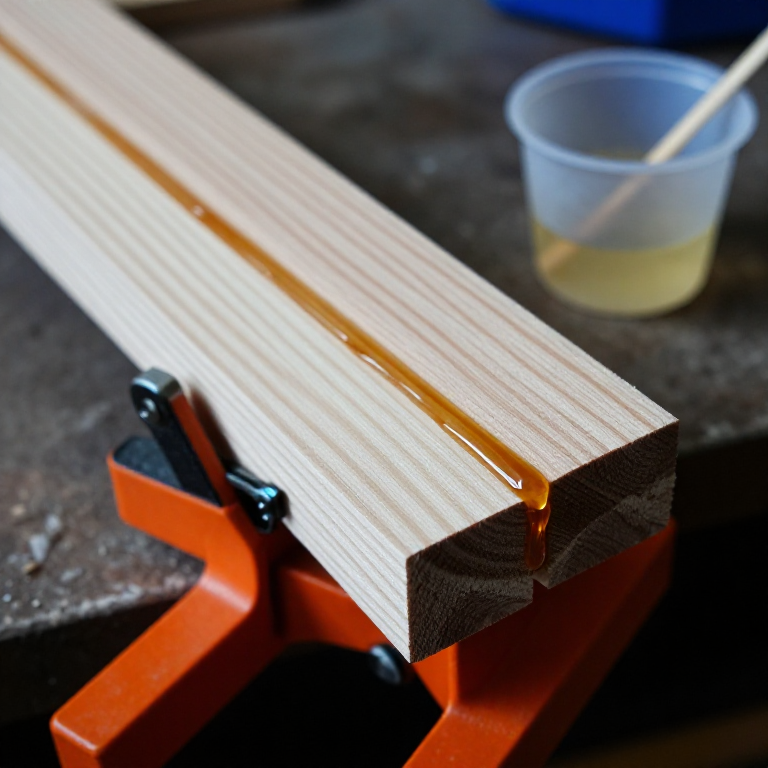


Epoxy Resin
Pierre Castan, a Swiss chemist at the dental firm De Trey Frères, was looking for a resin for dentures. He reacted a phenol carrying two hydroxy groups with epichlorohydrin, then hardened the product with an acid anhydride, and got a hard, clear, unusually adherent solid. Ciba licensed it and sold it as Araldite; in the US Sylvan Greenlee developed epoxies independently.
**US 2,324,483**, "Process of preparing synthetic resins", Castan, granted 20. July 1943, claims condensing "a polybasic carboxylic acid anhydride" with the product of "a phenol having at least two phenolic hydroxy groups and of an epichlorhydrine". It does not single out bisphenol A, the phenol most epoxies use today.
**Epichlorohydrin is a carcinogen; you start from a two-part kit.** You glue pine lap joints at the right ratio and four wrong ones, then test hardness and break the joints.
Principiante
2 hours plus 24 h cure
Instrucciones
1
1
Cut the joint pieces
Cut the joint pieces
Saw ten pine strips 100 x 25 mm. Sand one face of each end with 120 grit and dust off. Label five pairs 1:1, 1.25:1, 1:1.25, 1.5:1 and 1:1.5.
Materiales para este paso:
 Tabla de pino1 pieza
Herramientas necesarias:
 Serrucho
 Regla
Regla Papel de lija
 Cinta de carrocero
2
2
Measure by syringe
Measure by syringe
Gloves on. For each ratio draw resin and hardener in separate syringes (1:1 = 2 ml + 2 ml; 1.25:1 = 2.5 + 2; and so on) into its own cup. This assumes a 1:1-by-volume kit - scale to your label.
Materiales para este paso:
 Epoxi de dos componentes25 ml
Herramientas necesarias:
 Guantes de nitrilo
 Juego de jeringas
 Vasos graduados de mezcla
 Gafas de seguridad transparentes
3
3
Mix thoroughly
Mix thoroughly
Stir each cup 2 minutes, scraping the walls and bottom. Unmixed streaks behave like a wrong ratio.
Herramientas necesarias:
 Varilla agitadora
4
4
Glue and pour
Glue and pour
Spread each mix on the sanded ends of its pair, overlap them 25 mm and spring-clamp over wax paper. Pour the rest as a coin-sized puddle on wax paper beside it.
Materiales para este paso:
 Papel encerado1 hoja
Herramientas necesarias:
 Pinza de resorte
5
5
Cure 24 hours
Cure 24 hours
Leave everything at room temperature, 20 °C or warmer, for 24 hours. Cold slows the cure.
6
6
Pencil hardness
Pencil hardness
Sharpen pencils 6B to 6H and flatten the tips on 400 grit. Push each at 45° across a puddle, from hard down, until one no longer scratches. Record that grade.
Herramientas necesarias:
 Juego de lápices de grafito
 Lupa de relojero
7
7
Break the joints
Break the joints
Clamp one strip of a joint in the vise and tap the free end sideways with the mallet until it breaks. Estimate how much of the bond face is torn wood.
Herramientas necesarias:
 Tornillo de banco
 Maza de gomaGafas de seguridad transparentes
8
8
Ratio, leftovers, results
Ratio, leftovers, results
Cargando el cuaderno de Jupyter…
9
9
History & Context
History & Context
**What the patent specifies:** a resin from a two-hydroxy phenol and epichlorohydrin, hardened by a polybasic acid anhydride. **Modern build (derived):** a two-part kit, most with an amine hardener that cures at room temperature.
Epoxy became the glue that holds metal, the matrix of fibreglass and carbon-fibre parts, and the boat-builder's resin. Its limits: it yellows in sunlight, softens with heat, and uncured resin and hardener sensitise skin - which is why the gloves stay on every time.
Materiales
3- 1 piezaMarcador de posición
- Marcador de posición
- 1 hojaMarcador de posición
Herramientas requeridas
14- Marcador de posición
- Marcador de posición
- Marcador de posición
- Marcador de posición
- Marcador de posición
- Marcador de posición
- Marcador de posición
- Marcador de posición
- Marcador de posición
- Marcador de posición
- Marcador de posición
- Marcador de posición
- Marcador de posición
- Marcador de posición
Este plano hace
Blueprints relacionados
Estos blueprints comparten conocimiento — técnicas, materiales o principios




CC0 Dominio público
Este Blueprint se publica bajo CC0. Eres libre de copiar, modificar, distribuir y usar este trabajo para cualquier propósito, sin pedir permiso.
Apoya al Maker comprando productos a través de su Blueprint, donde gana una Comisión del Maker establecida por los vendedores, o crea una nueva iteración de este Blueprint e inclúyela como conexión en tu propio Blueprint para compartir ingresos.