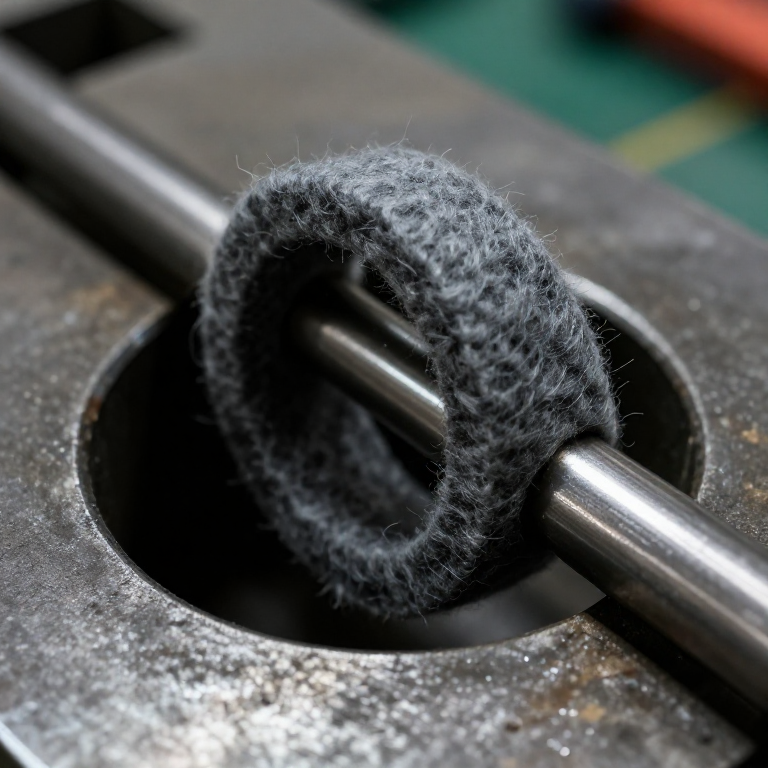


Felt Wiper Seal
Instrucciones
Cut the felt ring and its groove
Cut the felt ring and its groove
Dense wool felt, cut oversize so it is compressed in service.
- Cut a trapezoidal groove in an aluminium housing: 8 mm wide at the mouth, 6 mm deep, sides sloping inward.
- Cut a felt ring with an outside diameter matching the groove and a bore about 1 mm SMALLER than the 16 mm shaft.
- Cut the ring with a diagonal scarf joint rather than a butt joint.
- Press it into the groove — it should compress noticeably.
Why a trapezoidal groove. The sloping sides squeeze the felt inward as it is pressed home, so the ring grips the shaft firmly and cannot be dragged out of its groove by shaft movement. A plain square groove lets the felt walk out over time.
The diagonal scarf joint overlaps rather than butting, so there is no straight-through gap at the joint — the same reasoning as staggering packing ring joints, solved differently because there is only one ring.Materiales para este paso:
 Muselina de algodón1 metre
 Redondo de aluminio1 pieza
Herramientas necesarias:
 Juego de limas
 Taladro inalámbrico
 Juego de brocas
 Calibre digital de 6 pulgadas
 Segueta (sierra de marquetería)
Charge the felt with oil before fitting
Charge the felt with oil before fitting
A dry felt is an abrasive. A charged one is a lubricator.
- Soak the felt ring in oil until it is saturated.
- Squeeze out the excess so it is damp rather than dripping.
- Fit it to the housing and assemble over the shaft.
- Turn the shaft and observe the thin film left on the surface.
The felt is doing two jobs at once. Its fibres scrape and trap incoming grit, and the oil it holds is continuously wiped back onto the shaft as a protective film. That film is what stops the felt itself abrading the shaft, and it is why the traditional instruction is always to soak felt seals before fitting them.
Wool felt is specified rather than synthetic because wool's scaled fibres hold oil by capillary action far better and are naturally slightly greasy. This is the same capillary principle as the wick oiler later in this batch — the same physics doing a different job.Materiales para este paso:
 Aceite de linaza cocido1 botella
Herramientas necesarias:
Calibre digital de 6 pulgadasJuego de limasTest it against contamination, not against pressure
Test it against contamination, not against pressure
Judge it by the job it actually has.
- Mount the shaft in bearings with the wiper fitted at one end and nothing at the other.
- Dust fine sand or grinding dust over both ends while turning the shaft.
- Run for several minutes, then dismantle and inspect both bearings.
- Examine the felt — brush the trapped grit out of the fibres.
Materiales para este paso:
 Rodamiento de bolas2 piezas
 Tablero contrachapado1 hoja
Herramientas necesarias:
Taladro inalámbrico CronómetroCalibre digital de 6 pulgadas
Fit it in front of a lip seal and measure the difference
Fit it in front of a lip seal and measure the difference
Wipers are usually a first line of defence, not the only one.
- Fit the felt wiper OUTBOARD of the lip seal from blueprint 2, with the felt facing the dirty side.
- Run the contamination test again.
- Inspect the lip seal's contact line afterwards.
- Repeat with the lip seal alone and compare its wear.
Herramientas necesarias:
Calibre digital de 6 pulgadas Juego de llaves AllenCronómetro
The forgotten direction of sealing, and history
The forgotten direction of sealing, and history
Felt seals were standard on machine tools, electric motors and railway axleboxes for most of the twentieth century, and they persist wherever conditions are dirty and shafts are old. The great virtue is tolerance: felt does not care about shaft finish, roundness or a worn groove, and it will work on a shaft that a lip seal could not survive a shift on.
Exclusion is the half of sealing people forget. Bearing failures are far more often caused by contamination getting in than by lubricant getting out, so the wiper is frequently doing the more valuable job — and it is the cheapest part in the assembly. Modern equivalents are the double-lipped seal, where the second lip faces outward purely to exclude, and the rubber boot on a steering joint.
Against the batch: the packing gland, lip seal and face seal all retain fluid and are ranked by how little they leak. The labyrinth restricts flow both ways without touching. The felt wiper is the only one whose primary job is exclusion, and it is the only one that improves the life of the seal next to it rather than replacing it.
Its honest limits: it holds no pressure whatsoever, it wears out, it slowly gives up its oil, and it is unsuitable for high speeds where it would char. But it costs almost nothing, needs no precision to make or fit, and can be replaced with a strip of felt and a knife — a very different kind of engineering value from the lapped face seal, and no less real.
Materiales
5- 1 metreMarcador de posición
- 1 piezaMarcador de posición
- 1 botellaMarcador de posición
- Marcador de posición
- 1 hojaMarcador de posición
Herramientas requeridas
7- Marcador de posición
- 1 vendor sell this, none ship to you yetMarcador de posición
- Marcador de posición
- Marcador de posición
- Marcador de posición
- Marcador de posición
- Marcador de posición
Blueprints relacionados
Estos blueprints comparten conocimiento — técnicas, materiales o principios


CC0 Dominio público
Este Blueprint se publica bajo CC0. Eres libre de copiar, modificar, distribuir y usar este trabajo para cualquier propósito, sin pedir permiso.
Apoya al Maker comprando productos a través de su Blueprint, donde gana una Comisión del Maker establecida por los vendedores, o crea una nueva iteración de este Blueprint e inclúyela como conexión en tu propio Blueprint para compartir ingresos.